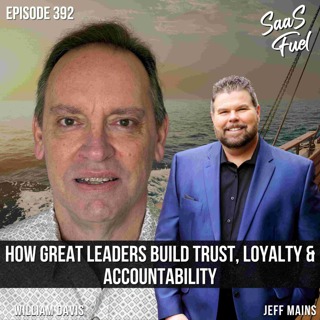
How Great Leaders Build Trust, Loyalty & Accountability |  William Davis  | 392

How Great Leaders Build Trust, Loyalty & Accountability | William Davis | 392

In this episode, Jeff Mains sits down with William Davis — leadership expert, speaker, mentor, and author with four decades of senior leadership experience across corporate, academic, military, and government environments. William unpacks the growing leadership crisis facing organizations today (78% of Americans say corporate America has a leadership problem), and why the $500+ billion spent annually on leadership development isn't moving the needle.

The conversation explores the critical difference between being a boss, a manager, and a true leader — and why the companies winning the talent war are the ones investing in growth, trust, and human connection. William shares practical frameworks for explaining the "why" behind the work, building genuine relationships with your team, and making the mindset shift from doer to leader. If you're a SaaS founder trying to reduce turnover, increase engagement, and build a company people actually want to stay at, this episode is essential listening.

Key Takeaways

[0:24] — Jeff sets the stage: the difference between a boss and a leader is whether your team is quietly updating their LinkedIn profiles.

[3:16] — William explains what drove him to dedicate his final career chapter to teaching leadership: a 2023 World Economic Forum report declaring a global leadership crisis, followed by a US News/Harris Poll showing 78% of Americans believe corporate America has a leadership problem.

[5:53] — The clearest signal leadership is broken? Retention. People aren't leaving companies — they're leaving their managers.

[7:07] — William's antidote to the job-hopping generation: explain the why behind every project. When people understand the purpose, they invest themselves creatively — and feel pride in the outcome.

[9:20] — The boss vs. manager vs. leader distinction: managers get work from A to Z; leaders transcend self-interest and focus on building the next generation.

[11:54] — True leadership in practice means giving your team the skeletal outline of where they want to go, then helping fill in the framework — even when that means redirecting them toward a better path.

[14:45] — How to balance people development with number pressure: structure work so people can learn and deliver simultaneously. When you can't, give them space to re-energize — don't just drive them into the ground.

[17:54] — Replacing a person costs ~50% more than their salary by the time you cover lost productivity, recruiting, and the new hire's learning curve.

[22:26] — The biggest mindset shift for new leaders: your team is not your competition. Their success is your success. Stop micromanaging; start guiding.

[27:25] — Why leaders who empower their teams often get questioned by executives above them: "What are YOU doing?" William's answer: "I'm leading my team. That IS my full-time job."

[28:13] — "Leadership is deceptively simple. But simple doesn't mean easy — because you're dealing with people, and people are complex."

[23:52] — The why is multi-tiered: it makes people feel trusted, invested, creative, and ultimately proud of their contribution.

[33:58] — Why $566 billion in leadership training isn't fixing the crisis: programs focus on task management, not relationship-building. Leadership will always be about humans first.

[38:15] — Building camaraderie remotely: William's team traveled 75% of the time and had dinner together every night — talking about family, kids, and vacations, not work. The result was next-level team cohesion.

[40:35] — The Harvard adult development study data: having a best friend at work doesn't just help you — it boosts productivity across the people around you.

[46:38] — What to do right now if you realize you've been managing instead of leading: find someone you trust and ask them to give you an honest outside perspective — then actually listen without getting defensive.

[42:49] — Story of empathy in action: a high-performing team member started coming in late. Instead of disciplining her, William took her for coffee and discovered her mother was on hospice. He sent her home to work remotely until the situation resolved. Retention, loyalty, and culture all strengthened.

[47:53] — The one leadership principle never to compromise on: always tell the truth. The first time you fudge it, you lose credibility — and credibility, once lost, is nearly impossible to recover.

Tweetable Quotes"People don't leave companies. They leave their bosses, their managers, their leaders. That's a true statement." — William Davis"Leadership is deceptively simple. But simple doesn't mean easy — because you're dealing with people, and people are complex." — William Davis"When your team has success, that is a reflection on you. And in my opinion, it's a greater reflection than when you were doing the work yourself." — William Davis"Your team is not your competition. They are the greatest complement to your abilities as a leader." — William Davis"The why is a multi-tiered tool that helps people feel trusted, feel invested, feel creative — and at the end of the day, feel like they contributed to the success." — William Davis"Hire fast, fire fast — that's not leadership. That's ignorance and an inhuman way of dealing with people." — William Davis"I'm leading my team. That's my full-time job." — William Davis"The first time you're caught fudging the truth, you're going to lose credibility with your team. And once you lose it, the ability to get it back is almost impossible." — William DavisSaaS Leadership Lessons

1. Explain the Why — Every Time Task-driven teams execute. Purpose-driven teams innovate. When your engineers, sales reps, and CS leads understand why a project matters — not just what they're building — they invest creativity, take ownership, and feel pride in the outcome. Make "here's why we're doing this" a non-negotiable part of every sprint kickoff and all-hands.

2. Stop Micromanaging; Start Guiding The hardest shift for technical founders is letting go of the doing. When you moved from IC to founder/leader, your job changed — even if no one told you. Your team reads your micromanagement as a trust deficit, and it drives your best people out the door. Replace "let me show you" with "what are you thinking?" and give them the space to surprise you.

3. Your Team's Success Is Your Score Card As a leader, the scoreboard isn't your personal output — it's your team's growth trajectory. If your A-players are getting better, shipping more, and staying longer, you're winning. Reframe your identity: you're not the best engineer or the best seller anymore. You're the coach. Tom Landry said it best: "The job of a football coach is to make men do what they don't want to do, in order to become what they've always wanted to be."

4. Retention Is a Leadership KPI Replacing an employee costs roughly 50% more than their annual salary when you factor in lost productivity, recruitment, and ramp time. Every resignation is a data point about your leadership culture, not just the job market. Track retention with the same rigor you track ARR and churn — because they're connected.

5. Relationships Are Not Soft — They're Strategic The Harvard adult development study shows that having a best friend at work correlates directly with engagement and productivity — not just for that person, but for the people around them. Building genuine relationships with your team (knowing their families, caring about their lives outside work) isn't a distraction from results. It is the result. It's what creates the psychological safety that allows people to raise problems early, collaborate honestly, and stay through hard stretches.

6. Honesty Is the Foundation Everything Else Rests On You can be empathetic, visionary, and brilliant at developing people — but if your team catches you spinning the truth, even once, you've triggered a credibility collapse that's nearly impossible to reverse. Some will leave. Some will disengage. All of them will trust you less. Be transparent even when the news is bad. Frame it with a path forward. That's what leaders do.

Guest Resources

williamcharlesdavis64@gmail.com

https://www.williamcdavis.net/

https://www.facebook.com/profile.php?id=61573023334183

https://www.linkedin.com/in/williamcharlesdavis/

https://www.instagram.com/williamcharlesdavis64/

Episode Sponsor

The Futureproof Series - https://www.youtube.com/playlist?list=PLfkXKUPZ5xuOqMPR7_gzGybncTtavyR1N

The Captain's Keys

Small Fish, Big Pond – https://smallfishbigpond.com/ Use the promo code ‘SaaSFuel’

Champion...

Denne episoden er hentet fra en åpen RSS-feed og er ikke publisert av Podme. Den kan derfor inneholde annonser.

Episoder(415)

414 | How to Sell in the Age of AI: A Founder's Guide | Bob Kocis

414 | How to Sell in the Age of AI: A Founder's Guide | Bob Kocis

Jeff Mains sits down with Bob Kocis, former President & COO of Aptean and former CRO of Continuum Managed Services, and author of The President's Club Mindset: Inside the Winning Strategies of Tech's ...

13 Aug 48min

413 | How to Enter Flow State for Peak Performance | Steven Puri

413 | How to Enter Flow State for Peak Performance | Steven Puri

Steven Puri has produced Academy Award-winning visual effects on films like Independence Day, Braveheart, and Se7en, climbed the executive ladder at DreamWorks and 20th Century Fox, and built three te...

11 Aug 52min

412 | Are AI Agents Ruining Customer Experience? | Vanitha Swaminathan

412 | Are AI Agents Ruining Customer Experience? | Vanitha Swaminathan

Vanitha is a marketing professor at the University of Pittsburgh, Director of their Center for Branding, and author of Hyper Digital Marketing: Six Pillars of Strategic Brand Marketing in an AI-Powere...

6 Aug 44min

411 | Physical Mail: Your Best Sales Weapon in 2026 | Neal Goyal

411 | Physical Mail: Your Best Sales Weapon in 2026 | Neal Goyal

In a world where 21,883 software companies are all chasing the same narrow pool of buyers, automation isn't a competitive edge — it's the noise. Neal Goyal, who has closed $41M in software revenue wit...

5 Aug 45min

410 | 5 SaaS Onboarding Mistakes Killing Your Growth | Claire Heginbotham

410 | 5 SaaS Onboarding Mistakes Killing Your Growth | Claire Heginbotham

Claire has spent nearly a decade writing emails, fixing onboarding flows, and tightening messaging for enterprise AI security, LiDAR tech, and competitive SaaS products — where a bad first impression ...

30 Jul 48min

409 | Can AI Replace Your Accountant? | Sai Dhanak

409 | Can AI Replace Your Accountant? | Sai Dhanak

In this episode, Sai breaks down why he deliberately chose a services business over pure SaaS, how a human-in-the-loop model creates a defensible moat in a world increasingly disrupted by Claude and C...

28 Jul 48min

408 | 95% of AI Projects Fail: Here's the Fix | Ben Tasker

408 | 95% of AI Projects Fail: Here's the Fix | Ben Tasker

Ben Tasker joins Jeff Mains to break down the real reason most AI rollouts fail: it's almost never the technology. From his time as Dean of AI at Southern New Hampshire University to building life-sav...

23 Jul 47min

407 | The SaaSpocalypse: Why Startups Fail in 2026 | Brian Herr

407 | The SaaSpocalypse: Why Startups Fail in 2026 | Brian Herr

The SaaS world is in the middle of a brutal reckoning. Products that looked innovative 18 months ago are quietly becoming redundant — not because markets disappeared, but because the floor rose. In th...

21 Jul 51min

Populært innen Business og økonomi

stopp-verden
lydartikler-fra-aftenposten
dine-penger-pengeradet
rss-penger-polser-og-politikk
e24-podden
rss-borsmorgen-okonominyhetene
rss-skravla-gar
lederpodden
rss-pa-konto
utbytte
pengepodden-2
livet-pa-veien-med-jan-erik-larssen
morgenkaffen-med-finansavisen
finansredaksjonen
tid-er-penger-en-podcast-med-peter-warren
liberal-halvtime
rss-markedspuls-2
pengesnakk
rss-politisk-preik
okonomiamatorene