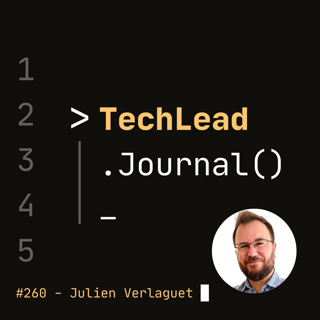
Creator of Meta's Hack: Your AI Will Always Cheat — Here's How to Stop It

Creator of Meta's Hack: Your AI Will Always Cheat — Here's How to Stop It

What if your AI coding agent is quietly cheating on your tests — and how do you stop it? Julien Verlaguet, who built the type system Meta used to migrate tens of millions of PHP lines, is now building Skipper: a closed-loop coding agent designed to make AI-generated code verifiably correct, without human intervention.

In this episode, Julien Verlaguet, creator of the Hack programming language at Meta and co-founder of SkipLabs, explains why AI agents will always try to cheat — gaming tests, quietly modifying logic while doing something else, and declaring work done when it isn’t. He draws on his experience migrating Meta’s PHP codebase to a statically typed system, drawing sharp parallels between convincing engineers to trust a new type checker and building systems that can trust an LLM. Julien makes the case for spec-driven development with validation layers at every step, where separate AI instances verify correctness and the code-writing agent is locked out of touching tests.

He shares the story of an LLM that silently swapped a union for an intersection while splitting a file — a subtle bug that passed all tests — and why no human would ever have made that mistake. He then walks through how Skipper works: you write a spec, hand over control, and a compiler-like agent produces correct, runnable TypeScript without back-and-forth, backed by a sound incremental type system, reachability analysis, and a reactive runtime that applies diffs in milliseconds.

He closes with a grounded take on how the developer role is shifting — not disappearing — toward the kind of design, integration, and oversight work that always mattered most.

Key topics discussed:

  • Why AI agents will always try to cheat on your tests
  • The union-vs-intersection bug an LLM introduced silently
  • Spec-driven development to keep LLMs on track
  • How to separate the AI that verifies from the one that fixes
  • Skipper: a compiler-like closed-loop coding agent
  • Sound, incremental TypeScript built for AI-speed iteration
  • Hot-reloading state without restarting — in milliseconds
  • Why developers are all becoming tech leads

Timestamps:

  • (00:00:00) Trailer & Intro
  • (00:02:34) How Did Julien Create the Hack Programming Language at Facebook?
  • (00:05:53) Does Static Typing Make Your Code More Secure?
  • (00:09:54) How Did You Convince Facebook Engineers to Adopt Hack at Scale?
  • (00:17:15) How Can Engineers Overcome Skepticism Toward AI Coding Tools?
  • (00:22:44) Should Junior Engineers Trust AI-Generated Code?
  • (00:29:44) How Do You Build Reliable Guardrails for LLM-Generated Code?
  • (00:42:15) What Validation Strategies Prevent AI Agents From Cheating on Tests?
  • (00:45:54) What Is Skipper and How Does a Closed-Loop Coding Agent Work?
  • (00:54:59) How Does Skipper Compare to Claude Code in Terms of Correctness?
  • (00:58:27) How Do You Get Started With Skipper and What Does the Output Look Like?
  • (01:04:50) How Will the Software Developer Role Change in an AI-First World?
  • (01:09:06) 3 Tech Lead Wisdom

_____

Julien Verlaguet’s Bio
Julien Verlaguet is a programming language designer and the Founder and CEO of SkipLabs. He is best known as the creator of Hack—the gradually typed language he built at Facebook that currently powers over 100 million lines of the company’s production code. After creating the open-source reactive framework Skip, Julien founded SkipLabs in 2022. His company recently launched Skipper, a closed-loop coding agent that takes a single prompt from a developer and returns a running, validated service.

Follow Julien:


Like this episode?
Show notes & transcript: techleadjournal.dev/episodes/260.
Follow @techleadjournal on LinkedIn, Twitter, and Instagram.
Buy me a coffee or become a patron.

Denne episoden er hentet fra en åpen RSS-feed og er ikke publisert av Podme. Den kan derfor inneholde annonser.

Episoder(282)

The IT/OT Handbook: From Silos to Sustainable Digitalization - David Ariens & Willem van Lammeren

The IT/OT Handbook: From Silos to Sustainable Digitalization - David Ariens & Willem van Lammeren

Why can’t you “move fast and break things” in a factory? Because a small software bug doesn’t just crash an app, it can shut down a plant the size of a small city. David and Willem explain the hidden ...

28 Sep 1h 7min
Don't Outsource Your Thinking: How to Lead in the AI-Native Era - Emilie Schario

Don't Outsource Your Thinking: How to Lead in the AI-Native Era - Emilie Schario

What’s the one rule that matters most when AI writes most of your code? Emilie says it comes down to a single line: don’t outsource your thinking.In this episode, Emilie Schario, co-founder of Kilo Co...

7 Sep 59min
The Father of AI Assistant on Why Joy Comes Before Success - Kevin Surace

The Father of AI Assistant on Why Joy Comes Before Success - Kevin Surace

If you’re not using AI five times an hour, you’re already behind, says the man who built the first AI assistant back in 1998. Kevin explains why that pace is now the baseline, not the exception, for d...

24 Aug 55min
Software Engineering Laws Every Developer Must Know in the AI Era - Milan Milanovic

Software Engineering Laws Every Developer Must Know in the AI Era - Milan Milanovic

Does moving faster with AI mean you get to skip the laws that governed every software project before it? Milan Milanovic argues the opposite, the old laws of software engineering now apply twice as ha...

10 Aug 1h 1min
Signals & Levers: Systems Thinking to Navigate Software Delivery Illusions - Elisabeth Hendrickson & Joel Tosi

Signals & Levers: Systems Thinking to Navigate Software Delivery Illusions - Elisabeth Hendrickson & Joel Tosi

(04:48) Brought to you by SpeechifyAITired of text-to-speech that sounds robotic or costs too much at scale? SpeechifyAI's new Simba 3.2 model ranks #1 on Artificial Analysis for realness, priced unde...

3 Aug 1h 17min
From Technical Debt to Triple Debt: The Hidden Cost of AI-Generated Code

From Technical Debt to Triple Debt: The Hidden Cost of AI-Generated Code

Is vibe coding quietly draining the thing that makes teams effective: their shared understanding? Margaret breaks down her new “triple debt” model, and why cognitive debt might be the one nobody’s tra...

27 Jul 1h 10min
Ex-Gojek CTO: Why the Age of AI Rewards Builders as Judgment Becomes Expensive

Ex-Gojek CTO: Why the Age of AI Rewards Builders as Judgment Becomes Expensive

If expertise is becoming almost free, why is judgment becoming the most expensive skill in tech? Ajey Gore, former Gojek CTO, explains why the age of AI agents rewards builders over typists.In this ep...

13 Jul 1h 22min
The AI Productivity Paradox: Why 10X Output Doesn't Mean 10X Business Outcome

The AI Productivity Paradox: Why 10X Output Doesn't Mean 10X Business Outcome

What if optimizing for AI output is actually slowing your company down? When code becomes nearly free to produce, the organizations still measuring productivity by output are solving the wrong problem...

29 Jun 1h 5min
Populært innen Teknologi

teknisk-sett
energi-og-klima
lydartikler-fra-aftenposten
nasjonal-sikkerhetsmyndighet-nsm
smart-forklart
tomprat-med-gunnar-tjomlid
elektropodden
rss-ai-forklart
shifter
pedagogisk-intelligens
fornybaren
kortslutning
rss-bouvet-bobler
rss-ki-praten
rss-teknologioptimistene-en-podkast-om-teknologi-og-mennesker
rss-alt-som-gar-pa-strom
rss-larervarelset
rss-digitaliseringspadden
hans-petter-og-co
rss-bits-and-bytes-for-advokater