The Oracle, Decoded: How They Reverse-Engineered Warren Buffett

The Oracle, Decoded: How They Reverse-Engineered Warren Buffett

For fifty years, Warren Buffett's record looked like magic — a once-in-a-century gift you either have or you don't. Then three quantitative researchers took that genius apart, piece by piece, and found that most of it could be copied. The part that couldn't is the part almost nobody wants.

This episode walks backstage on the famous "Buffett's Alpha" paper to ask the rudest question in investing: can the Oracle be reverse-engineered? The answer is humbling — and it changes what "be like Buffett" should mean for you.

In this episode:

The scoreboard everyone misreads. A dollar invested with Buffett in 1976 became more than $3,685 by 2017 — the best risk-adjusted record of any stock or fund that survived the stretch. The twist: he didn't take more risk. His market sensitivity (beta) was just 0.69. He got rich by being more efficient, not braver.

The trick explained. The standard four-factor model captured Buffett's style — cheap, big, steady, no chasing hot stocks — but left a giant pile of return unexplained. Add two more factors, "betting against beta" and "quality minus junk," and the magic shrinks to statistically indistinguishable from zero. Neither luck nor magic, the authors wrote, but a reward for leveraging cheap, safe, high-quality stocks.

The quiet half of the balance sheet. The part nobody discusses: financing. Roughly 1.6-to-1.7 leverage, funded by insurance float at about 1.72% a year — below what the US government paid to borrow — plus deferred taxes and the options he sold to investors who couldn't borrow. He wasn't just avoiding the crowd's mistake; he was getting paid by it.

The snow already skied. Those factors are now sold in low-cost funds. The edges crowded, Berkshire's size turned into an anchor, and a market carried by a handful of AI names is sprinting past exactly the strategy Buffett built to ignore. Even the greatest compounding machine ever built is sliding back toward the market's ordinary pace.

The strongest bear case — answered. If it's all factors and cheap leverage, was it ever genius, or just survivorship bias with a lab coat? Two answers: the "clone" only worked as a frictionless backtest, and the residual the equation couldn't explain — temperament — is the one thing survivorship bias can't manufacture. He sat through a 44% drawdown without flinching, and bought when everyone else was selling in 2008.

What it means for you. You can rent a rough version of the factor exposures today, for not very much. What you cannot rent is the float, the structure, or the temperament to do something boring, correctly, for half a century while everyone around you chases something shinier. That was never the part that looked like magic. It turns out it was the only real magic there ever was.

Read the written version at quietvelocity1.substack.com, the companion Substack to Conviction Bet.

New episodes weekly. Subscribe on Apple Podcasts, Spotify, YouTube, or Amazon Music.

Conviction Bet is independent investment commentary. Nothing in this episode is investment advice.

Denne episoden er hentet fra en åpen RSS-feed og er ikke publisert av Podme. Den kan derfor inneholde annonser.

Episoder(21)

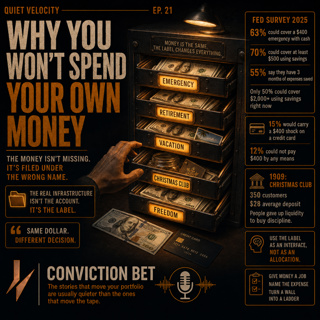
Why You Won't Spend Your Own Money

Why You Won't Spend Your Own Money

Your balance tells you what you have. The label shapes what you'll actually use. And you're the one who wrote it.The Federal Reserve asked Americans two versions of the same question. 70% said they co...

25 Aug 32min
You Can Copy The Key, Not The Locksmith: Nick Sleep's 921% Manual Is Free

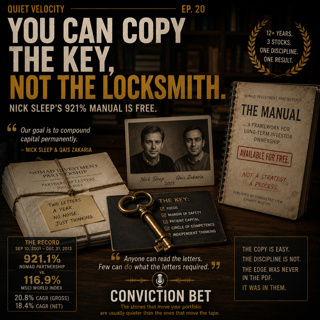
You Can Copy The Key, Not The Locksmith: Nick Sleep's 921% Manual Is Free

Two men, no analysts, no leverage, two letters a year. Twelve and a quarter years later: 921.1% against 116.9% for the MSCI World. A dollar became $10.21. Then they closed the fund, handed the capital...

13 Aug 37min

Can You Survive Being Right Too Early?

Can You Survive Being Right Too Early?

In late July, the market decided the AI build-out had gone too far. The Nasdaq fell into its second correction of the year, the Philadelphia Semiconductor Index dropped into a technical bear market, a...

6 Aug 32min
The Number That Isn't Your Return

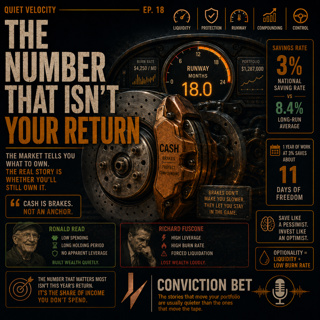
The Number That Isn't Your Return

A Vermont gas station attendant died in 2014 holding $8 million and a five-inch stack of stock certificates. That same year, a former Merrill Lynch executive who once ran the firm's Latin America arm ...

30 Jul 39min
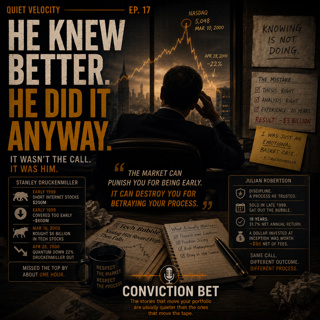
He Knew Better. He Did It Anyway

He Knew Better. He Did It Anyway

In March 2000, Stanley Druckenmiller had the internet bubble exactly right. He had shorted it, written the thesis, and run money for two decades without a losing year. Then he watched two junior trade...

23 Jul 33min
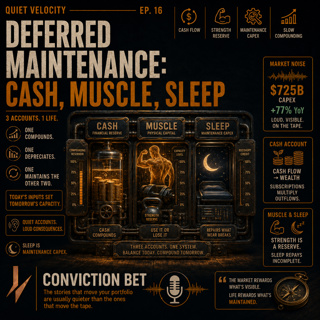
Deferred Maintenance: Cash, Muscle, Sleep

Deferred Maintenance: Cash, Muscle, Sleep

The four biggest tech companies are planning as much as $725 billion of capital spending this year — up 77% in a single year — much of it on machines that never have to sleep. The people underwriting ...

16 Jul 39min

The Rulebook You Never Read

The Rulebook You Never Read

At Monday's close, funds tracking the Nasdaq-100 lined up to buy an estimated $4 billion of SpaceX stock. Nobody at those funds decided SpaceX was worth owning — a rulebook decided. And three weeks ea...

9 Jul 32min

The Four Cards You're Not Playing

The Four Cards You're Not Playing

79% of professional large-cap fund managers lost to the S&P 500 last year. Stretch the window to fifteen years and the failure rate hits roughly 90%. The internet's favorite conclusion: if the pros ca...

1 Jul 28min

Populært innen Business og økonomi

stopp-verden
dine-penger-pengeradet
rss-penger-polser-og-politikk
e24-podden
rss-borsmorgen-okonominyhetene
rss-pa-konto
rss-skravla-gar
lydartikler-fra-aftenposten
finansredaksjonen
utbytte
pengepodden-2
livet-pa-veien-med-jan-erik-larssen
tid-er-penger-en-podcast-med-peter-warren
rss-orjasater
stormkast-med-valebrokk-stordalen
lederpodden
pengesnakk
morgenkaffen-med-finansavisen
liberal-halvtime
rss-markedspuls-2