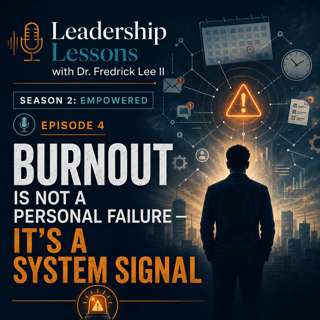

Burnout Is Not a Personal Failure — It’s a System Signal

Burnout Is Not a Personal Failure — It’s a System Signal

Episode Summary

In this episode of Leadership Lessons, Dr. Fredrick Lee II explores burnout not as a personal weakness, but as a signal that something deeper is out of alignment. Burnout is often misunderstood as simple exhaustion, poor self-care, or a lack of resilience. But as this episode makes clear, burnout can reveal a larger breakdown between workload, capacity, leadership behavior, culture, psychological safety, and organizational systems.

Building from Episode 3’s discussion on why high performers stay in harmful environments, Episode 4 examines what happens when people remain in systems that take more than they restore. Burnout becomes the body’s warning that the current way of working, leading, and adapting is no longer sustainable. Dr. Lee reminds listeners that change does not fail because people do not care. Change fails when behavior, emotions, and systems are misaligned.

This episode invites listeners to stop blaming themselves for exhaustion and begin asking better questions: What keeps draining me faster than I can recover? What is burnout trying to tell me? What pattern needs to be named? What boundary needs to be protected? What system needs to be examined?

Core Message

Burnout is not always a personal failure. Sometimes burnout is a system signal.

It may be signaling that workload is out of alignment with staffing, expectations are out of alignment with support, leadership messaging is out of alignment with leadership behavior, or change is out of alignment with readiness.

In This Episode

· Why burnout can hide behind productivity and high performance

· How high performers often become the hidden infrastructure of broken systems

· Why rest matters, but rest alone cannot fix chronic misalignment

· How burnout shows up physically, emotionally, behaviorally, and organizationally

· The difference between burnout management and sustainable change

· Why care and capacity are not the same thing

· How psychological safety affects whether people speak up before collapse

· Why leaders must treat burnout as operational data, not just a wellness issue

· How awareness becomes powerful when it interrupts automatic patterns

Key Takeaways

Burnout is more than exhaustion. Burnout can be a message from the body, emotions, behavior, team dynamics, and the system itself. It often reveals that the current way of operating is exceeding human capacity.

Output can disguise depletion. A person, team, or department may still be meeting deadlines while trust, creativity, engagement, and emotional capacity are declining. Measuring output alone does not reveal what the work is costing people.

Burnout should be understood as organizational data. When burnout is treated only as an individual wellness issue, the person carries all the responsibility while the system continues unchanged. Sustainable change asks whether the conditions need to be redesigned.

Care and capacity are not the same thing. People may care deeply about the mission and still lack the emotional, physical, or operational capacity to absorb more change without support. Leaders must learn the difference between unwillingness and depletion.

Burnout is a leadership issue. Leaders are not responsible for every individual feeling, but they are responsible for the conditions they create, reinforce, ignore, tolerate, and reward. Culture is shaped by daily behavior, not slogans or wellness programs.

Memorable Lines

“Burnout is not always a personal failure. Sometimes burnout is a system signal.”

“Rest was not enough.”

“Burnout management tries to help people cope with the conditions. Sustainable change asks whether the conditions need to be redesigned.”

“A high performer can become the hidden infrastructure of a broken process.”

“Output tells you what got done. It does not always tell you what it cost.”

“Care and capacity are not the same.”

“Burnout is not a badge of honor. It is a warning light.”

“Awareness is not passive when it changes how you participate.”

Reflection Questions

1. What signal have I been ignoring?

2. What keeps draining me faster than I can recover?

3. What did it cost to keep performing at this level?

4. What does my workplace actually reward, not just claim to value?

5. How long has this “hard season” been going on?

6. What would change if I stopped rescuing the pattern?

7. What is burnout trying to teach me about alignment?

Listener Engagement Prompts

Invite listeners to comment with one of the following:

· Rest was not enough.

· I am noticing the signal.

· What did it cost?

· Care and capacity are not the same.

· How long has this been going on?

· Awareness is asking me to...

· The signal I am noticing is...

· I am getting curious about...

· My boundary is...

· One word: signal, boundary, alignment, rest, truth, support, capacity, or change.

Practical Action Steps

This week, Dr. Lee invites listeners to take one aligned action, not ten. The goal is not to overhaul life overnight, but to listen to the signal and begin moving from shame into awareness.

1. Name the signal. Identify what burnout feels like for you right now. Is it resentment, dread, numbness, overworking, disconnection, guilt, decision fatigue, or loss of meaning?

2. Get curious about one behavior. Ask what the behavior may be protecting. Silence may be protecting safety. Overworking may be protecting identity. Avoidance may be protecting the nervous system from one more demand.

3. Map the misalignment. Create three columns: Behavior, Emotion, and System. Write what you are doing, what you are feeling, and what conditions may be reinforcing the pattern.

4. Set one sustainability boundary. Choose one clean, clear, realistic boundary around time, workload, clarity, respect, recovery, or communication.

5. Have one honest conversation. Talk with a mentor, coach, therapist, trusted colleague, spiritually grounded friend, or leader who has earned trust. Say one honest thing about what you are noticing.

Suggested Episode Description

Burnout is often treated like a personal weakness, but what if it is actually a signal? In this episode of Leadership Lessons with Dr. Fredrick Lee II, Dr. Lee explores burnout as organizational data and a warning sign of misalignment between behavior, emotions, and s...

Denne episoden er hentet fra en åpen RSS-feed og er ikke publisert av Podme. Den kan derfor inneholde annonser.

Episoder(36)

Bonus Episode, Part 4 What Happens Next?

Bonus Episode, Part 4 What Happens Next?

What happens after the apology?That is where the real leadership test begins.Converse removed the campaign imagery and said it understood why the image was deeply upsetting. Congressman Troy Carter th...

21 Sep 6min

Bonus Episode, Part 3 You Cannot Apologize Away Your Impact

Bonus Episode, Part 3 You Cannot Apologize Away Your Impact

Bonus Episode, Part 3 You Cannot Apologize Away Your ImpactThe Converse Ad Controversy: History, Impact and AccountabilitySome people hear the words “We’re sorry” and believe the conversation should b...

20 Sep 6min

Bonus Episode, Part 2 This Ad Had Too Many Chances to Be Stopped

Bonus Episode, Part 2 This Ad Had Too Many Chances to Be Stopped

Bonus Episode, Part 2This Ad Had Too Many Chances to Be StoppedThe Converse Ad Controversy: History, Impact and AccountabilityThis ad did not simply appear online. Before a global campaign reaches the...

20 Sep 6min

Bonus Episode, Part 1: You See Sneakers. I See History.

Bonus Episode, Part 1: You See Sneakers. I See History.

Bonus Episode, Part 1: You See Sneakers. I See History.Some of y’all are going to look at these advertisements and say, “It’s just shoes.” And that is exactly why we need to talk.In Part 1 of this Lea...

20 Sep 6min
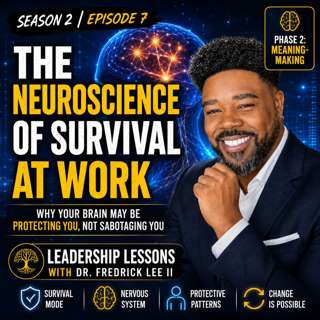
The Neuroscience of Survival at Work

The Neuroscience of Survival at Work

The Neuroscience of Survival at WorkSeason 2, Episode 7 | Phase 2: Meaning-Making — “Now I Understand Why”What if the behavior you keep criticizing in yourself is actually your nervous system trying t...

13 Aug 33min
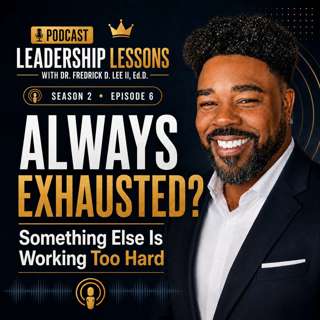
If You’re Always Exhausted, Something Else Is Working Too Hard

If You’re Always Exhausted, Something Else Is Working Too Hard

If You’re Always Exhausted, Something Else Is Working Too HardYou can be productive, dependable, successful, and still be deeply exhausted.Sometimes the problem is not simply how much you are doing. I...

27 Jul 29min
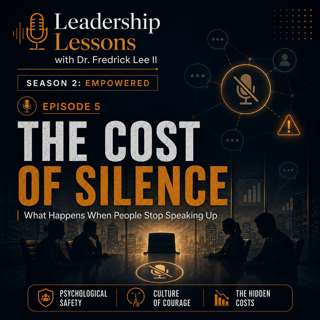
The Cost of Silence: What Happens When People Stop Speaking Up

The Cost of Silence: What Happens When People Stop Speaking Up

The Cost of Silence: What Happens When People Stop Speaking UpOne of the first signs that a culture, relationship, team, or family system is in trouble is not always noise.Sometimes it is quiet.A litt...

5 Jul 32min

Populært innen Fakta

fastlegen
dine-penger-pengeradet
fryktlos
relasjonspodden-med-dora-thorhallsdottir-kjersti-idem
rss-strid
treningspodden
foreldreradet
rss-ekteskapet
rss-bisarr-historie
rss-kunsten-a-leve
jakt-og-fiskepodden
sinnsyn
rss-orjasater
rss-kull
mikkels-paskenotter
gravid-uke-for-uke
rss-impressions-2
branncast
hverdagspsyken
rss-flydilla