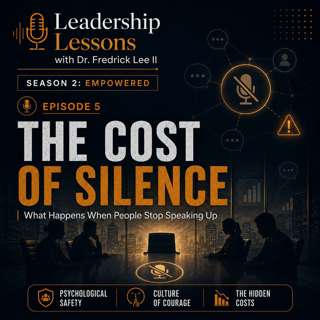
The Cost of Silence: What Happens When People Stop Speaking Up

The Cost of Silence: What Happens When People Stop Speaking Up

The Cost of Silence: What Happens When People Stop Speaking Up


One of the first signs that a culture, relationship, team, or family system is in trouble is not always noise.

Sometimes it is quiet.

A little too quiet.


In this episode of Leadership Lessons with Dr. Fredrick Lee II, Dr. Lee explores the hidden cost of silence and what happens when people stop believing their voice will matter. This conversation moves beyond the workplace and into the deeper human pattern of staying quiet to keep the peace, avoid conflict, protect ourselves, or survive environments that have not made truth feel safe.


Season 2, EMPOWERED: The Inner Work of Sustainable Change, is about understanding the human side of change through emotional intelligence, applied neuroscience, and change management. Episode 5 continues the Awareness stage of the season by helping listeners recognize silence as a signal, not just the absence of communication.


Silence may show up in a team meeting when the real conversation happens afterward in the hallway, parking lot, text thread, or private call. It may show up in relationships when someone keeps saying, “I’m fine,” while resentment quietly builds. It may show up in families where everyone knows the issue but keeps walking around it like furniture nobody wants to move. It may even show up internally, when you stop telling yourself the truth because denial feels easier than disruption.


Dr. Lee explains why silence often begins as protection, how the nervous system prioritizes safety over happiness, and why old coping patterns may have helped us survive one environment but may not serve us in the next. He also challenges leaders to stop assuming quiet means agreement and invites listeners to ask a deeper question: What is this silence protecting, and what is it costing?

This episode is for leaders, team members, high performers, caregivers, partners, family members, and anyone who has ever stayed silent to keep peace while feeling a war begin inside themselves.


In this episode, you will learn:

Why silence is not always agreement, peace, maturity, or professionalism.

How “the meeting after the meeting” reveals a breakdown in trust and psychological safety.

Why your nervous system may choose silence when honesty feels risky.

How silence can protect a moment but damage a pattern.

Why avoiding conflict can also mean avoiding intimacy.

How old coping patterns can become outdated tools.

Why leaders must create rooms where truth has somewhere safe to land.

How this lesson applies at work, in relationships, in families, and in your personal growth.

Key Reflection

When the real conversation happens after the official conversation, truth has left the room.

And when truth leaves the room, the system loses access to the wisdom, warnings, concerns, and clarity it needs to change.


Three practical things you can do right now:

  • 1. Complete a voice audit.

Choose one area of your life: work, relationship, family, friendship, or self-talk.

Finish this sentence:

“I have stopped speaking up about…”

Then ask yourself where that truth goes instead. Does it become resentment, distance, sarcasm, overthinking, fatigue, tension in your body, or side conversations?

  • 2. Do the protection and cost check.

Ask yourself two questions:

“What is my silence protecting?”

“What is my silence costing?”

Silence may be protecting your peace, your job, your reputation, your emotional energy, or your sense of belonging. But it may also be costing you clarity, connection, trust, intimacy, courage, or alignment.

  • 3. Choose one safer pathway for one honest sentence.

You do not need to deliver a speech. You do not need to unload five years of frustration in one conversation.


Start with one clear sentence.

  • At work: “I want to raise a concern before we move forward.”
  • In a relationship: “I care about us, and I need to be honest about what has been bothering me.”
  • In a family conversation: “I am willing to talk about this, but not if the conversation becomes disrespectful.”
  • With yourself: “I have been calling this peace, but it is costing me too much.”

Memorable Lines from the Episode

“When the real conversation happens after the official conversation, truth has left the room.”

“Silence is not the absence of communication. Silence is communication without a safe destination.”

“When you stay silent to keep the peace, it can start a war within yourself.”

“Your nervous system does not care about your happiness. It cares about your safety.”

“Old coping patterns are like tools from a camping trip. They may have helped you survive one environment, but they may not belong in the one you are trying to grow in now.”

“The goal is not reckless honesty. The goal is aligned honesty.”


Listen and Reflect

As you listen, ask yourself:

Where have I stopped speaking up?

What room, relationship, or system taught me to be quiet?

What is my silence protecting?

What is my silence costing?

What truth needs a safer place to land?


Call to Action

If this episode gives language to something you have experienced, share it with someone who may need it.


If you are listening on your favorite podcast platform, subscribe or follow Leadership Lessons with Dr. Fredrick Lee II so you do not miss the next part of the Season 2 journey.


If you are watching or engaging on social media, leave one word in the comments:

Voice. Truth. Safety. Peace. Courage. Alignment. Repair.


Your engagement helps this free general coaching content reach more people who are trying to lead, grow, heal, and communicate with more clarity in work, life, and relationships.


For those ready to go deeper, this is the kind of work Dr. Lee supports through coaching, emotional intelligence development, leadership development, and organizational change consulting.


Learn more at: www.mrchangeyourlife.com


Listen to the podcast at: leadershiplessons.transistor.fm


Episode Closing

This has been your Leadership Lesson, In Life!


Denne episoden er hentet fra en åpen RSS-feed og er ikke publisert av Podme. Den kan derfor inneholde annonser.

Episoder(30)

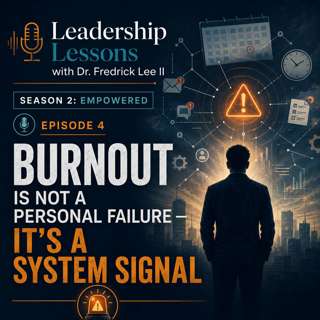
Burnout Is Not a Personal Failure — It’s a System Signal

Burnout Is Not a Personal Failure — It’s a System Signal

Episode SummaryIn this episode of Leadership Lessons, Dr. Fredrick Lee II explores burnout not as a personal weakness, but as a signal that something deeper is out of alignment. Burnout is often misun...

22 Jun 37min
Why High Performers Stay in Harmful Environments

Why High Performers Stay in Harmful Environments

Leadership Lessons with Dr. Fredrick Lee IISeason 2: EMPOWERED - The Inner Work of Sustainable ChangeEpisode 3: Why High Performers Stay in Harmful EnvironmentsEpisode SummaryHigh performers are often...

15 Jun 45min
Toxic Isn't Loud - It's Subtle, Chronic, and Normalized

Toxic Isn't Loud - It's Subtle, Chronic, and Normalized

content  typeSolo  primary  goalDiscussion  summaryThis episode explores the subtle, chronic toxicity that often goes unnoticed in organizations. It emphasizes the importance of awareness, emotional i...

6 Apr 33min

When Work Stops Feeling Safe (But You Can't Explain Why) | Psychological Safety at Work

When Work Stops Feeling Safe (But You Can't Explain Why) | Psychological Safety at Work

Does work suddenly feel different—even though nothing obvious has changed?In this episode of Leadership Lessons with Dr. Fredrick Lee II, we explore why many professionals feel a growing sense of unea...

8 Mar 19min

Ep. 14 When Professional Meets Petty: Leading Through Disrespect with Emotional Intelligence

Ep. 14 When Professional Meets Petty: Leading Through Disrespect with Emotional Intelligence

Episode 14: When Professional Meets Petty – Leading Through Disrespect with Emotional IntelligenceWhat do you do when professionalism meets pettiness — when the person you supervise challenges your au...

3 Nov 202539min

Bonus Episode #11 Why Do Men Think Natural Human Emotions Are a Sign of Weakness

Bonus Episode #11 Why Do Men Think Natural Human Emotions Are a Sign of Weakness

In this follow-up to Bonus Episode 6 – Men Are Not OK, Dr. Fredrick D. Lee II sits down with Te’Ana (she/her) — an esthetician from McKinney, Texas — for a raw, honest, and heartfelt conversation abou...

28 Okt 202530min

Bonus Episode #10 Beyond Survival – A Conversation on Healing, Identity, and Self-Efficacy

Bonus Episode #10 Beyond Survival – A Conversation on Healing, Identity, and Self-Efficacy

SummaryIn this episode of Leadership Lessons, Dr. Fredrick Lee II engages in a profound conversation with Dr. Cynthia Payne, a breast cancer survivor and healthcare leader. They explore the intersecti...

20 Okt 202535min

Populært innen Fakta

fastlegen
dine-penger-pengeradet
relasjonspodden-med-dora-thorhallsdottir-kjersti-idem
foreldreradet
rss-kunsten-a-leve
treningspodden
mikkels-paskenotter
rss-strid-de-norske-borgerkrigene
jakt-og-fiskepodden
hverdagspsyken
sinnsyn
rss-var-forste-kaffe
level-up-med-anniken-binz
tomprat-med-gunnar-tjomlid
rss-impressions-2
gravid-uke-for-uke
uroskolen
fryktlos
rss-bisarr-historie
diagnose