If You’re Always Exhausted, Something Else Is Working Too Hard

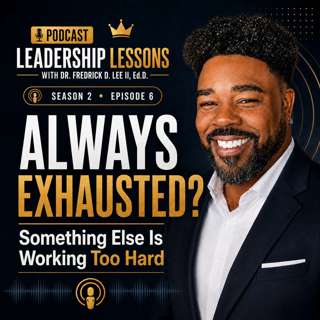
If You’re Always Exhausted, Something Else Is Working Too Hard

If You’re Always Exhausted, Something Else Is Working Too Hard


You can be productive, dependable, successful, and still be deeply exhausted.


Sometimes the problem is not simply how much you are doing. It is how hard your mind and body are working beneath the surface to help you keep doing it.


In this personal episode of Leadership Lessons, Dr. Fredrick Lee II explores the invisible labor behind chronic exhaustion, including masking, perfectionism, people-pleasing, emotional regulation, executive-function demands, constant self-monitoring, and the pressure to remain capable when you are already depleted.


Dr. Lee also shares parts of his own experience with neurodivergence, ADHD, anxiety, OCD, depression, high achievement, and leadership.

From the outside, competence can look effortless. Internally, it may require constant planning, rehearsing, remembering, regulating, anticipating, correcting, and recovering.


That hidden effort has a cost.


You may stop working, but your mind keeps reviewing the conversation. You may sit down to rest, but your nervous system remains alert. You may complete the task, but still feel as though you have forgotten something. You may appear calm while managing several internal processes that no one else can see.


This is why rest does not always feel restorative.


The episode challenges the idea that exhaustion is always a sign that you need to become more disciplined, organized, or productive.

Sometimes your exhaustion is information. It may be telling you that the way you are functioning is no longer sustainable.


In this episode, you will learn:

  • Why capable and high-performing people can experience hidden burnout
  • How neurodivergent masking and self-monitoring consume mental energy
  • Why perfectionism can function more like fear than excellence
  • How people-pleasing and emotional labor contribute to exhaustion
  • Why executive dysfunction is not laziness or a lack of ambition
  • How leadership roles can reward overfunctioning
  • Why your best cannot become your everyday expectation
  • How to identify the “background processes” draining your energy
  • What sustainable change can look like without abandoning your responsibilities

Dr. Lee uses the metaphor of open browser tabs to explain how unresolved stress, emotional demands, unfinished decisions, and constant mental tracking continue draining energy even when they are not receiving your full attention.

You may not be actively thinking about every open tab, but they are still using the battery.

The goal is not to close everything at once.

The goal is to recognize what is running, decide what still needs your attention, and begin closing the processes that no longer deserve your energy.


This episode’s practical challenge


Complete a background-process audit.


Ask yourself:

What am I doing internally every day that other people cannot see?


Consider the energy required to:

  • Rehearse conversations before they happen
  • Review conversations after they end
  • Anticipate how other people may respond
  • Monitor your tone, facial expression, or body language
  • Remember information that is not stored in a reliable system
  • Correct mistakes before anyone else notices
  • Keep people comfortable
  • Appear composed while feeling overwhelmed
  • Carry responsibilities that should be shared
  • Push through exhaustion because others depend on you

Then choose one background process to reduce for seven days.


You might ask for clarification instead of trying to interpret an unclear expectation. You might allow one task to be good enough. You might request support before reaching your limit. You might stop rehearsing every possible outcome. You might say no without preparing a full legal defense for your decision.


Your job is not to fix your entire life in one week.


Your job is to start.


Because sustainable change does not require you to move quickly. It requires you to move in the right direction.


If this episode feels personal, share it with someone who keeps saying, “I’m just tired,” when something deeper may be happening.


Follow or subscribe to Leadership Lessons with Dr. Fredrick Lee II for conversations about emotional intelligence, applied neuroscience, neurodivergence, burnout, leadership, workplace culture, boundaries, and the inner work of sustainable change.


For coaching, emotional intelligence development, leadership development, workplace culture support, or organizational change consulting, connect with Dr. Fredrick Lee and Change Your Life Coaching & Consulting Services.


Reflection question:
What is one invisible responsibility, expectation, or coping pattern you are ready to stop carrying alone?


This podcast provides general educational and coaching information and is not a substitute for individualized medical or mental health care.

Denne episoden er hentet fra en åpen RSS-feed og er ikke publisert av Podme. Den kan derfor inneholde annonser.

Episoder(32)

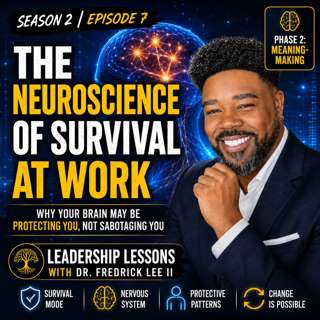
The Neuroscience of Survival at Work

The Neuroscience of Survival at Work

The Neuroscience of Survival at WorkSeason 2, Episode 7 | Phase 2: Meaning-Making — “Now I Understand Why”What if the behavior you keep criticizing in yourself is actually your nervous system trying t...

13 Aug 33min
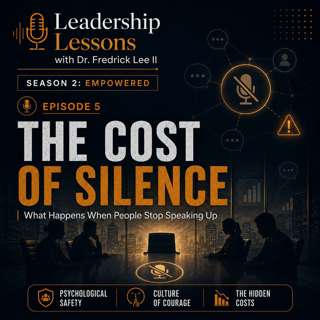
The Cost of Silence: What Happens When People Stop Speaking Up

The Cost of Silence: What Happens When People Stop Speaking Up

The Cost of Silence: What Happens When People Stop Speaking UpOne of the first signs that a culture, relationship, team, or family system is in trouble is not always noise.Sometimes it is quiet.A litt...

5 Jul 32min
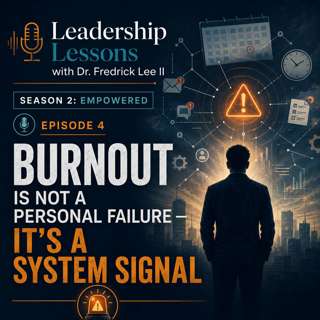
Burnout Is Not a Personal Failure — It’s a System Signal

Burnout Is Not a Personal Failure — It’s a System Signal

Episode SummaryIn this episode of Leadership Lessons, Dr. Fredrick Lee II explores burnout not as a personal weakness, but as a signal that something deeper is out of alignment. Burnout is often misun...

22 Jun 37min
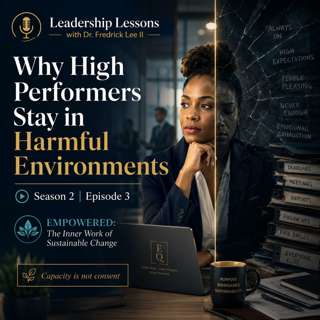
Why High Performers Stay in Harmful Environments

Why High Performers Stay in Harmful Environments

Leadership Lessons with Dr. Fredrick Lee IISeason 2: EMPOWERED - The Inner Work of Sustainable ChangeEpisode 3: Why High Performers Stay in Harmful EnvironmentsEpisode SummaryHigh performers are often...

15 Jun 45min
Toxic Isn't Loud - It's Subtle, Chronic, and Normalized

Toxic Isn't Loud - It's Subtle, Chronic, and Normalized

content  typeSolo  primary  goalDiscussion  summaryThis episode explores the subtle, chronic toxicity that often goes unnoticed in organizations. It emphasizes the importance of awareness, emotional i...

6 Apr 33min

When Work Stops Feeling Safe (But You Can't Explain Why) | Psychological Safety at Work

When Work Stops Feeling Safe (But You Can't Explain Why) | Psychological Safety at Work

Does work suddenly feel different—even though nothing obvious has changed?In this episode of Leadership Lessons with Dr. Fredrick Lee II, we explore why many professionals feel a growing sense of unea...

8 Mar 19min

Ep. 14 When Professional Meets Petty: Leading Through Disrespect with Emotional Intelligence

Ep. 14 When Professional Meets Petty: Leading Through Disrespect with Emotional Intelligence

Episode 14: When Professional Meets Petty – Leading Through Disrespect with Emotional IntelligenceWhat do you do when professionalism meets pettiness — when the person you supervise challenges your au...

3 Nov 202539min

Populært innen Fakta

fastlegen
dine-penger-pengeradet
relasjonspodden-med-dora-thorhallsdottir-kjersti-idem
treningspodden
rss-orjasater
foreldreradet
jakt-og-fiskepodden
rss-strid-de-norske-borgerkrigene
rss-kunsten-a-leve
sinnsyn
hverdagspsyken
tomprat-med-gunnar-tjomlid
gravid-uke-for-uke
rss-var-forste-kaffe
hr-podden-2
rss-impressions-2
fryktlos
mikkels-paskenotter
ukast
hagespiren-podcast