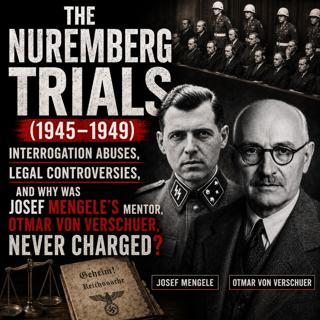

The LIES of The Nuremberg Trial. Many escaped Justice. Why Was Josef Mengele's Mentor Otmar von Verschuer Never Charged.

The LIES of The Nuremberg Trial. Many escaped Justice. Why Was Josef Mengele's Mentor Otmar von Verschuer Never Charged.

"After all, the victor will not be asked whether he told the truth or not."
Adolf Hitler, remarks to German military commanders on August 22, 1939, as quoted from the Nuremberg documentary record by Robert H. Jackson.

The history of Nuremberg stretches back nearly a thousand years, but the city became forever linked to Nazi Germany after Adolf Hitler transformed it into the symbolic center of the Nazi Party. Between 1927 and 1938, the massive Nuremberg Rallies showcased military spectacle, propaganda, and the consolidation of power, while the 1935 Nuremberg Laws stripped German Jews of their citizenship and laid the legal foundation for racial persecution. In this episode, we trace Nuremberg's evolution from a medieval imperial city to the stage for both Nazi pageantry and, after World War II, the world's most famous war crimes trials.

The Nuremberg Trials (1945–1949) remain among the most significant and controversial legal proceedings in modern history. This episode explores the International Military Tribunal and the subsequent Nuremberg Trials, examining the prosecution of Nazi political leaders, military commanders, physicians, judges, industrialists, and the executives of IG Farben. We explain why the Allies selected Nuremberg as the trial venue, how the proceedings introduced new concepts into international law, and how the judgments influenced later war crimes tribunals, crimes against humanity, genocide prosecutions, and international criminal justice.

The discussion also examines the enduring controversies surrounding the trials, including documented allegations of coercive interrogations, debates over the reliability of confessions, claims of "victor's justice," and legal arguments involving aggressive war, crimes against humanity, conspiracy charges, and ex post facto law. Rather than accepting any single narrative, we distinguish established historical evidence from disputed claims and revisionist interpretations while exploring why these debates continue to shape public understanding of World War II, the Holocaust, international tribunals, and the limits of justice after war.

The story does not end in 1949. We follow the legacy of the Nuremberg Trials through the breakup of IG Farben into Bayer, BASF, and Hoechst, examine how questions of corporate responsibility evolved during the Cold War, and discuss Bayer's later acquisition of Monsanto. From Nazi propaganda and industrial power to medicine, law, politics, and multinational corporations, this episode explores how decisions made in Nuremberg continue to influence legal systems, corporate accountability, historical memory, and global debates nearly eighty years later,

Clip: What Happened at the Nuremberg Trials? | History

Music: Leonard Cohen - Everybody Knows (Official Audio)

TAYLOR SWIFT & TRAVIS KELCE'S SECRETIVE SATANIC ILLUMINATI WEDDING IN NYC ON 33RD STREET!

1961 MOVIE: Judgment At Nuremberg

LIES YOUR TEACHER TAUGHT YOU: The Farce of Nuremberg Trials

The Nuremberg trials from 1945 to 1949 and the "confessions" under torture - Front National Suisse

The Legally-Flawed Nuremberg "War Crimes Trials" Did Not "Prove" the Holocaust

Les Problèmes de la Baltique: Finland in the Eye of the Storm. Erkki Hautamäki's book

Freemasonry, Bolshevism and Dirty Little Secrets You Weren't Supposed to Know: The Stalin-Churchill Pact | Justice for Germans

Erkki Hautamäki - Wikipedia

Goebbels Accuses Churchill of Lying

Joseph Goebbels: 1933-1945

How a Psychiatrist at Nuremberg Got Inside the Nazi Mind | HISTORY

The Secret Art Bunker of Nuremberg

Aspirin Contributed to Mortalities of 1918-1919 Spanish Influenza, and More | Winter Watch

The Tokyo Trial Explained

How they use hormones to flip sex: Hormones

Do you have a psychopath in your life? The best way to find out is read my book. BOOK *FREE* Download – Psychopath In Your Life4

Support is Appreciated: Support the Show – Psychopath In Your Life

Download Pods here: TOP PODS – Psychopath In Your Life

My old discussion forum with last 10 years of victim stories, is back online. Psychopath Victim Support Community | Forums powered by UBB.threads™

Google Maps My HOME Address: 309 E. Klug Avenue, Norfolk, NE 68701 SMART Meters & Timelines – Psychopath In Your Life

Harald Quandt is one of those remarkable historical figures whose life intersects with several major stories at once: the Nazi leadership, the Battle of Crete, Monte Cassino, postwar German industry, and the modern BMW fortune.

1921
  • Harald Quandt is born.
  • His father is Günther Quandt, one of Germany's wealthiest industrialists.
  • His mother is Magda Quandt.
1929
  • His parents divorce.
  • Magda remains part of Berlin's wealthy social circles.
1931
  • Magda marries Joseph Goebbels.
  • Harald suddenly becomes the stepson of one of Hitler's closest associates.
1933

Hitler comes to power.

Harald now grows up at the center of the Nazi elite.

He spends time with:

  • Adolf Hitler.
  • Joseph Goebbels.
  • Hermann Göring.
  • Other senior Nazi leaders.

Unlike many children, he personally knew the people running the Third Reich.

1932–1940

Magda and Goebbels have six children together.

Harald becomes their older half-brother.

The family is frequently photographed as the "ideal Nazi family."

Hitler reportedly had a warm relationship with the Goebbels children.

1939

Harald volunteers for military service.

Despite his family connections, he receives no exemption.

He joins the elite Luftwaffe paratroopers (Fallschirmjäger).

1941
  • He fights in the invasion of Crete.
  • The battle becomes one of the bloodiest airborne operations of the war.
  • Harald survives and receives decorations for bravery.
1941–1943

He serves on the Eastern Front.

Later he serves in Italy.

By now he is a commissioned officer.

1944
  • Harald fights at the Battle of Monte Cassino.
  • The German Fallschirmjäger become famous for their stubborn defense.
  • He is seriously wounded.
  • British forces capture him.
  • He is sent first to hospital, then to a prisoner-of-war camp near Benghazi, Libya.
April 1945
  • While Harald is in captivity, Berlin collapses.
  • His mother, Magda, writes him what amounts to a farewell letter.
  • She explains she sees no future without National Socialism.
  • The letter is one of the most haunting surviving personal documents from Hitler's bunker.
May 1, 1945
  • Magda poisons all six of Harald's younger half-siblings.
  • Joseph and Magda Goebbels then kill themselves.
  • Harald becomes the only surviving child of Magda Goebbels.
1947
  • Released from British captivity.
  • He returns to Germany.
  • Instead of entering politics, he joins the family businesses founded by his father.
1954
  • Günther Quandt dies.
  • Harald and his half-brother Herbert inherit enormous industrial holdings.
  • These include major interests connected with what became BMW and other industrial firms.
1950s–1960s
  • The Quandt family becomes one of the richest industrial dynasties in West Germany.
  • Harald generally avoids public political discussion.
  • Unlike Albert Speer or others, he writes no major memoir.
1960

Harald's half-brother Herbert Quandt plays a decisive role in rescuing BMW from financial collapse by increasing the family's investment.

Without Herbert's intervention, many historians believe BMW might have been absorbed by another company.

1967
  • Harald dies in a private airplane crash in Italy.
  • He is only 45 years old.
After 1967

His daughters inherit substantial wealth.

The broader Quandt family fortune continues growing through BMW and other investments.

2007

A German television documentary draws renewed attention to the family's wartime history.

It examines the use of forced labor in Quandt factories during World War II.

2011

An independent historical investigation commissioned by the family concludes that Quandt companies used more than 50,000 forced laborers during the war and that the family's wartime activities were more deeply intertwined with the Nazi system than had previously been acknowledged.

What makes Harald historically unique?

He occupies an unusual position in history.

He was:

  • The biological son of one of Germany's richest industrialists.
  • The stepson of Joseph Goebbels.
  • Personally acquainted with Hitler.
  • An officer in an elite combat formation rather than a political official.
  • A British prisoner of war when Berlin fell.
  • The only surviving child of Magda Goebbels.
  • Heir to one of Germany's largest postwar industrial fortunes.

Harald never chose to become Joseph Goebbels' stepson. He entered that world at age ten when his mother remarried. He then lived through the collapse of the regime, lost his mother and six half-siblings in a single day, spent years as a POW, and returned to inherit an industrial empire whose wartime legacy remains the subject of historical scrutiny. Few individual biographies intersect with so many of the defining themes of twentieth-century German history.

Günther Quandt built and expanded the industrial empire.

Herbert Quandt inherited part of it and rescued BMW.

Harald Quandt inherited the other major branch while carrying the extraordinary distinction of being Joseph Goebbels' stepson.

The startling part is that Harald left a British prisoner-of-war camp in 1947, returned to Germany, and within several years became one of the richest men in the country because his biological father's industrial empire had survived the war and denazification.

Italy did have trials, but it never had a single international tribunal like Nuremberg or Tokyo. Most large-scale prosecutions simply never happened. Your transcript lays out the reasons quite well.

The major reasons were:

Italy switched sides before the war ended.

This is probably the biggest reason.

  • Mussolini was overthrown in July 1943.
  • Italy surrendered to the Allies in September 1943.
  • The new Italian government declared war on Germany.
  • Italian troops fought alongside the Allies for the remainder of the war.

That allowed postwar Italy to argue:

"Yes, we were fascist, but we also helped defeat fascism."

That was an argument Germany and Japan could not make.

Italy became both defendant and victim.

After September 1943:

  • Germany occupied northern Italy.
  • Italians fought Italians in a civil war.
  • German troops committed atrocities inside Italy.
  • Italian resistance groups fought the Germans.

So Italy could say:

"We committed crimes, but we also suffered under Nazi occupation."

That complicated any attempt to stage one giant international trial.

Mussolini was already dead.

On April 28, 1945:

  • Mussolini was captured.
  • He was executed by Italian partisans.
  • Several senior Fascist officials were executed with him.

Italy later argued that much of the principal leadership had already been punished by Italians themselves.

The Cold War intervened—again.

By 1947:

The Western Allies were increasingly worried about:

  • Soviet influence.
  • The powerful Italian Communist Party.
  • Keeping Italy in the Western camp.

Britain and the United States lost interest in prosecutions.

Yugoslavia wanted hundreds of Italian officers extradited.

Ethiopia wanted Italian commanders tried for poison gas, massacres, and colonial atrocities.

Instead:

  • Britain slowed things down.
  • The U.S. withdrew support.
  • Extraditions largely failed.

Many suspects simply remained in Italy.

Italy declared a broad amnesty.

In 1946, Justice Minister Palmiro Togliatti issued a sweeping amnesty.

Although intended to exclude the worst crimes, in practice it was interpreted broadly.

Out of approximately 218,000 cases reviewed during the defascistization process, only 738 resulted in convictions.

Some officials were politically inconvenient to prosecute.

One striking example in your transcript is General Mario Roatta.

Yugoslavia wanted him tried.

Instead, he escaped with assistance from Italian police and British intelligence, eventually living freely in Spain before returning to Italy.

The larger pattern

One thing you've probably noticed over the past few days is that the same theme keeps appearing:

  • Germany: extensive trials initially, then rapid reintegration as the Cold War intensified.
  • Japan: selective prosecutions, immunity for Unit 731 personnel, preservation of the emperor, alliance with the United States.
  • Italy: limited prosecutions, broad amnesties, reluctance to extradite suspects, reconciliation prioritized over extensive trials.

The specific circumstances differed, but by roughly 1947–1948, Western governments increasingly emphasized rebuilding allies and containing Soviet influence over pursuing every alleged war criminal. That shift is well documented, even though historians continue to debate whether it was justified or whether accountability should have remained the higher priority.

Ancient and Medieval Origins

The exact origin is uncertain. Soft, brimless caps resembling the fez were worn around the Mediterranean and North Africa for centuries. The city of Fez (Fès), Morocco, became associated with the hat because of its production of the red dye used to color felt hats, although historians debate whether the hat itself originated there.

1400s–1700s

Similar brimless felt caps were common throughout:

  • Morocco
  • Algeria
  • Tunisia
  • Egypt
  • The Balkans
  • Parts of the Ottoman Empire

At this stage it was simply regional headwear.

1826

A turning point.

Sultan Mahmud II abolished the Janissaries and modernized the Ottoman military.

He ordered the fez to replace turbans as standard military and civil-service dress.

Why?

  • Easier to manufacture.
  • Symbolized modernization.
  • Allowed Muslims to touch their forehead to the ground during prayer because it had no brim.
  • Created a uniform appearance across the empire.

This is when the fez became internationally recognized.

1830s–1870s

The fez spread across the Ottoman Empire.

It was worn by:

  • Soldiers
  • Police
  • Judges
  • Bureaucrats
  • Postal workers
  • Government officials
  • Merchants

For many people, wearing a fez meant loyalty to the Ottoman state.

Late 1800s

European colonial officers and travelers frequently encountered the fez throughout:

  • Turkey
  • Egypt
  • Bosnia
  • Syria
  • Lebanon
  • Palestine
  • Libya
  • Tunisia

It became one of the visual symbols of the Ottoman world.

1878–1918

Bosnia came under Austro-Hungarian rule.

The Austrians kept Bosnian Muslim regiments wearing fezzes because they respected local religious traditions.

Those Bosnian regiments became famous throughout Europe.

This explains the Waffen-SS connection decades later.

1914–1918 (World War I)

Fezzes were still worn by:

  • Ottoman Army units.
  • Bosnian Muslim regiments.
  • Many civilians throughout the Middle East.

1925

  • Mustafa Kemal Atatürk banned the fez in Turkey under the Hat Law.
  • He regarded it as a symbol of the old Ottoman Empire and wanted Western-style hats instead.
  • The ban dramatically reduced everyday use in Turkey.

1930s–1945

The Nazis recruited Bosnian Muslims into the:

13th Waffen Mountain Division SS "Handschar."

  • Those soldiers wore the traditional fez with SS insignia.
  • It looked strange because the SS is usually associated with black peaked caps.
  • Historically, however, Himmler was willing to preserve traditional dress when recruiting foreign units.

1870s–Present (Shriners)

The Shriners International adopted the fez in the late nineteenth century.

Why?

The organization borrowed Middle Eastern imagery because its rituals and symbolism were inspired by romanticized ideas of Arabia, North Africa, and the Ottoman world—not because it had any historical connection to those governments.

The fez became their most recognizable symbol.

It usually bears:

  • The scimitar.
  • Crescent.
  • Sphinx.
  • Chapter name.

Today

The fez is still worn:

  • By Shriners.
  • During some ceremonial military occasions in the Balkans.
  • In parts of Morocco.
  • During cultural festivals throughout North Africa.
  • By a few traditional religious groups.
Who has worn the fez?
  • Ottoman Sultans.
  • Ottoman Army officers and soldiers.
  • Ottoman police.
  • Ottoman judges.
  • Civil servants.
  • Bosnian Muslim regiments under Austria-Hungary.
  • Ottoman officials throughout the Middle East.
  • 13th Waffen-SS Handschar Division.
  • Shriners.
  • Various North African civilians.
  • Some Sufi religious orders.

One interesting historical irony is that the fez has represented very different things depending on the era:

  • In Morocco, it reflected regional tradition.
  • In the Ottoman Empire, it symbolized modernization and state service.
  • In Austria-Hungary, it identified Bosnian Muslim regiments.
  • In the Waffen-SS, it marked a foreign volunteer formation.
  • Among the Shriners, it became a ceremonial emblem inspired by an imagined "Oriental" aesthetic.

It is one of those rare pieces of clothing that has crossed empires, religions, military organizations, and fraternal societies while retaining its instantly recognizable shape.

Fez

  • Ottoman officials.
  • Military officers.
  • Judges.
  • Police.
  • Bosnian regiments.
  • Shriners.
  • Later, the Handschar SS division.

Top hat

  • Bankers.
  • Industrialists.
  • Politicians.
  • Diplomats.
  • Wealthy businessmen.
  • Freemasons in some ceremonial settings.
  • Victorian and Edwardian upper classes.

One irony is that the Nazis persecuted the Roma under racial laws while simultaneously recruiting Bosnian Muslim SS troops who wore fezzes. So during World War II you could have:

  • Roma civilians in the Balkans wearing fezzes as traditional local dress.
  • Bosnian Muslim Waffen-SS soldiers wearing fezzes with SS insignia.

The same style of hat had completely different meanings depending on who was wearing it.

So if you're researching symbolism, I would be cautious about assigning a single meaning to the fez. Historically it has been worn by:

  • Ottoman officials.
  • Muslim civilians.
  • Christians in some Balkan regions.
  • Jewish merchants in Ottoman cities.
  • Roma in Ottoman territories.
  • Bosnian regiments of Austria-Hungary.
  • The Handschar SS Division.
  • Shriners.

That's one reason historians generally treat it as regional and cultural headwear, whose meaning changed depending on the time, place, and wearer, rather than as the emblem of one particular people or organization.

The Roma were a mobile people whose communities spread from the Indian subcontinent into the Byzantine Empire, the Balkans, the Ottoman Empire, Central Europe, and eventually Western Europe. Because they often adopted aspects of local dress while retaining elements of their own culture, they became one of the groups through which clothing styles could be seen across multiple regions.

For example:

  • In Ottoman Bosnia, a Roma blacksmith might wear a fez because local Bosnian Muslims did.
  • In Bulgaria, Roma musicians often wore the same headwear as other local men.
  • In parts of Turkey, Roma communities also wore fezzes.
  • By contrast, in Spain, England, or France, Roma communities generally dressed more like the surrounding populations and did not typically wear fezzes.

One thing that makes the Balkans fascinating is how mixed the population was. In the same town you might have:

  • Bosnian Muslims wearing fezzes.
  • Orthodox Serbs.
  • Catholic Croats.
  • Sephardic Jews.
  • Ashkenazi Jews.
  • Roma families.
  • Ottoman officials.
  • Austro-Hungarian administrators (after 1878).

"How did one piece of headwear become accepted by so many different peoples across the Ottoman world?"

The fez crossed ethnic, linguistic, and even religious boundaries. It was worn by Muslims, Christians, Jews, and some Roma communities. Later it appeared on Austrian Bosnian regiments, the Handschar SS division, and eventually the Shriners in the United States.

That makes the fez less a symbol of one people than a symbol of a shared cultural sphere that stretched from North Africa through the eastern Mediterranean and deep into the Balkans. That's one reason it shows up in such unexpected places when you start following its history.

Today, many Americans associate Islam primarily with the Middle East or with terrorism because of the events of the last few decades. That was not always the dominant public perception.

Here's the timeline.

1700s–1800s

Most Americans had very little direct contact with Muslims.

Islam was known largely through:

  • The Ottoman Empire.
  • North African Barbary states.
  • Biblical history.
  • Travel literature.

The biggest early American interaction came during the Barbary States conflicts (1801–1805 and 1815), when the young United States fought piracy in the Mediterranean.

Late 1800s

America developed a fascination with what people called "the Orient."

You saw:

  • Shriners wearing fezzes.
  • "Arabian Nights" themes.
  • Turkish smoking rooms.
  • Belly dancing at world fairs.
  • Moorish architecture.
  • Ottoman-inspired decorations.

Muslim imagery was often viewed as exotic or romantic rather than threatening.

1870s–1920s

This is probably the era you're noticing.

Many American fraternal organizations adopted Middle Eastern imagery.

Examples:

  • Shriners International
  • Moorish Revival architecture.
  • Crescent symbols.
  • Fezzes.
  • Arabic-inspired names.
  • Camel imagery.

These groups were not Islamic organizations. They borrowed symbols because Americans found the Ottoman and Arab world mysterious and fashionable.

1920s–1945

The Middle East was still not a major focus of American public life.

Attention centered much more on:

  • Europe.
  • Japan.
  • The Great Depression.
  • World War II.

1948–1970s

Several events gradually increased attention to the Middle East:

  • Creation of Israel.
  • Arab-Israeli wars.
  • Oil discoveries.
  • OPEC.
  • The 1973 oil embargo.

Americans increasingly associated the region with geopolitics rather than romance.

1979

A major turning point.

The Iranian Revolution and the U.S. embassy hostage crisis dominated television for over a year.

For many Americans, this was their first sustained exposure to modern political Islam.

1980s

Additional events reinforced that shift:

  • Lebanon.
  • Beirut barracks bombing.
  • Airline hijackings.
  • Libya.
  • Palestinian terrorism.

1990s

The perception hardened further.

Events included:

  • 1993 World Trade Center bombing.
  • East Africa embassy bombings.
  • USS Cole attack.

September 11, 2001

This was by far the largest turning point.

After the attacks, Islam became strongly associated in the American public mind with terrorism, security, Afghanistan, Iraq, and the broader "War on Terror."

That doesn't mean Americans viewed all Muslims that way, but public discussion changed dramatically.

Why are there so many Islamic-looking symbols in America?

Because many of them arrived before Islam was widely viewed through a security lens.

The Shriners adopted the fez in 1872.

Moorish Revival buildings were fashionable.

Arabian Nights stories were enormously popular.

None of these were seen as controversial.

So the same fez that looked perfectly ordinary on a Shriner in 1920 might today surprise people who associate it primarily with the Ottoman Empire or Islam.

In many ways, the symbolism stayed the same, but its cultural meaning changed because the public's perception of Islam changed over the twentieth century, especially after 1979 and even more after 2001. That's why Americans today often notice symbols that earlier generations simply regarded as exotic, decorative, or fraternal rather than politically or religiously significant.

The Marshall Plan Myth

The 50th anniversary of the Marshall Plan provided another occasion for the media to celebrate the government's good works. The U.S.'s headlong plunge into global welfarism (nearly $100 billion in current dollars), they said, saved European economies after the Second World War. One reporter, Garrick Utley of NBC, even theorized that Marshall aid explains why East Germany was poor and West Germany rich.

As economist Tyler Cowen has noted, the countries that received the most Marshall Plan money (allies Britain, Sweden, and Greece) grew the slowest between 1947 and 1955, while those that received the least money (axis powers Germany, Austria, and Italy) grew the most. In terms of post-war prosperity, then, it eventually paid to be a political enemy of the U.S. instead of a "beneficiary" of international charity.

But this truth is only news if you think that the Marshall Plan was genuinely intended to help foreign countries. But as with all government programs, it pays returns to look beneath the surface. So what exactly was the point of the Marshall Plan, named for General George Marshall? It's been well-described in the works of historians William Appleman Williams, Gabriel Kolko, Stephen Ambrose, and Alan Milward.

Marshall himself played the role of a patsy, delivering prepackaged speeches written by the players behind the plan. His original pitch, given at Harvard, was for money to end "hunger, poverty, desperation, and chaos." But the real upshot of the Marshall Plan was a political maneuver to loot American taxpayers to keep influential American corporations on the government dole. The Plan's legacy was the egregious and perpetual use of foreign aid for domestic political and economic purposes.

After the war ended, Harry Truman's popularity in the polls began to plummet, as did the prestige of government generally. The American people had made huge sacrifices to fight the war and now wanted curbs in government, which had been administering a centrally planned economy. Most of all, they wanted the foreign policy recommended by George Washington and Thomas Jefferson: trade with all, entanglements with none.

In the mainstream of thinking was Republican Senator Robert Taft, a hero of all free-market activists at the time. He demanded tax cuts, spending cuts, and an end to "constantly increasing interference with family life and with business by autocratic government bureaus and autocratic labor leaders." The Republican party swept midterm elections in 1946, taking back the Congress on a hard-core, anti-big government platform.

Truman had to do something big and he knew it. As Charles Mee reports, he needed "some large program that would let him recapture the initiative, something big enough to enable him to gather in all the traditional factions of the Democratic Party and also some middle-of-the-road Republicans, and at the same time, something that would hamper the Republican phalanx," and establish him as a world leader.

The issue was right before him: foreign aid, funneled through the corporate establishment and cloaked in the rhetoric of opposition to foreign (but not domestic) communism. Cynically, he would make good use of Russia, which only the day before had been our gallant ally in the war, and transform it into a monster that had to be destroyed. By stealing the Republican's anti-socialist rhetoric, Truman hoped to frazzle his opponents and make himself a hero on the world stage.

Truman had plenty of co-conspirators, men who have gone down in history as the architects of the original New World Order. Fabled establishmentarians Averell Harriman and Charles Kindleberger were central figures. But it was Dean Acheson, undersecretary of state and the most menacing statist of the immediate post-war era, who concocted the plan to make the wartime empire permanent. Acheson persuaded Navy secretary James Forrestal and domestic fixer Clark Clifford to show Truman how he could elevate a political scam like foreign aid into a mighty ideological struggle on the global stage.

A little-known business group, founded in 1942 and called the Committee for Economic Development, was elevated into a think tank for a new international order—the economic counterpart to the Council on Foreign Relations. The Committee's founders were the heads of the top steel, automotive, and electric industries who had benefited from the New Deal's corporatist statism. Its membership overlapped with the farther left National Planning Association, which was unabashedly national socialist in ideological orientation.

These groups understood that they owed their profit margins to government subsidies provided by the New Deal and wartime production subsidies. Faced with post-war peace, they feared a future in which they would be forced to compete on a free-market basis. Their personal and institutional security was at stake, so they got busy dreaming up strategies to sustain a profitable statism in a peacetime economy.

Corporate economic interests, then, overlapped with Truman's political interests, and an unholy alliance between business and government was born. They would use Europe's miseries to line their own pockets in the name of "rebuilding" and providing "security" against trumped-up threats to American security.

The test case came in 1947 with aid to Greece, where a communist party was making electoral advances. Truman saw the main chance, and demanded $400 million in foreign aid, which Congress approved as a swipe against Russia. Just as the money was being channeled to special-interest groups, however, members of Congress learned that the "Russian connection" to the Greek communist party had been phonied up. As it turned out, Greece, like every European country, just wanted the cash.

Even so, the political success of the Truman doctrine of global giveaways had been demonstrated, and the script for billions in future giveaways had been written. Over the next five years, "Marshall money" would corrupt nearly every Christian democratic party in Europe, turning them into carbon copies of the U.S. Democratic party. Those political parties in turn worked to create monstrous welfare states and regulatory controls that continue to hinder European economic growth today.

On the heels of the success in Greece, Dean Acheson formed an ad hoc committee to find "situations elsewhere in the world" that "may require analogous, technical, and military aid on our part." With no effort, the ad hoc committee was able to classify most of Europe as in need of economic aid. The committee found shortages of just about everything, and, in particular, dollars to buy goods from corporate America. A mythical "dollar shortage" (as if trade is only possible with a world awash in paper) was the crisis of the moment.

But beneath the surface, the true objective was the internationalization of the New Deal, a bureaucrat's dream. As Julius Krug, secretary of the interior, said in his memoirs, the Marshall Plan, "essential to our own continued productivity and prosperity," was a Tennessee Valley Authority on a world scale. "It is as if we were building a TVA every Tuesday."

Yet even after the Greece vote, polls showed tremendous public opposition to any foreign giveaways. In one meeting, the Republican House Majority Leader Charles Halleck told Truman flat out: "You must realize there is a growing resistance to these programs. I have been out on the hustings, and I know. The people don't like it."

The Truman gang had already thought of that. Months before the vote, he brought together the heads of major corporations to enlist them in the cause. Members of this organizing committee, drawn from the Committee for Economic Development, included, most prominently, Hiland Vatcheller, president of the Allegheny-Ludlum Steel Corporation; W. Randolph Burgess, vice-chairman of National City Bank of New York; Paul G. Hoffmann, president of Studebaker Corp. (and later administrator of Marshall funds), as well as the secretary treasurers of the AFL and the CIO.

Leading the corporate charge for secure profits was Will Clayton, the Texas cotton impresario whose business was about to experience a remarkable tax-subsidized boom. The last world war had already made his company the second largest cotton-trading company in the world. Unlike his competitors during the New Deal, while working with FDR to wreck the American economy, he was smart enough to move his operations to Brazil, Mexico, Paraguay, and Egypt. By the Second World War, he was selling 15 percent of the world cotton crop.

As the war ended, he reenlisted in the campaign for the home front. As undersecretary of state for economic affairs in 1947, Clayton too saw the main chance. "Let us admit right off," he said in defense of the idea of foreign aid: "We need markets—big markets—in which to buy and sell." Here is the core truth of all such aid. The intent is not to help foreign countries; it is to reward home-based multinationals who actually get the cash as the government purchases political influence abroad.

Nothing was left to chance. Acheson worked with the established corporate elites and the State Department to create a supposed grass-roots organization called "Citizens' Committee for the Marshall Plan." As many as one thousand speakers representing the group toured the country to whip up support. It also ghost-wrote Congressional testimony from other organizations on behalf of the aid package. As Averell Harriman told several European ambassadors during a visit to the British embassy, they haven't seen anything compared with the "flood of organized propaganda which the Administration is about to unloose."

It was left to Will Clayton to make the economic case. Perversely, he touted the Marshall Plan as the triumph of "free enterprise." Moreover, he said, if communism comes to Europe, "I think the situation which we would face in this country would be a very grave one." We would "have to reorder and readjust our whole economy in this country if we lost the European market."

In the days before the vote, the claims became more extreme and, with the media-corporate-banking- government elite on board, the propaganda became ever more hysterical. We were told that a depression would come. The U.S. would be bombed. We'd be in another war if the aid package failed. The situation is as bleak as it was for France in 1938. American life as we know it would end forthwith.

When the plan passed, as it easily did (with even Taft's vote), the ink was hardly dry on the legislation when the ships full of goods hit the high seas. At any given moment over the next few months, 150 boats were carrying wheat, flour, cotton, tires, borax, drilling equipment, tractors, tobacco, aircraft parts, and anything else big domestic manufacturers could get their hands on.

As with most goods shipped under the Marshall Plan, American producers had the advantage: 50 percent had to be sent on American vessels. Oil exports to Europe exploded even as imports from Europe were cut by one-third. In aid distribution, there was bias in favor of finished goods, to prevent European businesses from competing with American producers on down the production line.

Taking a leaf from the Roosevelt playbook, Truman bypassed the usual bureaucracy and established a new bureau—the Economic Cooperative Administration—to distribute the aid. It too was staffed by the heads of major industrial-corporate interests who stood to benefit at public expense. Paul Hoffman headed the group and passed out billions to well-heeled corporate powers. As historian Anthony Carew summarizes, the Marshall Plan "was in all major respects a business organization run by businessmen." (Hoffman later became head of the far-left Ford Foundation.)

Most of all, the aid was used for purchases at distorted prices by American tax dollars in the hands of European governments. The mad scramble for tax dollars was a disgrace to behold, creating a low point in U.S. business history. Time and again, Congress intervened to grant corporate America what it really wanted: restrictions that forced Marshall aid to go to purchases of American oil, aluminum, wood, textiles, and machines.

The aid was also used to directly subsidize particular firms in recipient countries, whether or not there were viable markets for their products. Instead, the firms received money because their continued existence would artificially support "full employment" policies. And since American labor union groups were intimately involved in choosing who got the money, the lion's share went to companies with closed union shops, paradoxically restricting the ability of labor markets to readjust to new economic realities.

From an economic perspective, the Marshall Plan was modeled on a static view of investment. Countries were asked what their present needs were and the U.S. responded. Not a thought was given to the possibility that economic growth alone would provide. It eventually did, but only after the Marshall Plan welfare was cut off and domestic manufacturers were able to find markets for their products.

The result was the largest peacetime transfer of wealth from the taxpayers to corporations until that point in U.S. history. And it wasn't only dollars that were exported. Through a massive and tax-funded "technical expertise program," European businesses came to the U.S. to take lessons in management practices, visiting mostly unionized automobile companies, electric utility plants, and huge farm operations—the most socialistic of U.S. sectors.

All told, the Marshall Plan dumped $13 billion, or nearly $100 billion in today's dollars. It was enough to firmly entrench American companies in European markets, especially in Britain, France, and Germany. American-controlled companies dominated industries such as shoes, milk, cereals, machines, cars, canned goods, petroleum refinement, locks and keys, printing, tires, soaps, clocks, farm machinery, and much more.

These were mere bubbles of prosperity, forced investment created through insider deals of the worst sort. Indeed, Hoffman worked under the constant fear that the racketeering would come to the surface. He feared some enterprising journalist might expose the entire thing, hearings would follow, and the plan would be discredited. That never happened.

A year after the Marshall Plan began sucking private capital out of the economy, the U.S. fell into recession, precisely the opposite of what its proponents predicted. Meanwhile, the aid did not help Europe. What reconstructed Europe was the post-Marshall freeing up of controlled prices, keeping inflation in check, and curbing union power—that is, the free market. As even Hoffman admitted in his memoir, the aid did not in fact help the economies of Europe. The primary benefit was "psychological." Expensive therapy, indeed.

The actual legacy of the Marshall Plan was a vast expansion of government at home, the beginnings of the Cold War rhetoric that would sustain the welfare-warfare state for 40 years, a permanent global troop presence, and an entire business class on the take from Washington. It also created a belief on the part of the ruling elite in D.C. that it could trick the public into backing anything, including the idea that government and its connected interest groups should run the world at taxpayer expense.

The Secret Art Bunker of Nuremberg By the time war broke out in 1939, Nazi officials had already developed a detailed plan for a network of tunnels to smuggle and hide valuable artwork.

Though more than 1,800 people in Nuremberg, Germany, died in a fiery hailstorm amid one million incendiary bombs and 120 blockbusters dropped on the city by the British Royal Air Force on Jan. 2, 1945, a horde of Nazi-accumulated artwork survived undamaged in a bunker hidden about 78 feet underground. The secret art bunker of Nuremberg, today known as the Historischer Kunstbunker, held the keys to the historic relics of the Nazis' Party Rally city.

The Nazis used a medieval tunnel system underneath Nuremberg's imperial castle to hide the city's ancient treasures, including the Imperial regalia of the Holy Roman Emperor, valuable paintings and even pieces of stained glass windows from local cathedrals. The underground maze had existed since the 14th century—medieval workers used hammers and chisels to carve a labyrinth of tunnels and vaults underneath the castle hill. The naturally cool chambers had been used to store beer and vats of pickled cabbage. The tunnel system runs about four stories deep and spans an estimated total area of six acres—equating to a space of more than six football fields.

By the time war broke out in 1939, Nazi officials had already developed a detailed plan to preserve "cultural treasures" in Nuremberg held sacred by Hitler's Third Reich. These items included works of art, religious items and artifacts made in Nuremberg, the former seat of the Holy Roman Empire. Described since the 19th century as the "Treasury of the German Empire," Nuremberg was home to such notable artists as Albrecht Dürer, Hans Sachs and Augustin Hirschvogel. The Nazis found propaganda value in Nuremberg's history and transformed it into a symbol of the Third Reich during the 1930s. City officials collaborated with Heinrich Himmler and the SS to hide artwork in the bunker. The storage site was designed by Dr. Konrad Fries, head of the city's Air Raid Protection department, an architect named Dr. Heinz Schmeissner, and Julius Linke, head of the city's monument preservation department.

The secret tunnel system was completely renovated within six months after the war began. Previously, the tunnels were used to store Nazi Party Rally equipment, including props, lighting, and allegedly a podium used by Hitler. Renovations transformed the tunnels into a state-of-the-art artifact preservation facility with air conditioning, ventilation and moisture-control systems, and modern plumbing. Shock-resistant steel doors were designed to withstand bomb tremors. Guards kept watch in chambers equipped with bunks. The facility contained a wireless communication hub and an escape route with a ladder to the surface. Six main chambers were used to store artwork.

Artwork with cultural significance to the Third Reich was systematically removed during the war from Nuremberg and other German cities—and from conquered territories—and stored in the bunker. The horde of items packed into the subterranean maze included historic armor and weapons, a globe created by Martin Behaim in 1492, scientific instruments, manuscripts, statues, paintings and drawings. The Nazis removed stained glass windows from Nuremberg's Frauenkirche and St. Lorenz cathedrals and packed them in carefully constructed wooden crates. Afterwards they installed substitute glass in the windows and draped them with long flags to conceal the missing panes from view. Fountains and altarpieces were also stored in the bunker. Artwork was packed into padded boxes as protection from bomb blasts.

The most famous items stored in the bunker were the Imperial treasures, called the "Reichskleinodien," which included the jeweled crown, scepter and orb of the ancient Holy Roman Emperor. The Nazis removed these objects from Austria in 1938. Another high-profile item was a Marian altar created by famed German artisan Veit Stoss, stolen from Krakow cathedral in Poland. According to postwar interviews conducted by the U.S. Army, various Nazi leaders worked together to confiscate and store the items, with Himmler and the S.S. playing a key role. Himmler ordered that the Imperial treasures be kept in copper containers.

Operations at the bunker were kept top secret. Allied bombings in January and February 1945 razed the Nazis' hallowed city to rubble, killing several thousand people and leaving more than 100,000 residents homeless. All artwork in the bunker was totally unscathed. More than 20,000 civilians huddled in a makeshift air raid shelter beneath the city's Paniersplatz Square during Allied attacks, unaware of the art bunker's existence. As Allied troops closed in at the end of March, Nazi officials frantically relocated the Imperial treasures due to fear of looting.

As houses were leveled, streets blocked with rubble and city residents starved, Nazi extremists launched a crackdown to prevent surrender—and nearly destroyed the art bunker. Fanatical Nazi politician Karl Holz commanded Nuremberg's defenses. He ordered that anyone caught attempting to flee the city, waving a white flag or failing to report for work duties would be executed. Using city loudspeakers to spread terror, Holz declared: "Who does not want to live with honor must die in shame," and referred to the Allies as "devils." On Holz's orders, four Nuremberg residents were publicly executed for "disgrace" and an additional 35 citizens were sent to Dachau concentration camp for alleged defeatism. Holz planned to drastically enforce Hitler's "Nero" decree (Nerobefehl), which called upon Germans to self-destruct rather than surrender. As American troops closed in on the outskirts of Nuremberg, Holz prepared to deploy demolition teams to blow up whole sections of the city—including the art bunker, according to later testimony by city official Albert Dreykorn.

Holz's plan to destroy the art bunker was allegedly the last straw for city mayor Willy Liebel, a close associate of Albert Speer. Liebel had deported Jews and helped implement Nuremberg racist laws, yet switched side when confronted with the possible destruction of German artwork in the bunker. As American troops entered the eastern outskirts of the city on April 20, 1945, Liebel took refuge in a shelter below city police headquarters and attempted to contact the U.S. Army to negotiate surrender. Hearing of this, Holz entered the room and shot the mayor in the head, according to eyewitness Dreykorn. Claiming Liebel "committed suicide," Holz ordered troops in the city to hold to the last man. The resulting siege cost many lives on both sides during fierce house-to-house fighting. Ultimately Holz was killed during a standoff with American soldiers after refusing four chances to surrender. Following a victory celebration on the city's main square, American troops moved into Nuremberg castle and discovered the steel doors of the secret art bunker.

The U.S. Army launched an investigation under the leadership of German-born U.S. Intelligence officer and "Monuments Man" Lt. Walter William Horn. An art expert, Horn had attended Heidelberg University and emigrated to the U.S. due to opposition to Nazism. Horn interrogated 21 people in Nuremberg, including two city councilors. After conducting hard rounds of cross-examination, Horn learned the location of the hidden Imperial treasures. Nazi officials confessed to hiding the items behind a wall in the Paniersplatz civilian air raid shelter, 80 feet below ground. According to Horn's investigation, the Nazis planned to use the Imperial treasures as symbols to inspire a future resistance movement.

All works of art and cultural items stored in the secret art bunker of Nuremberg were eventually returned to the places they had occupied before the war. Due to bomb damage, it took more than 70 years before various historic objects could be displayed in restored buildings in Nuremberg. Despite protests from city residents—including Dr. Ernst Gunter Troche, director of the Germanic National Museum—the Holy Roman emperor's Imperial treasures were returned to Vienna, where they had been for 134 years before the Nazis claimed them. Source: The Secret Art Bunker of Nuremberg

How a Psychiatrist at Nuremberg Got Inside the Nazi Mind

Assigned to evaluate the Third Reich's top leaders ahead of the Nuremberg Trials, American Douglas Kelley probed how ordinary men could commit extraordinary evil.

When the Allies prepared to put Nazi Germany's top leaders on trial at Nuremberg after World War II, the U.S. Army tapped a young psychiatrist, Captain Douglas McGlashan Kelley, for an extraordinary assignment. Kelley's task was to assess and preserve the mental stability of the captured Nazi elite—men like Hermann Göring and Rudolf Hess—as they awaited judgment for war crimes that had shaken the world.

Kelley, who had been overseeing psychiatric services for thousands of G.I.s, was surprised by the order. He had "no experience with war criminals," writes Jack El-Hai in his 2013 book The Nazi and the Psychiatrist: Hermann Göring, Dr. Douglas M. Kelley, and a Fatal Meeting of Minds at the End of WWII. Nor did he have experience with addiction withdrawal, an issue Göring, in particular, was struggling with.

But Kelley quickly recognized the opportunity. Rather than just look after the prisoners, he envisioned a far more ambitious project: probing deep into the Nazi mind, looking for an explanation of how anyone could commit the heinous deeds these men were accused of. Were the Nazi leaders somehow different from the rest of humanity?

His conclusions would make him one of the most controversial figures in the history of psychiatry—and later play a role in a shocking personal tragedy.

Kelley Called Nuremberg a 'Psychiatrist's Playground'

Kelley reported for duty in Mondorf-les-Bains, a small resort town in Luxembourg, in August 1945, the same month he turned 33. The Americans had established a top-secret interrogation center there and converted a one-time hotel into a prison (nicknamed "Camp Ashcan") for captured Nazis. Among its occupants were Admiral Karl Dönitz, who had briefly become Germany's head of state after the suicide of Adolf Hitler, and Hermann Göring, Hitler's longtime second-in-command, who would have succeeded Hitler had the two not had a falling out in the final days of the war.

In preparation for their war crimes trial, the Army soon transferred Göring and other Nazi leaders to a prison in the bomb-flattened city of Nuremberg, Germany. Kelley moved with them, responsible for interviewing and producing mental evaluations of 22 prisoners prior to trial.

"He began to study them as subjects, as a biologist might scrutinize animals confined in laboratory cages," El-Hai writes. For Kelley, the prison was "a psychiatrist's playground."

Hermann Göring (R), widely seen as Adolf Hitler's second in command and successor to lead the Third Reich, was the captured Nazi that American psychologist Douglas Kelley spent the most time assessing.

'Like King Kong Meeting Godzilla'

With Hitler and several of his key subordinates either dead by suicide or rumored to have escaped to South America or elsewhere, Göring was the most famous Nazi in captivity. He was also the one Kelley spent the most time with, keeping copious notes on their conversations.

The two men shared several common traits, El-Hai says. Both could be charming and cleverly manipulative. Both also had narcissistic tendencies, in El-Hai's view, along with outsize egos.

In Göring's case, that included a conviction that while he might be executed for his crimes, German history would exonerate—and lionize—him. "In 50 or 60 years, there will be statues of Hermann Göring all over Germany," he told Kelley. "Little statues, maybe, but one in every German home."

El-Hai says that he and Kelley's son, Douglas Jr., a major source for the book, used to joke that "Kelley meeting Göring was like King Kong meeting Godzilla."

After months of interviewing and administering Rorschach inkblot tests to Göring and his fellow Nazis, El-Hai wrote, Kelley had concluded that "none of the top Nazi prisoners, except [Robert] Ley, who had experienced traumatic brain injury, showed any signs of mental illness or personality traits that would label him insane."

As to Göring specifically, El-Hai writes, Kelley "was astonished that such a clearly intelligent and cultured man so blatantly lacked a moral compass and empathy for others."

Ahead of the Nuremberg Trials, top Nazi leaders (seen here on 11/2/1945) were held in a former resort hotel in Luxembourg, nicknamed Camp Ashcan, where they were interrogated and psychologically evaluated. Bettmann Archive via Getty Images

Göring: Trial, Conviction, Suicide

Göring and 21 other Nazis went on trial before the International Military Tribunal in November 1945 at the Nuremberg Palace of Justice.

About two months into the nearly year-long trial, Kelley left Nuremberg and returned to Chattanooga, Tennessee. He said he wanted to get home to his wife, resume his civilian career and start work on a book based on his experiences. He recalled in it that Göring "wept unashamedly when I left Nuremberg for the States."

Göring spent hours on the witness stand, offering a spirited, often defiant defense of both his own behavior and Nazism in general, The New York Times reported. But his wartime record spoke for itself. He was found guilty on all four of the charges against him: conspiracy to wage war, crimes against peace, war crimes and crimes against humanity. On October 1, 1946, the tribunal sentenced him to death by hanging. They rejected his request for a firing squad.

As El-Hai tells the story, hours before the scheduled execution, Göring slipped a small glass capsule filled with potassium cyanide into his mouth and crushed it with his teeth, most likely dying within seconds. In a note he left behind, he claimed he'd had the cyanide the entire time he was in prison and managed to conceal it despite repeated searches of his cell.

News of Göring's suicide took Kelley by surprise. But in the aftermath, Kelley expressed a controversial admiration for his decision to take matters into his own hands, calling the suicide "a skillful, even brilliant, finishing touch."

The Allies had another finishing touch in mind—reportedly transporting Göring's corpse to the former concentration camp at Dachau for cremation in one of its infamous oven

After Nuremberg, Kelley (L) built a successful career in psychiatry and criminology. Here, as keynote speaker at the 1956 meeting of the Colorado Association for Mental Health, he is speaking to colleagues. Denver Post via Getty Images

Kelley Ends His Life as Göring Did

Kelley had returned to a busy civilian life, at various times practicing psychiatry, running a psychiatric hospital, teaching, lecturing and working on his book, 22 Cells in Nuremberg, published in 1947. His public statements often focused on his experiences at Nuremberg and his conclusion that Nazis weren't all that different from other people.

"Without Hitler, these people are not abnormal, not pervert[ed], not geniuses," he told the Nashville Tennessean. "They are like any aggressive, smart, ambitious, ruthless businessman."

Not everyone agreed with Kelley's diagnosis. Gustave Gilbert, a psychologist who briefly served alongside him at Nuremberg, took a different view. Gilbert had stayed through the trials and written a popular book about them, Nuremberg Diary.

Unlike Kelley, Gilbert maintained that Nazis were indeed a breed apart. Göring, he concluded, was an "aggressive psychopath." Both Kelley and Gilbert have since been faulted for trying to explain the "Nazi mind" from such a small sample size.

Kelley transitioned from psychiatry into criminology, becoming a go-to consultant for police departments in California, where his family was now living, and a star witness in headline-making criminal cases. When the director Nicholas Ray wanted an expert on juvenile delinquency to review the script for his 1955 film Rebel Without a Cause, he chose Kelley for the job. Kelley also began appearing on a local TV program called "Science in Action."

From all appearances, Kelley had found professional success. But his home life in Berkeley was another story. He drank heavily, fought with his wife and behaved tyrannically toward his son, says El-Hai.

On New Year's Day 1958, apparently after a fight with his wife, Kelley stormed off to his upstairs study, then emerged to announce that he was about to take cyanide and would be dead in 30 seconds. After putting something in his mouth and swallowing, El-Hai writes, he collapsed "like a slackened marionette." Witnessing the event were Kelley's wife, father and 10-year-old son. Kelley was dead on arrival at a Berkeley hospital.

'He Must Have Just Cracked'

The irony of Kelley dying the same way as his most famous patient was lost on no one. Some early accounts even suggested he might have snuck the poison home from Nuremberg, although evidence soon emerged that it came from a U.S.-based chemical supply house. Source: How a Psychiatrist at Nuremberg Got Inside the Nazi Mind | HISTORY

1804–1815
  • Napoleonic Wars.
  • Rise of Prussia.
  • 1813: Iron Cross established.

1871

  • German unification.
  • German Empire proclaimed.

1880s–1914

  • Industrial expansion.
  • Growth of eugenics movement.
  • Alliance systems form.
  • Arms race.

1914–1918

  • World War I.

1917

  • Russian Revolution.
  • Bolsheviks seize power.

1918

  • German surrender.
  • Collapse of German Empire.
  • Collapse of Austro-Hungarian Empire.

1919

  • Treaty of Versailles.
  • Weimar Republic established.

1922

  • Soviet Union created.
  • Stalin becomes General Secretary.

1923

  • Hitler's Beer Hall Putsch.

1924

  • Lenin dies.
  • Stalin gradually consolidates power.

1929

  • Wall Street Crash.
  • Worldwide Depression.

1932

  • According to Erkki Hautamäki, Mannerheim begins maintaining the alleged S-32 intelligence file.

1932–1933

  • Holodomor in Soviet Ukraine.
  • Stalin's collectivization campaign.

1933

  • Hitler appointed Chancellor.

1934

  • Hitler becomes Führer.
  • Night of the Long Knives.

1935

  • Nuremberg Laws.

The two principal laws were:

  • Reich Citizenship Law
    • Defined who could be a citizen of Nazi Germany.
    • Full citizenship was restricted primarily to those the regime classified as having "German or related blood."
    • Jews were reduced to the status of state subjects without full political rights.
  • Law for the Protection of German Blood and German Honour
    • Prohibited marriages between Jews and non-Jewish Germans.
    • Prohibited sexual relations between Jews and non-Jewish Germans.
    • Restricted Jews from employing certain German women under age 45 in their households.
    • Included other provisions intended to enforce racial separation.

Later regulations expanded these laws by defining who the regime considered Jewish or of mixed ancestry, based largely on grandparents rather than religious practice.

These laws became a major legal foundation for the Nazi regime's racial policies before World War II.

1935

  • September 15: Nuremberg Laws adopted at the Nazi Party Rally in Nuremberg.
  • Reich Citizenship Law limits German citizenship to those the regime classified as having "German or related blood."
  • Law for the Protection of German Blood and German Honour prohibits marriages and sexual relations between Jews and non-Jewish Germans and establishes legal racial separation.
  • 1935: The Nazi regime chose Nuremberg for its annual party rallies because the city had strong symbolic importance. It was associated with the medieval Holy Roman Empire and had become the site of the largest Nazi Party rallies. That's why the racial laws announced there became known as the Nuremberg Laws.
  • 1945: After the war, the Allies chose Nuremberg for the International Military Tribunal largely for practical and symbolic reasons. The Palace of Justice was one of the few large courthouses that had survived the bombing with an attached prison, making it suitable for a major trial. Symbolically, holding the trials in the city where the Nazi Party had staged its massive rallies and proclaimed the Nuremberg Laws underscored the repudiation of the regime.

1936

  • Rhineland remilitarized.
  • Berlin Olympics.
  • Spanish Civil War begins.

1938

  • Anschluss.
  • Munich Agreement.
  • Sudetenland.

1939

  • Britain and France guarantee Poland.
  • Molotov-Ribbentrop Pact.
  • Germany invades Poland.
  • Soviet Union invades eastern Poland.
  • Britain and France declare war.
  • Winter War begins.

1940

  • Denmark and Norway.
  • France falls.
  • Battle of Britain.

1941

  • Operation Barbarossa.
  • Germany invades Soviet Union.
  • Pearl Harbor.
  • United States enters the war.

1942

  • Wannsee Conference.
  • Stalingrad begins.

1943

  • Stalingrad ends.
  • Allied bombing intensifies.

1944

  • D-Day.
  • Soviet advances.
  • July 20 plot against Hitler.

1945

  • Yalta Conference.
  • Hitler dies.
  • Germany surrenders.
  • Potsdam Conference.
  • Hiroshima.
  • Nagasaki.
  • Beginning of Allied occupation.

1945–1946

  • International Military Tribunal at Nuremberg.

From here, the story shifts naturally from the war to what followed.

1946

  • Judgment at the International Military Tribunal.
  • Organization Gehlen begins under U.S. sponsorship.
  • Early Operation Paperclip transfers.

1946–1949

  • Subsequent Nuremberg Trials.
  • Doctors Trial.
  • Judges Trial.
  • IG Farben Trial.
  • Krupp Trial.
  • Einsatzgruppen Trial.
  • Industrialists and military leaders tried.

1947

  • CIA established.

1948

  • Berlin Blockade.
  • Radiological warfare planning begins in the United States.

1949

  • NATO established.
  • Soviet Union tests its first atomic bomb.

1950

  • According to Hautamäki, the S-32 material is transferred or preserved through Tahvanainen's copies.

1950s

  • Cold War expands.
  • Former German scientists employed in the United States and Soviet Union.
  • Human radiation experiments.
  • Biological and chemical weapons research.

1953

  • Stalin dies.

1955

  • West Germany joins NATO.
  • Bundeswehr created.
  • BND established from the Gehlen Organization.

1960s–1980s

  • Cold War.
  • Nuclear arms race.
  • Intelligence operations.
  • Human experimentation controversies become public.

1991

  • Soviet Union collapses.
  • Soviet archives begin opening.
  • Renewed examination of World War II history.

2004–2005

  • Erkki Hautamäki publishes Finland in the Eye of the Storm, introducing the alleged S-32 material to a wider audience.

2000s–Present

  • Continued debates over intelligence archives.
  • Declassification of additional WWII and Cold War documents.
  • Russia–Ukraine conflict renews interest in Stalin, the Molotov-Ribbentrop Pact, the Holodomor, Finland, and the origins of the Second World War.
German White Book

The German White Book was a 1939 diplomatic publication issued by the German Foreign Office presenting documents and arguments about the German–Polish crisis immediately before the outbreak of the Second World War. It was intended to justify Germany's actions to domestic and international audiences and is now studied primarily as a historical source illustrating Nazi diplomatic messaging and propaganda.

Purpose and contents

Published under the full title Documents Concerning the Last Phase of the German-Polish Crisis, the work assembled selected diplomatic correspondence, official statements, and explanatory notes. Its central claim was that Germany had acted reasonably while placing responsibility for the crisis on Poland and, indirectly, on Britain. The English-language edition distributed in New York was only 48 pages long, making it a concise political document rather than a comprehensive historical record.

Historical context

The book appeared immediately after Germany invaded Poland on 1 September 1939, marking the beginning of the Second World War in Europe. Like the diplomatic "white books," "blue books," and similar collections published by several governments during international crises, it sought to influence public opinion by presenting a carefully curated documentary record supporting its government's position.

Historical assessment

Modern historians generally treat the German White Book as a primary source for understanding how Nazi Germany explained and defended its foreign policy rather than as a neutral account of events. The selection, omission, and framing of documents reflected the political objectives of the German government, making the publication valuable for studying wartime diplomacy and propaganda alongside other countries' official document collections.

Legacy

Today, the book is found mainly in research libraries, archives, and historical collections. Scholars use it to compare Germany's official narrative with diplomatic records from other governments and with later historical research into the origins of the Second World War, rather than as a definitive account of the 1939 crisis.

Freemasonry, Bolshevism: The Stalin-Churchill Pact

The facts are, as I have previously covered, and which is well documented, Hitler did not want war with Poland, much less with England and France. He tried for many years to come to a reasonable, honorable and peaceful settlement with Poland, with the assistance of England. The British, French, Soviets and Americans seemed to only have been looking for an excuse to war again with Germany, and to provoke one with their belligerence regarding the Versailles Dictates, and overtly through their proxies, particularly in Czechoslovakia.

That was thwarted, at least temporarily, with the Munich Agreement. But the Poles who had regressed into stubbornness following the death Marshal Pilsudski, became increasingly more belligerent concerning Danzig and the corridor issues, once they had received military assurances from France and England. No attention was paid by the world media or the League of Nations to the suffering of the ethnic Germans in Poland whose human rights were increasingly being violated, followed by brutal pogroms, with thousands upon thousands of refugees streaming across the frontier into Germany. There were also numerous reported incursions into Germany by Polish forces. Hitler, who had been more patient and diplomatic than even many in his own party could comprehend, could no longer allow this situation continue. It was then just a matter of how to deal with it, without immediately bringing down the wrath of the international war mongers upon Germany.

Right from the beginning, in the early days in Munich, Hitler had declared himself at war against Bolshevism, which already had its tentacles well established in Germany, and particularly in Bavaria. He never ceased to fight them throughout his years of political struggle and in street battles, nor to root them out once he finally achieved power in 1933. Indeed, Bolshevism had some roots in Germany, as well as Paris, London and New York, and not to mention Washington, DC, where the Roosevelt administration was oozing Red. Jüri Lina's documentary, based upon his book and his deep research, proves that Communism was the product of Freemasonry and High Finance (the International Bankster Gangsters) and completely supportive of the barbaric Bolsheviks, who profited immensely from it.

In many public speeches, Hitler had also declared himself at war with High Finance, "International Jewry" and Freemasonry. So, again, is it any surprise that they declared war on Germany in 1933? Obviously, he was NOT one of theirs, and he had other ideas about how and by whom Germany should be governed and financed, and whom the new German government should serve: das Volk! Thus, it was no small or easy decision for Hitler to sign a "Friendship Pact" with Stalin, whom he had no illusions about. But after all, England had refused Germany's friendship, while the French leadership involved itself in various anti-German intrigues. After the invasion of Poland and especially, after victory over France, Hitler made mention of the documents he had found, which laid out clearly a great conspiracy.

The Molotov-Ribbentrop Pact, signed on August 23, 1939 gave Hitler a free hand to deal with Poland militarily, in a way that might prevent a larger and more catastrophic war, or so he hoped. It also opened the door to trade with the Soviets, in particular for much needed resources in return for German weapons and technology, but also in terms of "spheres of influence" which Hitler also hoped would keep the Russian Bear at bay, perhaps long enough to buy himself some time in a potential war with the West. But I do not believe for a minute that Hitler, in spite of his public rhetoric, ever took his eyes off of Stalin via his military and other intelligence branches. Indeed, it would not have been lost upon him that when the Soviets joined the battle in Poland on September 17th, 1939, that neither France nor England declared war on the Soviets. Obviously something was wrong with this picture, and you didn't need to be genius to figure it out.

Stalin had his own agenda, which was always the Bolshevik Communist agenda to take over all of Europe, and the world. He was a "wild card" and a whore who knew that virtually everyone had an interest in obtaining his services in the interests of serving their own agendas. The British knew all too well what had taken place in the Soviet Union, not only with the overthrow and murder of the Czar and his family, but the years of brutal tyranny, mass murder and slavery, as did the USA, but they hid it from the masses as best they could. Yet in 1939, while the Royals and the "upper crust" of British society quietly backed Hitler whom they saw as a defense against Bolshevism, the British Government secretly entertained the butcher.

He wanted a bidding war for his services and his allegiance, and was playing everyone. The Bolshevik Communist goal was always to have the Western powers fight each other into exhaustion, and then to quickly roll over them. The National Socialists were wise to that plan and I believe this is why Hitler always sought friendship with England, with whom Germany had much more in common, on economic and cultural levels, that is, unless you count in Fleet Street and the City of London.

A Dirty Little Secret Revealed

Here is yet another fact that you won't hear discussed on the History Channel, nor on the BBC. Why? Because you weren't supposed to know! Secret negotiations between Churchill and Stalin for mutual co-operation in a four front war against Germany began in April 1939, and by July they had already agreed that if Germany were to attack Poland, a declaration of war by the western Allies would only be against Germany, and not the Soviets. So Stalin's "Friendship Pact" with Hitler was a complete charade. By the way, this is also in the time frame when Polish atrocities against ethnic Germans were ramped up. The barbarous nature of those heinous crimes, and in particular, those later witnessed in the Bromberg Massacre bear a suspicious resemblance to those committed by the NKVD and Cheka in the Soviet Union, and in the Spanish Civil War. Germany had, of course, played a major role their in defeating the Bolsheviks.

On October 15th, 1939 Winston Churchill, the International Bankster Gangster's Boy and High Level Freemason, came to a verbal agreement with other the International Bankster Gangster's Boy and fellow High Level Freemason Stalin. Following this agreement, Stalin had a free hand to invade Finland, while Churchill would invade Scandinavia, for the purposes of attacking Germany from the North, blocking access to shipments of raw materials, and controlling the northern sea lanes, essentially denying Germany any access to the open ocean. The Half-American Churchill, of course, was not yet the Prime Minister, but had been one of the war mongers seeking to oust the "appeaser" Chamberlain, no doubt hand picked by the City of London. Stalin would later sign the pact in writing on January 28th, 1940 and Churchill on February 8th, 1940. How do we know this? Marshall Mannerheim's Secret file S-32, as detailed below.

But, before we go there, I must say that there are still those out there who say "Hitler let the Brits get away at Dunkirk" and others who say "Hitler was stupid for trying to fight a war on two fronts!" I have covered both Dunkirk and Operation Barbarossa in a number of older posts. Hitler had no choice but to attack the Soviets, as they were poised to attack Germany and to roll through Europe. Of course he never wanted a "two front war". Who would? It was his worst nightmare. But it got worse. What about a four front war as the Allies planned? Stalin was going to stab Hitler in the back. He probably assumed that Hitler would lose a lot more of his troops and weapons against the BEF at Dunkirk, or indeed, may have thought that Hitler would carry on to invade Britain, leaving the rear wide open to him. That would have been suicide, don't you think?. Do we really think Hitler didn't bear that in mind?

Hitler went into great detail about all of the intel reports he received in his speech when declared war on the Soviet Union. We also know now that this threat was really thanks to Viktor Suvorov. I am sure Stalin was very surprised at how fast Germany dispensed with the French and Brits and was caught totally off guard. Not only by the speed of the Germans, but also their skill and ability, despite the overwhelming superior troop strength, and the weapons and resources of the Allies. The Germans were also very conservative in their use of weapons (including tanks and planes) and munitions in the West. Thus, they had much more left with which to fight the Soviets later.

Some say Hitler should have just "hit Stalin and run". Hitler could not simply hope to cripple the Soviets temporarily and then leave. And go where exactly? There was no way Stalin would call it quits and walk away. The USSR was backed all the way by the USA who were supplying them with money, weapons and machinery through Lend-Lease, and Hitler knew it. It was "go all the way" and "do or die". And he came "oh so close", especially with the help he got from the millions of non-German Waffen SS volunteers. Sadly, he had traitors within his General Staff who did not carry out his orders, or sometimes did exactly the opposite of what Hitler had commanded.

One more thing…at the outbreak of war, Britain and France moved very quickly to officially recognize the government of Spain under Franco and Churchill bribed him to not support Germany, or to give minimal and grudging support at best. Hitler despised Franco for this, after all Hitler had done for him, and wondered why he was so difficult to deal with. But the bribery story only came out in recent years.

Now to "S-32"

Erkki Hautamäki's book, "Finland in the Eye of the Storm"

"Larger nations displayed a ruthless disdain towards smaller nations and their right to remain neutral. In its entirety are revealed, the secret agreements, political intrigue, deception and an inconceivable chain of events that led to the beginning of the Second World War and finally its end. Even Finland, a small northern republic and democracy was unwittingly drawn to this war frenzy of the lager nations.

Finland was however fortunate in those years of turmoil to have as its military and political leader a figure of great foresight and determination in the form of field Marshall Mannerheim. He had a broad experience spanning many years in international politics and a network of contacts on to which Finland was able to build the military and political alliances that saved the country.

During the Winter War, having received details of a secret agreement between the Western Powers and the Soviet Union to destroy Germany, Mannerheim, along with Finland's political leaders made crucial decisions that saved the nation and possibly all the Nordic countries from becoming one large battleground. From 1932 onwards, Mannerheim kept original documents consisting of, for example, secret reports, letters, personal notes, into a file code named "S-32". Political reasons stopped Mannerheim from using this file as evidence after the war.

I have used secret documents, which victor nations have suppressed for 50 years, in Marshall C.G.E. Mannerheim's file "S-32" as the basis of my research. This material can finally shed some light on the historical truth that was not published along with Mannerheim's memoirs. I have strived to merge the dramatic content in file S-32 with other source material and to display it in chronological order to give a clear account of political and military development in Europe. We can thus follow a logical chain of historical events, which lead us on from the First World War. We will come to realize – as the Marshall used to say- that matters which were put forward to him were often so complex, unclear and even unbelievable that he had to pause to get a sense of what was actually meant. The same patience is asked of the reader. With this book I hope to prove, particularly to my Finnish countrymen along with readers from other countries that our wartime leaders were not guilty of the crimes they were blamed for or the wars Finland was dragged into between 1939-1945.
[…]
Erkki Hautamäki, who holds the rank of Major in the Finnish army, has at his disposal the secret files of Vilho Tahvanainen, an undercover courier and trusted aid to Marshall Mannerheim. The Tahvanainen files consist of copies of Mannerheim's secret (S-32) files covering the years 1932-50 duplicated with the authority of the Marshall himself. The author of this book has had a unique opportunity to compare and contrast documents and files from different countries and get an idea of the behind the scenes politics of the larger nations during WW2.

"Churchill and Stalin negotiated the starting of co-operation in a war of many fronts against Germany since April 1939. In July it was agreed that when Germany and the Soviet Union attack Poland, the declaration of war of the western allies would be focused only against German actions. On the 23rd of August 1939 Stalin and Hitler signed the so called Molotov-Ribbentrop agreement. Its secret extra protocol included the so-called concept of the sphere of interest that did not mean permission to conquer the Baltic states and Finland. It meant instead the right to demand strategic bases in case of war. On the 15th of October 1939 an agreement was signed between Stalin and Churchill (the allied forces). The core of it was the plan to destroy Germany both militarily and economically. Churchill's old plan regarding the Scandinavian operation was also accepted.
[…]
The winter war of Finland did not stop because of Stalin's fear of a possible threat of western allies attacking to defend Finland. It ended when Hitler sent Stalin an edict that Stalin shall cease the acts of war against Finland, or Germany will bombard Soviet troops and fight for Finland unbidden. The Marshal received from Hitler information about this edict and copies of the plan of the western allies and Stalin concerning Finland. If this would have happened, the allied forces would have conquered Norway and Sweden in the name of Finnish aid. Simultaneously the Soviet Union would have conquered Finland. Finland would have drawn into war and Scandinavia would have been a front against Germany. Churchill and the allied forces thus sold Finland to the Russians.

Stalin played simultaneously an ally of Germany and the western allies. His goal was to get the western allies and Germany to wear themselves down in their fighting against each other. After this he would conquer a weakened Europe. Stalin purchased first the newest mechanical weaponry from Germany. After it he obtained from the USA an immense amount of war material against Germany (and Finland) as Lend-lease aid. No final account of these possessions has yet been made. The unconditional denial of passage for allied forces through Sweden partially saved Finland. The agreement of Churchill and Stalin allowed the conquering of Scandinavia and the Baltic countries. A section was added that the conquered areas should be given their independence back after peace had come.

When the general courier of Stalin was transporting the strategic war plans from Churchill, the air force of Germany compelled the airplane to land on 9 Feb. 1940. During the examination of the air crew and the passengers, all documents were photographed. Hitler received exact information about the attack plans on several fronts of the allied forces. He thus started a preventive attack plan in Norway. Stalin did not know that the plans had been revealed. The Marshal's so called scabbard order of the day on 9 July 1941 was born after Hitler's edict to unambiguously express the goals of Finnish warfare, or otherwise Germany starts taking Finland under its government.

"Source : http://juliusmilaitis.bloSgspot.de/2

Held for the purpose of bringing Nazi war criminals to justice, the Nuremberg trials were a series of 13 trials carried out in Nuremberg, Germany, between 1945 and 1949. The defendants, who included Nazi Party officials and high-ranking military officers along with German industrialists, lawyers and doctors, were indicted on such charges as crimes against peace and crimes against humanity. Nazi leader Adolf Hitler (1889-1945) committed suicide and was never brought to trial. Although the legal justifications for the trials and their procedural innovations were controversial at the time, the Nuremberg trials are now regarded as a milestone toward the establishment of a permanent international court, and an important precedent for dealing with later instances of genocide and other crimes against humanity.

Shortly after Adolf Hitler came to power as chancellor of Germany in 1933, he and his Nazi government began implementing policies designed to persecute German-Jewish people and other perceived enemies of the Nazi state. Over the next decade, these policies grew increasingly repressive and violent and resulted, by the end of World War II (1939-45), in the systematic, state-sponsored murder of some 6 million European Jews (along with an estimated 4 million to 6 million non-Jews).

Did you know?

The death sentences imposed in October 1946 were carried out by Master Sergeant John C. Woods (1903-50), who told a reporter from Time magazine that he was proud of his work. "The way I look at this hanging job, somebody has to do it . . . 10 men in 103 minutes. That's fast work."

In December 1942, the Allied leaders of Great Britain, the United States and the Soviet Union "issued the first joint declaration officially noting the mass murder of European Jewry and resolving to prosecute those responsible for violence against civilian populations," according to the United States Holocaust Memorial Museum (USHMM). Joseph Stalin (1878-1953), the Soviet leader, initially proposed the execution of 50,000 to 100,000 German staff officers. British Prime Minister Winston Churchill (1874-1965) discussed the possibility of summary execution (execution without a trial) of high-ranking Nazis, but was persuaded by American leaders that a criminal trial would be more effective. Among other advantages, criminal proceedings would require documentation of the crimes charged against the defendants and prevent later accusations that the defendants had been condemned without evidence.

There were many legal and procedural difficulties to overcome in setting up the Nuremberg trials. First, there was no precedent for an international trial of war criminals. There were earlier instances of prosecution for war crimes, such as the execution of Confederate army officer Henry Wirz (1823-65) for his maltreatment of Union prisoners of war during the AmericanCivil War (1861-65); and the courts-martial held by Turkey in 1919-20 to punish those responsible for the Armenian genocide of 1915-16. However, these were trials conducted according to the laws of a single nation rather than, as in the case of the Nuremberg trials, a group of four powers (France, Britain, the Soviet Union and the U.S.) with different legal traditions and practices.

The Allies eventually established the laws and procedures for the Nuremberg trials with the London Charter of the International Military Tribunal (IMT), issued on August 8, 1945. Among other things, the charter defined three categories of crimes: crimes against peace (including planning, preparing, starting or waging wars of aggression or wars in violation of international agreements), war crimes (including violations of customs or laws of war, including improper treatment of civilians and prisoners of war) and crimes against humanity (including murder, enslavement or deportation of civilians or persecution on political, religious or racial grounds). It was determined that civilian officials as well as military officers could be accused of war crimes.

The city of Nuremberg (also known as Nurnberg) in the German state of Bavaria was selected as the location for the trials because its Palace of Justice was relatively undamaged by the war and included a large prison area. Additionally, Nuremberg had been the site of annual Nazi propaganda rallies; holding the postwar trials there marked the symbolic end of Hitler's government, the Third Reich.

The Major War Criminals' Trial: 1945-46

The best-known of the Nuremberg trials was the Trial of Major War Criminals, held from November 20, 1945, to October 1, 1946. The format of the trial was a mix of legal traditions: There were prosecutors and defense attorneys according to British and American law, but the decisions and sentences were imposed by a tribunal (panel of judges) rather than a single judge and a jury. The chief American prosecutor was Robert H. Jackson (1892-1954), an associate justice of the U.S. Supreme Court. Each of the four Allied powers supplied two judges–a main judge and an alternate.

Twenty-four individuals were indicted, along with six Nazi organizations determined to be criminal (such as the "Gestapo," or secret state police). One of the indicted men was deemed medically unfit to stand trial, while a second man killed himself before the trial began. Hitler and two of his top associates, Heinrich Himmler (1900-45) and Joseph Goebbels (1897-45), had each committed suicide in the spring of 1945 before they could be brought to trial. The defendants were allowed to choose their own lawyers, and the most common defense strategy was that the crimes defined in the London Charter were examples of ex post facto law; that is, they were laws that criminalized actions committed before the laws were drafted. Another defense was that the trial was a form of victor's justice–the Allies were applying a harsh standard to crimes committed by Germans and leniency to crimes committed by their own soldiers.

As the accused men and judges spoke four different languages, the trial saw the introduction of a technological innovation taken for granted today: instantaneous translation. IBM provided the technology and recruited men and women from international telephone exchanges to provide on-the-spot translations through headphones in English, French, German and Russian.

In the end, the international tribunal found all but three of the defendants guilty. Twelve were sentenced to death, one in absentia, and the rest were given prison sentences ranging from 10 years to life behind bars. Ten of the condemned were executed by hanging on October 16, 1946. Hermann Göring (1893-1946), Hitler's designated successor and head of the "Luftwaffe" (German air force), committed suicide the night before his execution with a cyanide capsule, he had hidden in a jar of skin medication.

Following the Trial of Major War Criminals, there were 12 additional trials held at Nuremberg. These proceedings, lasting from December 1946 to April 1949, are grouped together as the Subsequent Nuremberg Proceedings. They differed from the first trial in that they were conducted before U.S. military tribunals rather than the international tribunal that decided the fate of the major Nazi leaders. The reason for the change was that growing differences among the four Allied powers had made other joint trials impossible. The subsequent trials were held in the same location at the Palace of Justice in Nuremberg.

These proceedings included the Doctors Trial (December 9, 1946-August 20, 1947), in which 23 defendants were accused of crimes against humanity, including medical experiments on prisoners of war. In the Judges Trial (March 5-December 4, 1947), 16 lawyers and judges were charged with furthering the Nazi plan for racial purity by implementing the eugenics laws of the Third Reich. Other subsequent trials dealt with German industrialists accused of using slave labor and plundering occupied countries; high-ranking army officers accused of atrocities against prisoners of war; and SS officers accused of violence against concentration-camp inmates. Of the 185 people indicted in the subsequent Nuremberg trials, 12 defendants received death sentences, 8 others were given life in prison and an additional 77 people received prison terms of varying lengths, according to the USHMM. Authorities later reduced a number of the sentences.

The Nuremberg trials were controversial even among those who wanted the major criminals punished. Harlan Stone (1872-1946), chief justice of the U.S. Supreme Court at the time, described the proceedings as a "sanctimonious fraud" and a "high-grade lynching party." William O. Douglas (1898-1980), then an associate U.S. Supreme Court justice, said the Allies "substituted power for principle" at Nuremberg.

Nonetheless, most observers considered the trials a step forward for the establishment of international law. The findings at Nuremberg led directly to the United Nations Genocide Convention (1948) and Universal Declaration of Human Rights (1948), as well as the Geneva Convention on the Laws and Customs of War (1949). In addition, the International Military Tribunal supplied a useful precedent for the trials of Japanese war criminals in Tokyo (1946-48); the 1961 trial of Nazi leader Adolf Eichmann (1906-62); and the establishment of tribunals for war crimes Source: What Were the Nuremberg Trials? | HISTORY

The Legally-Flawed Nuremberg "War Crimes Trials" Did Not "Prove" the Holocaust The Holocaust storytellers like to claim that the Nuremberg War Crimes Trials "proved" the mass murder of Jews in open court. In reality, nothing of the sort was ever proved.

The Holocaust storytellers like to claim that the Nuremberg War Crimes Trials "proved" the mass murder of Jews in open court.In reality, nothing of the sort was ever proved, and the main charges did not relate at all to the alleged mass murder of Jews.

Below: The Nuremberg Trials have been dismissed by all honest legal experts as a farce. People were charged on hearsay evidence, and for "crimes" such as "waging aggressive war." The Soviets, who had invaded Poland, Finland, and the Baltic States earlier in the war, sat on the judges' panel and sentenced German leaders to death for invading Poland.

The actual indictments at the main Nuremberg Trials were as follows:

"1. Participation in a common plan or conspiracy for the accomplishment of a crime against peace.

"2. Planning, initiating and waging wars of aggression and other crimes against peace.

"3. War crimes.

"4. Crimes against humanity."

In normal legal systems, it is an established legal principle that no one can be charged for a crime that was not a crime at the time the act was committed—in other words, that no one can be charged retrospectively for an act which was not classified as a crime at the time when it was committed.

The Nuremberg Trial indictments are clearly a major abrogation of this principle, a fact which led the famous British General Bernard Montgomery, victor of the Battle of El Alamein, to remark with reference to the Nuremberg Trials that he no longer wished to lead any armies because it had now "become a crime to lose a war."

The legal basis of these main charges aside, the entire Nuremberg Trials process was from the very beginning a mockery because one of the judging parties—the Soviet Union—had, for the first two years of the war, been an ally of Nazi Germany!

For the German leaders to be charged with "waging aggressive war" and "planning, initiating, and waging wars of aggression and other crimes against peace"—and then to be found guilty thereof by judges who included Soviets, is one of the most extreme acts of twisted irony ever seen on the international legal stage.

If Germany could be charged for invading Poland on September 1, 1939 (the main charge of "waging aggressive war"), then why were the Soviets not charged for invading Poland on September 17, 1939—after concluding a secret deal with Nazi Germany over the matter? Why was the Soviet Union not charged with "waging aggressive war" over its invasion of neutral Finland on November 30, 1939? In addition, nothing was said of the seizure of Lithuania, Latvia, and Estonia by the Soviet Union in June 1940.

The irony of the Soviets sitting in judgment over the Germans on charges of "waging aggressive war" was but only one of the many travesties of justice at the Nuremberg Trials.

The third charge, that of "war crimes" was equally outrageous. According to the definition used at the trials, a war crime was "a serious violation of the laws and customs of war." The mass Allied bombing of German civilians—started by Britain (with the Germans only retaliating after months of nightly bombing)—was certainly a violation of the "laws and customs of war," as were the mass rapes of German women carried out by Soviet soldiers in 1945.

However, these same Allies saw fit to put German leaders on trial for a handful of outrageous acts committed by underlings—none of which were ever sanctioned at senior level, unlike the bombing of civilians, an idea which came from Winston Churchill himself.

The fourth charge, "Crimes against humanity" was vaguely defined by the Nuremberg Trials as acts "committed in execution of, or in connection with, the aggressive war, and therefore constituted crimes against humanity" (Judgment: The Law Relating to War Crimes and Crimes against Humanity, Judgment of the International Military Tribunal). In other words, none of the defendants at Nuremberg were specifically charged with the mass gassing of Jews or the operation of extermination camps. They were only alleged to have been "generally responsible." As a result, it is untrue to claim that the Nuremberg Trials "proved the Holocaust."

Even much of the "evidence" produced at those trials has long since been accepted as false. A reading of some of the incredible evidence presented as evidence borders on the laughable if it were not so illustrative of the outrageousness of the "trials." By way of example, some of the "evidence" submitted to Nuremberg under the "crimes against humanity" charge included wild claims of "Jewish soap," "shrunken heads," "lampshades," "gassing by steam", execution by "electrocution," socks made of human hair, and even an astonishing affidavit by a "survivor" which claimed that the SS had killed Jews in one of the Polish camps with a "pedal-driven brain-bashing machine."

All of this was accepted at face value during the court proceedings, even though they have long since been dismissed as lies by all serious historians. Source: The Legally-Flawed Nuremberg "War Crimes Trials" Did Not "Prove" the Holocaust

The Nuremberg trials (1945 - 1949) and the Confessions under torture The Nuremberg trials from 1945 to 1949 and the "confessions" under torture Germar Rudolf:"The Nuremberg trials were held in the German city of Nuremberg from 1945 to 1949. These trials were held by the victorious Allies (France, Great Britain, the United States and Soviet Russia) with the Germans as defendants. It was the worst kind of show trial, with the chief judge being Nikichenko, who had presided over the 1936-1938 Stalin show trials in the Soviet Union. The court made ridiculous findings such as turning Jews into lampshades and even soap, these claims are now discredited and the Holocaust museum in Israel admits they were false. U.S. Supreme Court Chief Justice Harlan Fiske Stone called the Nuremberg trials a fraud. He stated that "U.S. Attorney General Jackson is off conducting his high-level lynching party at Nuremberg." He added, "I don't care what he does to the Nazis, but I hate to see the pretense that he is running a court and proceeding according to common law."President John F Kennedy, in his book Profiles in Courage, criticized Nuremberg as a "show trial. "The Allies used extremely brutal torture against their German prisoners, not only during the war, but also afterwards, to force them to provide fraudulent confessions for crimes they never committed - all in order to secure convictions at war crimes trials. The subject is well known to revisionists, but the facts have been suppressed by the mainstream for over 70 years.U.S. Senator Joseph McCarthy, in a statement to the American press on May 20, 1949, called attention to cases of torture to obtain confessions.In addressing these cases, Senator McCarthy told the press:

"I have heard testimony and read documentary evidence that the defendants were beaten, abused, and physically tortured by methods that could only be conceived in diseased brains. They were subjected to mock trials and alleged executions, they were told that their families would be deprived of their ration cards.

All these things were done with the approval of the prosecutor in order to provide the psychological atmosphere necessary to extract the required confessions. If the United States allows such acts by a few people to go unpunished, then the whole world may rightly criticize us severely and forever doubt the correctness of our motives and moral integrity."

The methods of intimidation described were repeated at the Frankfurt/Main and Dachau trials, and many Germans were convicted of atrocities on the basis of their confessions.

Methods used by American interrogators included brutal beatings, hooding the prisoner and hitting him in the face with brass knuckles, breaking his jaw, pulling his teeth, giving him starvation rations, and putting him in solitary confinement. The prisoners were then presented with prepared statements to sign, "confessing" to various crimes."

The Nuremberg prosecutors - Kempner, Rapp, Niederman - all Jewish. In a letter to his wife, Nuremberg Chief Prosecutor Thomas J. Dodd wrote that the prosecution team was 75% Jewish.

The "confession" of Auschwitz commandant Rudolf Hoess

No evidence supports the Holocaust hoax more than the statements or "confessions" of Rudolf Hoess, the former camp commander of Auschwitz-Birkenau. The reasons why this "confession" was not only important but essential to the Allied prosecutors was that they had no real evidence for their monstrous claims; they had no autopsies, no documents, or even a credible theory of how crimes of such magnitude could have been committed. In comparison, getting a confession was childishly easy.

In his memoirs written in the last months of his life, while in captivity in Poland awaiting execution, former Auschwitz commandant Rudolf Hoess wrote that he was severely mistreated by his British captors just after the war ended.

"I was treated terribly by the [British] field security police. ... During the first interrogation, they beat me to get evidence. I don't know what's in the transcript, or what I said, even though I signed it, because they gave me alcohol and beat me with a whip. It was too much to bear, even for me. ... Minden on the Weser River ... there they treated me even worse, especially the first British prosecutor, who was a major. ... I was for all intents and purposes psychologically dissected. ... They also left me in no doubt as to what would happen to me."

Rudolf Hoess, pictured in his Nuremberg prison uniform, was subjected to violent torture for days and nights on end by his British Army captors. When his "confession" was presented in court as "proof of the Holocaust," he admitted that he would have confessed to anything to stop the relentless torture. The book "Legions of Death", written by Rupert Butler and published by Hamlyn Books, London, UK, 1983; pages 234-238, deals with this subject.

Germar Rudolf continues:

"The American investigators in charge of the interrogations (and who later acted as prosecutors in the trials) were: lieutenant colonel Burton F. Ellis (head of the War Crimes Committee) and his assistants, Captain Raphael Shumacker, lieutenant Robert E. Byrne, lieutenant William R. Perl, Mr. Morris Ellowitz, Mr. Harry Thon and Mr. Kirschbaum. The legal adviser to the court was Colonel A. H. Rosenfeld. The reader will immediately understand from their names that the majority of these people were "racially biased," in the words of Judge Wenersturm - that is, they were Jewish, and therefore should never have been involved in such an investigation.

When General Taylor, the Attorney General, was asked where he got the "six million" figure, he replied that it was based on the confession of S.S. General Otto Ohlendorf. He too was tortured. But as to these "confessions" in general, we can do no better than to quote the British Sunday Pictorial in reviewing Judge van Roden's report: "Strong men were reduced to broken wrecks ready to mumble any confession demanded by their prosecutors."

Virtually all of the American investigators who brought cases before the U.S. military tribunals at Dachau were "Jewish refugees from Germany" who "hated the Germans," recalled Joseph Halow, a U.S. Army court reporter at the Dachau trials in 1947. "Many of the investigators gave vent to their hatred by trying to force the Germans to confess by treating them brutally," including "beating them severely."

Benjamin Ferencz (above, left), the senior American Jewish prosecutor at the Nuremberg war crimes tribunals in 1945 and 1947 recalls how testimony was sorted:

"We did not have a regular courtroom where we could call witnesses and question them, with a secretary and someone to cross-examine or guarantee their rights. We would gather the statements of the witnesses that we considered favorable and they would write an affidavit. And then they would swear it in front of an officer.

If it came from a hostile witness, we would interview them in private to see if we could determine the truth. And when we got to the point where we felt we had established the truth, we would ask him to write in his own handwriting and sign it; and then we would usually bring an officer in to testify to it." - USHMM 1994 interview.

Lieutenant William Perl (above, center) was an Austrian Jew who had emigrated to America in 1940. He was the primary interrogator of the Germans accused of the Malmedy massacre. Indeed, he was fluent in German and, in fact, many of the interrogators at Nuremberg were German or Austrian Jews who had emigrated to America before World War II and were known as the "Ritchie Boys." There were about 9,000 of these Jews in America and they specialized in the "interrogation" of German prisoners. Perl was an active Zionist who had worked to smuggle European Jews into Palestine before coming to America. Perl was also a good friend and associate of Zionist Ze'ev Jabotinsky, founder of the murderous Irgun terrorist organization in Israel. Perl supervised the torture of the German defendants.

Colonel Robin Stephens (pictured above, right) was responsible for a sadistic torture program during and after World War II, still largely covered up by the British government. Much of the coerced "evidence" fabricated was used as a pretext to convict National Socialist leaders of war crimes."

The London Cage was used in part as a torture center, inside which large numbers of German officers and soldiers were subjected to systematic abuse. A total of 3,573 men passed through the Cage, a network of nine "cages" throughout Britain run by the Prisoner of War Interrogation Section (PWIS), which was part of the Directorate of Military Intelligence, and more than 1,000 were persuaded to make statements about war crimes. Moreover, the brutality did not end with the war: a number of German civilians joined the military who were interrogated there until 1948. Red Cross inspections could never take place in these interrogation centers, as the British authorities, as Darius Rejali states in his book Torture and Democracy, refused to allow them, arguing that "the prisoners were either civilians or criminals within the armed forces, and therefore not protected by the Geneva Convention. Source : Les procès de Nuremberg de 1945 à 1949 et les "confessions" sous la torture

Youth Ceremonies —Rites of Passage for the Youth

The following pieces are the core of Kieckebusch's thorough treatment: 'How Do We Organize Youth Ceremonies?" The proposed organization of the ceremony is taken from last year's ceremonies by Kreisleitung Northeim. It was developed by party member [propaganda] rings. The musical suggestions were developed by party member Köhler, head of the Music School for Youth and Nation in Hanover. The remaining material was developed by Gau Education Chief Kieckbusch of Hanover, who prepared this material for the Hoheitsträger and the districts in his Gau.

The transition from 14 to 15 is an important event for the youth. Many finish school and leave their parents' home to take up an occupation. The boys move from the Jungvolk to the Hitler Youth and the girls move from the Jungmädel to the League of German Girls. More than that, each youth now has greater independence, which is signified by the fact that each German upon completion of the fourteenth year has legal freedom of conscience. Each German at 14 is allowed to choose his faith. His inner beliefs can now become public.

A greater sense of independence develops in all other areas of life as well. To hold a brief moment of contemplation at the beginning of this process is both an inner need and an old tradition of our people. The NSDAP would neglect a major part of its responsibility, education and leadership, if it did not provide a way for our youth to celebrate this rite of passage. The Hitler Youth and National Socialist teachers and schools also have their inner and outer parts to play.

However, were each of these to organize its own ceremony for the youth, it would disrupt the unified experience of the youth and destroy the ever necessary unity of the National Socialist movement. That danger is particularly great today since we are at the beginning of developing our ability to lead through ceremonies. And as good as the individual attempts at organizing ceremonies by the various groups may be, it is necessary to maintain the unity of the National Socialist worldview. Here, as in every other area, we must develop a unified National Socialist system of ceremonies. This will naturally have to include all relevant groups. The Hitler Youth, schools, and parents must join to develop a unified ceremony for the youth under the authority of the NSDAP.

What follows is a plan for youth ceremonies which has already proved itself in one district of the NSDAP, and which exemplifies a unified National Socialist approach to ceremonies. In that Gau with its 27 counties, the party, the Hitler Youth and the schools have already made plans for the coming year. Since it has proven itself, it is provided here for all party leaders in the Greater German Reich. (Himstedt)

How Do I Organize a Youth Ceremony?

Basic Principles

The National Socialist ceremony for the youth is organized by the party!

The need for a unified National Socialist ceremony alongside confessional confirmation and communion has led to a variety of attempts to make the ceremony of the youth organization of the school the leading one. Graduation from school, the transition from the Young People to the Hitler Youth, beginning an apprenticeship, etc., are occasions for ceremonies. They are landmarks along the way of a larger process: maturation. At these "turning points," which have to be seen from a National Socialist standpoint, the party is responsible for promoting the idea in the lives of young Germans. The party leader is therefore responsible for these ceremonies

The name of the ceremony

No satisfactory name for the ceremony has yet been found. Consider the normal personal ceremonies: the Geburtsfeier [birth celebration] (including naming), Hochzeitsfeier [weddings], Totenfeier [funerals]. That would make the term Jugendfeier [youth ceremony] appropriate. But if one considers the content of the ceremony, the word Lebensfeier [life ceremony] is appropriate, since it suggests the transition from childhood to adulthood. Instead of the term Jugendfeier, the word Jugendbekenntnis [youth affirmation] has been proposed, which also is related to the content of the ceremony. None of these words is completely satisfactory. Considering such common phrases as "Best wishes on the occasion of your Lebenswende [life turning point], the term Lebenswende may be the most useful.

Should a better term be found, we should use it. Terms such as Schulentlassungsfeier [school leaving ceremony], Jugendweihe [youth consecration], Jugendappell [youth appeal], etc., are to be avoided. Schulentlassungsfeier is not appropriate because not all the youth are actually leaving school. Even the trade school pupils have three years of job training ahead of them, and those going to secondary school will study further, too. The term Jugendweihe has bad connotations because of its former use by the Marxists, and on worldview grounds we must avoid the term Weihen [consecration]. We do not consecrate or bless, but rather only give eloquent expression to an event, in this case the arrival of maturity.

The ceremony involves all those in the year between 14 and 15,

not only those who are not confirmed or do not take first communion. The party is not a sect, but rather it involves every citizen! The ceremony should be organized in a way that makes it a valuable experience for those who are not confirmed. And children who participate in religious ceremonies should sense that the party ceremony is the most genuine and most German.

If possible, parents and children should be talked to in advance,

in order to make them aware of the nature of our ceremony. But even without such preparation, the ceremony should be understandable and effective.

The preparation of the ceremony

is the responsibility of the local group leader, supported by the education leader. The Hitler Youth leader and school leaders should be informed of the nature of the ceremony so that they know what will happen and can support it. The schools can provide information about the children involved. Parents should receive a dignified announcement of the ceremony, and a request to have their children participate.

The room for the ceremony

should be as large as possible, and well-lit. It should have the movement's symbols, and fresh greens and flowers. The youth sit at the front of the room, their family members in the rear. The Hitler Youth and the League of German Girls will sit in uniform (see the picture). It is important that all participants be well-dressed.

The high points of the ceremony are:

The children should thank their parents and make their own affirmation of their coming tasks. Both elements are to be carefully prepared. The affirmation should not be made by an adult! The ceremony should consist of four parts. This allows for other texts to replace those suggested here, which cannot be given for reasons of space. Do not include too many poems. The suggestions here can sound more natural, particularly when read by the youth.

The Course of the Ceremony

Opening

A fanfare, a march in with flags.

Introduction to the ceremony

A quotation from the Führer: "We want a hard generation that is strong, reliable, loyal obedient and decent, so that we do not need to be ashamed." (Spoken by a uniformed political leader, for example an S.A. Man, an SS Man, or a party leader.)

Music:

(a song)

1. HJ Speaker [Hitler Youth]:

Young people stand here
On the threshold of their lives.

A brief drum roll.

2. HJ Speaker:

We enter joyfully
Through the open door.
We face our fate courageously,
For while fate defeats the cowardly,
God helps the brave!

Drum roll.

3. HJ Speaker:

We the youth are the bridge
From ancestors to grandchildren.

A song

"Now let the banners fly..."

(First the tune is played. The words are available in the Schulungsbrief [another Nazi magazine], February 1938, p. 45.)

The Meaning of the Ceremony

Address:

German youth, German parents!

Germans have always found the transition from 14 to 15 an important moment. It marks the beginning of a new stage of life. It is true that the young person is not yet fully adult. But the body has completed the greater part of its growth. With this physical growth the young person becomes increasingly able to determine his own life. This ceremony marks the point at which boys and girls increasingly become men and women. As you become more mature, you must increasingly follow the laws and meet the duties of life.

Until now you have been a child. If you misbehaved, you did not have to bear the responsibility. Your father or mother made good the damage and they forgave you. Now you will increasingly encounter people who will not forgive your bad behavior as your mother and father did. They will hold you responsible. If you have been well-behaved and did whatever your father and mother told you to do, you must realize that you will increasingly encounter situations in which your father and mother will no longer be able to help you.

You will have to make your own decisions. If you leave school you will begin an apprenticeship, or if you continue school you will have a future occupation in mind. You will move from the Young People to the Hitler Youth or from the Young Girls to the League of German Girls. You will leave the circle in which you had become the oldest, and join a new one in which you will again be the youngest. You face something new in every direction. Whether in your apprenticeship or in further schooling, that is in your professional training, or in your personal lives, greater demands will be placed on you young men and women.

How well you meet these demands will determine the remainder of your life. If you obey the laws of life you will succeed, and you will become useful men and diligent women. If you fail to meet life's demands, you will face a shipwreck. That is the meaning of this ceremony, of your transition. You must decide here between the good and the bad. Life is uncertain. Hard fate may strike some of you, perhaps even destroy you. We are defenseless against such blows of fate, but they are rare. In most cases where life does not go well, it is a matter of personal failure. Each person has his good and bad aspects. It is our will that determines whether the good or the bad wins. That is the meaning of this ceremony. Here, before yourselves and us all, before your people and your Führer, and before God Almighty, you will pledge that the good will win in you, and that you want to become decent German people.

What is good, and what is bad?

We say that the bad is harmful, the good useful. Never make the mistake of asking what is good for you. Only that is good which is gained through honest means and serves the people.

Never forget when you begin your apprenticeship to learn how one earns his own bread, and that the bread you eat today as children of your parents, and that you shall later produce, is the bread of your people. Never forget that the camaraderie you will learn among your comrades is the camaraderie that the entire nation needs from you. Never forget, boys and girls, that you live today in a free and strong Germany, and that your future will be secure only if you preserve this spirit of community. Before Adolf Hitler, your parents and grandparents of the German community were divided into classes and groups, and Germany was defeated.

Back then, someone who got his hands dirty by working honestly and industriously for his people was held in contempt by those who earned their money in other ways. German boys and girls, you must never again let Germany be divided into classes and groups, into parties and religious denominations. The community you had as Pimpfe [members of the youth group for young boys] or Young Girls you must also have as members of the Hitler Youth or the League of German Girls, and further on when you put on the uniform of the Labor Service, the army, the SA, the SS, the NSKK, or the NS Flying Corps.

You must have it even later when you become a political leader or a member of the Women's League so that alongside your work or household you can carry on the work of Adolf Hitler, even when the day comes that the Führer is no longer with us. You must be comrades for your entire life, and must respect every citizen who works, or who as a soldier is ready to give his life for Germany, and you must yourself strive to become such a worker or soldier. The life before you is not a matter of good or bad behavior, or parental punishment, or cowardly behavior to avoid parental punishment, but rather it is a matter of proving yourself as a man or a woman. You will not have this strength if you do not have a living faith in God during your entire life. But it must be a faith that leads you to serve God through deeds, not words.

It must be a faith that makes you consider yourself God's tool, called through your work, your struggle, your creation of new life, to serve the eternal maintenance of order, justice, and life itself in this world. You must never feel yourself a servant or slave of God, but rather a fighter for God. One gives a comrade the greatest joy when one gives him a weapon in the certainty that he will never use it against us, but rather use it to defend that which is holy to us all. One does not give a weapon to a fool! God gave us weapons. The creative strength in our hands with which we work, the creative strength in our minds, with which we learn and seek and research, the strength in our hearts and souls, with which we believe, the strengths with which we create new life, these are the weapons God has given humanity. We would be fools if we did not use these weapons to work, fight, create order, and maintain life, but rather served life ill because we were lazy, cowardly, disloyal, immoral. We would then be truly pitiable creatures before God!

Were you like that, you would be ungrateful to the parents who raised you and educated you, who led you to come here under the flags of your people. You would be ungrateful to the teachers who taught you so much, and who helped you to begin to understand your duties. You would be ungrateful to your leaders in the Young People and the Hitler Youth who have helped you deal with some of the difficult questions young people face. At the least, out of gratitude to your parents, teachers, and comrades, you must work to become useful people in the future.

We must here give parents, teachers and the leaders of these boys and girls our thanks. When these children were born, they carried in their blood the ability to become German boys and girls, and eventually German women and men. But when they were born, they could neither speak nor think, nor did they believe anything. We thank their German mothers, German fathers, German teachers, and the leaders of the Young People and Young Girls that they raised these children such that they are now mature enough to stand here before the flags of their people and make an affirmation to Germany.

The methods of education and leadership they will experience in the coming years will be different than those of their childhood. You must know that you have a great responsibility also in the coming years to educate and lead these young people. Fulfill that responsibility as well as you have fulfilled those in the past. These words are also directed to the master who accepts these young boys or girls as apprentices, and to the leaders of the Labor Front and the army, who in the coming years will also be involved in the education of these young people.

Boys and girls!

If you have such teachers, leaders and comrades in the future, and use all your strength as well, the Führer's hopes for you will be fulfilled. You will become a hard, loyal, industrious and successful generation. We will not need to be ashamed of you before the past or the future generations of our people. This is the proud hope and certainty we can give you in this solemn hour, if the affirmation you will now give is not only spoken, but also realized. But we must also give this warning: If you do not stand together, but become disunited, if you are not loyal, but disloyal, if you do not work and are cowardly, you will fall into terrible chaos and Germany will collapse. God will have no home in Germany any longer.

A song is sung (The tune is played through first).

Loyalty stands Where We Stand...
(See the Hoheitsträger, Issue IX/38, p. 20)

The pledge of the youth:

Speaker (one of the youth celebrating the event):

We affirm:
The German people has been created by the will of God.
All those who fight for the life of our people, and those
who died,
Carried out the will of God.
Their deeds are to us holy obligation

All the boys and girls participating:

This we believe.

Speaker:

We affirm that God gave us all our strength,
In order to maintain the life of our people
And defend it. It is therefore our holiest
Duty to fight to our last breath
Anything that threatens or endangers the life
Of our people. God will decide
Whether we live or die.

Everyone present: This we pledge.

Speaker:

We want to be free from all selfishness.
We want to be fighters for this Reich
Named Germany, our home.
We will never forget that we are German.

Everyone present: That is what we want.

Conclusion of the ceremony:

The political leader: The pledge has been made. A new group of our people has joined our fighting and creative people's community. We are happy in the confidence this experience gave us in the eternal growth of our people. We conclude his pledge and this ceremony with a greeting to the Führer. Adolf Hitler, Sieg Heil!

Singing of the National Anthem and the Horst-Wessel Song.

The flags are carried out.

*

Here are two other versions of the ceremony.

A Youth Ceremony in Dortmund

The District Leader in Dortmund, party comrade Hesseldieck, gives us the following valuable ideas:

The totality of education in the schools is not to be separated from the worldview education that became the party's responsibility after the seizure of power. We must claim and influence the totality of education. That requires our involvement at the critical transition points of the youth. As the youth leave school and assume their obligations to fight and work for the German people, the party must be involved, which means it becomes the duty of the respective political leader, the county leader, or the local group leader.

For these reasons, I decided to hold school leaving ceremonies in the name of the party for all boys and girls finishing school. I delegated this responsibility for obvious reasons to the National Socialist Teacher's Federation. (The NS Teacher's Federation made all the preparations, and the ceremonies were conducted by the party's political leaders. The Editors.) The center of each ceremony, the pledge by the boys and girls, was entirely the responsibility of the political leader. All those completing middle, upper and advanced schools were gathered on one day. The ceremony took place in the large Dortmund film theater, the "Capitol." About 1800 youth participated. I myself led the pledge for the boys and girls. In other local groups, the ceremony was held in similar ways, led by the respective local group leader. In many cases, the youth received a picture of the Führer along with a quotation of National Socialist thought, or else the book Remember that you are a German.

These ceremonies had a powerful effect on everyone, particularly on the youth. We also impressed the opponents of our worldview. That proves to me that this is the right way.

"Ceremony of the Youth" in Segeberg County

The county office in Segeberg (Bad Segeberg in Holstein) conducted a "Ceremony of the Youth" for the first time in 1938. Despite the brief period of preparation, it was a great success.

Many parents who did not want to have their children confirmed came to us with the request to show them the way to their future. This was done in the form of a National Socialist ceremony. It was not a copy or substitute for some kind of religious ceremony, but rather something new. We wanted to show that National Socialism can create new forms that correspond to the greatness of our idea, and that are impressive for those participating. 55 children chose to participate from the local groups of Segeberg county.

Since it was not possible to carry out a single ceremony given the distances, ceremonies were held by the local groups in Kaltenkirchen and Bad Segeberg. Rooms were decorated and all the necessary preparations were made. 26 children participated in the western part of the county, 29 in the eastern part. The success was almost surprising, since the preparations began only at the beginning of the year.

There were no sufficiently large official meeting halls in Kaltenkirchen and Bad Segeberg. We therefore used the largest available private halls, halls in which many of our meetings were held during the struggle for power. Both halls were well decorated with greenery, flowers, symbols of the party, and flags. Both ceremonies followed the following plan:

1. Entrance of the flags with music.
2. The poem "Adolf Hitler" (Anne-Marie Koeppen).
3. The song "Holy Fatherland..."
4. Address by the district leader, party comrade Sach, Bad Segeberg.
5. Music.
7. The oath, and presentation of a book.
7. The song "Raise our flags...".
8. Sieg Heil and the National Anthem.
9. Exit of the flags.

Each book included a page with a motto, and the following inscription:

Presented on the day when you took on obligations for the life of your people.
Bad Segeberg, 20 March 1939.
Signed: Werner Stiehr, Kreisleiter, Member of the Reichstag.
Signed: ...... (Signed by the respective local group leader.)

Not only the members of the local group, but all the inhabitants of the town and its surroundings were invited. 700 people attended in Bad Segeberg, 600 in Kaltenkirchen. I stress that party groups did not order members to attend, but rather that attendance was entirely voluntary. I consider ordering people to attend in such situations unwise, since it gives an impression of compulsion that is not in keeping with the meaning of such a ceremony. Most of the attendees in Bad Segeberg, which has a population of 6600, were from the town itself, while many in Kaltenkirchen, which has 12,000 inhabitants, came from the surrounding areas.

District Education Leader Otto Gubitz.

Nazi Propaganda by Joseph Goebbels 1933-1945 This is a collection of English translations of Nazi propaganda material by Joseph Goebbels, part of a larger site on Nazi and East German propaganda. It includes many of his weekly articles for Das Reich, as well as a range of his speeches. Some of Goebbels's pre-1933 articles and speeches are available on the pre-1933 section of the German Propaganda Archive. Nazi articles on Joseph Goebbels Goebbels' speeches on the eve of the new year Goebbels's annual speeches on the eve of Hitler's birthday Miscellaneous Speeches A selection of Goebbels's articles

Adolf Hitler: Speeches, Articles, Proclamations and Major Documents (1920–1945)

This timeline mirrors the format of the Joseph Goebbels archive, focusing on Hitler's speeches, writings, proclamations, and major political addresses.

Early writings and speeches

  • Early National Socialist speeches (1920–1923).
  • Beer Hall Putsch speeches (1923).
  • Landsberg Prison writings (1924).
  • Mein Kampf, Volume I (1925).
  • Mein Kampf, Volume II (1926).
  • "Second Book" (written 1928; unpublished during Hitler's lifetime).

Annual speeches

  • 30 January 1933: Proclamation to the German Nation after becoming Chancellor.
  • Annual Reichstag speeches (1933–1945).
  • Annual Nuremberg Rally speeches (1933–1938).
  • Annual New Year proclamations (1933–1945).
  • Annual speeches on the anniversary of the Beer Hall Putsch (November 9).

Major speeches before World War II

1933

  • Proclamation to the German Nation (1 February 1933).
  • Speech supporting the Enabling Act (23 March 1933).
  • First Nuremberg Rally address as Chancellor.

1934

  • Speech following the death of Paul von Hindenburg.
  • Nuremberg Rally address.

1935

  • Speech announcing the Nuremberg Laws.
  • Wehrmacht rearmament speeches.

1936

  • Rhineland remilitarization speech.
  • Nuremberg Rally address.

1937

  • Nuremberg Rally address.

1938

  • Anschluss speeches.
  • Sudetenland speeches.
  • Munich period speeches.

1939

  • Reichstag speech (30 January).
  • Military conference speech (22 August).
  • Reichstag speech announcing the invasion of Poland (1 September).
  • Peace Proposal speech following the Polish campaign (6 October).

Major wartime speeches

1940

  • Speeches following victories in Western Europe.
  • Reichstag address after the fall of France.

1941

  • Proclamation announcing the invasion of the Soviet Union (22 June).
  • Reichstag speech declaring war on the United States (11 December).

1942

  • Annual Reichstag address.
  • Wartime military speeches.

1943

  • Speeches following Stalingrad.
  • Calls for continued resistance.

1944

  • Radio address following the July 20 assassination attempt.
  • Final major public speeches.

1945

  • Final New Year's proclamation.
  • Final Reichstag proclamation (30 January).
  • Political Testament (29 April).
  • Personal Testament (29 April).
  • Final military orders.
  • Death in Berlin (30 April 1945).

Major books and documents

  • Mein Kampf (1925–1926).
  • Second Book (written 1928).
  • Four-Year Plan directives.
  • Führer Directives (1939–1945).
  • Political Testament (1945).
  • Personal Testament (1945).

Selected themes in Hitler's speeches

  • German nationalism.
  • Versailles Treaty.
  • Rearmament.
  • Anti-communism.
  • Anti-Semitism.
  • Foreign policy.
  • Lebensraum.
  • National unity.
  • Wartime propaganda.
  • Total resistance.
  • Final victory.
War Propaganda: 1939-1945 Miscellaneous Propaganda Material from Nazi Literature for Propagandists Links The USA

"Americans believe that the United States of America became a separate country following its War of Independence against the British in 1783.

However, what happened was the setting up of the USA as a corporation subject to British maritime law. If you don't believe me then when you watch Obama speaking what do you think the gold border around your flag signifies?

So, if the US is just a corporation, not a country where's the evidence? Should we look for the Queen signing off acts of Parliament which automatically apply to the USA -

legislation.gov.uk/uksi… - it isn't the only one.

The one above was the Queen dictating social security legislation to the IRS. Still think you're independent."

IRS Forces U.S. Citizens To Pay A Percentage Of Their Taxes To The Queen Of The UK Deep State – Political Vel Craft

References USA History

UNITED STATES is a Corporation - There are Two Constitutions - Sovereignty

Federal Reserve - The Enemy of America

A history lesson for Americans. You're still British. – Patriots for Truth

bankruptcyofus.pdf

War and Emergency Powers

Media Release: The People Are the Enemy

"Since March 9, 1933, the United States has been in a state of declared national emergency Powers listed:

  • Seize property
  • Organize and control production
  • Seize commodities
  • Assign military forces abroad
  • Institute martial law
  • Seize transportation
  • Seize communications
  • Regulate private enterprise
  • Restrict travel
  • Control lives of citizens

(Source attributed in text: Senate Report 93-549) 14th Amendment | AntiCorruption Society

The IRS is not a US government agency. It is an agency of the IMF (International Monetary Fund) (Diversified Metal Products v I.R.S et al. CV-93-405E-EJE U.S.D.C.D.I., Public Law 94-564, Senate report 94-1148 pg. 5967, Reorganization Plan No. 26, Public Law 102-391).

The IMF (International Monetary Fund) is an agency of the U.N.

(Black's Law Dictionary 6th Ed. page 816)

The United States has NOT had a Treasury since 1921 (41 Stat. Ch 214 page 654)

The U.S. Treasury is now the IMF (International Monetary Fund) (Presidential Documents Volume 24-No. 4 page 113, 22 U.S.C. 285-2887)

The United States does not have any employees because there is no longer a United States! No more reorganizations. After over 200 years of bankruptcy it is finally over. (Executive Order 12803)

The FCC, CIA, FBI, NASA and all of the other alphabet gangs were never part of the U.S. government, even though the "U.S. Government" held stock in the agencies. (U.S. v Strang, 254 US491 Lewis v. US, 680 F.2nd, 1239)

Social Security Numbers are issued by the U.N. through the IMF (International Monetary Fund). The application for a Social Security Number is the SS5 Form. The Department of the Treasury (IMF) issues the SS5 forms and not the Social Security Administration. The new SS5 forms do not state who publishes them while the old form states they are "Department of the Treasury". (20 CFR (Council on Foreign Relations) Chap. 111 Subpart B. 422.103 (b))

There are NO Judicial Courts in America and have not been since 1789. Judges do not enforce Statutes and Codes. Executive Administrators enforce Statutes and Codes. (FRC v. GE 281 US 464 Keller v. PE 261 US 428, 1 Stat 138-178)

There have NOT been any judges in America since 1789. There have just been administrators. (FRC v. GE 281 US 464 Keller v. PE 261 US 428 1 Stat. 138-178)

According to GATT (The General Agreement on Tariffs and Trade) you MUST have a Social Security number. (House Report (103-826)

New York City is defined in Federal Regulations as the United Nations. Rudolph Guiliani stated on C-Span that "New York City is the capital of the World." For once, he told the truth. (20 CFR (Council on Foreign Relations) Chap. 111, subpart B 44.103 (b) (2) (2) )

Social Security is not insurance or a contract, nor is there a Trust Fund. (Helvering v. Davis 301 US 619 Steward Co. v. Davis 301 US 548)

Your Social Security check comes directly from the IMF (International Monetary Fund), which is an agency of the United Nations. (It says "U.S. Department of Treasury" at the top left corner, which again is part of the U.N. as pointed out above)

You own NO property!! Slaves can't own property. Read carefully the Deed to the property you think is yours. You are listed as a TENANT. (Senate Document 43, 73rd Congress 1st Session)

The most powerful court in America is NOT the United States Supreme court, but rather the Supreme Court of Pennsylvania. (42 PA. C.S.A. 502)

The King of England financially backed both sides of the American Revolutionary War.. (Treaty of Versailles-July 16, 1782 Treaty of Peace 8 Stat 80)

You CANNOT use the U.S. Constitution to defend yourself because you are NOT a party to it! The U.S. Constitution applies to the CORPORATION OF THE UNITED STATES, a privately owned and operated corporation (headquartered out of Washington, DC) much like IBM (International Business Machines, Microsoft, et al) and NOT to the people of the sovereign Republic of the united States of America. (Padelford Fay & Co. v The Mayor and Alderman of the City of Savannah 14 Georgia 438, 520)

America is a British Colony. The United States is a corporation, not a land mass and it existed before the Revolutionary War and the British Troops did not leave until 1796 (Republica v. Sweers 1 Dallas 43, Treaty of Commerce 8 Stat 116, Treaty of Peace 8 Stat 80, IRS Publication 6209, Articles of Association October 20, 1774)

Britain is owned by the Vatican. (Treaty of 1213)

The Pope can abolish any law in the United States (Elements of Ecclesiastical Law Vol. 1, 53-54)

A 1040 Form is for tribute paid to Britain (IRS Publication 6209)

The Pope claims to own the entire planet through the laws of conquest and discovery. (Papal Bulls of 1495 & 1493)

The Pope has ordered the genocide and enslavement of millions of people.(Papal Bulls of 1455 & 1493)

The Pope's laws are obligatory on everyone. (Bened. XIV., De Syn. Dioec, lib, ix, c. vii, n. 4. Prati, 1844 Syllabus Prop 28, 29, 44)

We are slaves and own absolutely nothing, NOT even what we think are our children. (Tillman vs. Roberts 108 So. 62, Van Koten vs. Van Koten 154 N.E. 146, Senate Document 438 73rd Congress 1st Session, Wynehammer v. People 13 N.Y. REP 378, 481)

Military dictator George Washington divided up the States (Estates) in to Districts (Messages and papers of the Presidents Volume 1 page 99 1828 Dictionary of Estate)

"The People" does NOT include you and me. (Barron vs. Mayor and City Council of Baltimore 32 U.S. 243)

It is NOT the duty of the police to protect you. Their job is to protect THE CORPORATION and arrest code breakers. (SAPP vs. Tallahassee, 348 So. 2nd. 363, REiff vs. City of Phila. 477 F. 1262, Lynch vs. NC Dept. of Justice 376 S.E. 2nd. 247)

Every thing in the "United States" is up for sale: bridges, roads, water, schools, hospitals, prisons, airports, etc, etc… Did anybody take time to check who bought Klamath Lake?? (Executive Order 12803)

"We are human capital" (Executive Order 13037) The world cabal makes money off of the use of your signatures on mortgages, car loans, credit cards, your social security number, etc.

The U.N. – United Nations – has financed the operations of the United States government (the corporation of THE UNITED STATES OF AMERICA) for over 50 years (U.S. Department of Treasury is part of the U.N. see above) and now owns every man, woman and child in America.

The U.N. also holds all of the land of America in Fee Simple.

The good news is we don't have to fulfill "our" fictitious obligations. You can discharge a fictitious obligation with another's fictitious obligation.

Source: Stop The Pirates: These documents are NOT secret! They ARE a matter of Public Record.

Denne episoden er hentet fra en åpen RSS-feed og er ikke publisert av Podme. Den kan derfor inneholde annonser.

Episoder(569)

Was George H.W. Bush Really George Scherff Jr., a Nazi Agent? Was Nikola Tesla Murdered by Hitler's Commando, Otto Skorzeny?

Was George H.W. Bush Really George Scherff Jr., a Nazi Agent? Was Nikola Tesla Murdered by Hitler's Commando, Otto Skorzeny?

"The German people lost the war. Did the people who financed it, profit from it, and survived it lose anything at all?" What happens to powerful people, powerful institutions, and powerful ideas when...

5 Jul 6h 29min

Is the Killer inside your home? Iran's Nuclear Program: Forgotten U.S. and Israeli Connection.  Iran has ONE Nuclear Reactor -USA has 94

Is the Killer inside your home? Iran's Nuclear Program: Forgotten U.S. and Israeli Connection. Iran has ONE Nuclear Reactor -USA has 94

"The biggest question isn't what Iran is doing today. It's who helped build the system in the first place." What happens when we stop looking at history as a series of isolated events and start follow...

21 Jun 4h 46min

Are The Pyramids in Egypt a Psyops? The American Experiment: Who Are These People? Gilded Age into Eugenics: How Did It Happen?

Are The Pyramids in Egypt a Psyops? The American Experiment: Who Are These People? Gilded Age into Eugenics: How Did It Happen?

"Isn't it odd, we always picture people the way they were... Never as they really are." — Bette Davis  If you've ever looked at history and wondered, "Who are these people?" and "What was really happe...

14 Jun 4h 13min

Hitler Wore the Iron Cross and Swastika: Who Turned an Ancient Symbol of Peace from India Into Nazi Germany's Mark of Evil?

Hitler Wore the Iron Cross and Swastika: Who Turned an Ancient Symbol of Peace from India Into Nazi Germany's Mark of Evil?

"A mark once tied to luck, harmony, and peace did not suddenly wake up evil one morning. Somewhere along the line, somebody put it on trial, rewrote its identity, and turned it into a weapon."   This ...

31 Mai 2h 39min

Psychopaths Running Things? What Brain Science, Manipulation, and "The Eyes" Might Be Telling Us

Psychopaths Running Things? What Brain Science, Manipulation, and "The Eyes" Might Be Telling Us

"Evil doesn't knock on your door and announce itself. It comes packaged as help, wrapped in charm, smiles, credentials, and promises." "The most dangerous predator is not the one hiding in the shadows...

24 Mai 1h 54min

Pederasty or Pedophilia? The Elite Tradition of Raping Children: Habsburg Vienna, Freud, Psychiatry & The Roots of Modern Mental Health

Pederasty or Pedophilia? The Elite Tradition of Raping Children: Habsburg Vienna, Freud, Psychiatry & The Roots of Modern Mental Health

"Across centuries, the costumes changed — robes, crowns, uniforms, suits, and titles — but the pattern remained the same: power protecting itself while the vulnerable were told to stay silent." The hi...

17 Mai 2h 34min

Jet Fuel Hoax: Jets don't use fuel to keep engines running - Fuel Disruptions: Trigger Drug Shortages, Food Price Surges, and Global Instability.  What is Aerotoxic Syndrome?

Jet Fuel Hoax: Jets don't use fuel to keep engines running - Fuel Disruptions: Trigger Drug Shortages, Food Price Surges, and Global Instability. What is Aerotoxic Syndrome?

"First the fuel spikes. Then the shelves thin out. Then the explanations begin. By then, it's already too late."   Clips:  Jet Fuel Hoax -- SPACEBUSTERS - YouTube Music:  War Pigs   *]:pointer-events-...

10 Mai 2h 49min

Populært innen Fakta

fastlegen
dine-penger-pengeradet
relasjonspodden-med-dora-thorhallsdottir-kjersti-idem
rss-kunsten-a-leve
foreldreradet
treningspodden
mikkels-paskenotter
sinnsyn
jakt-og-fiskepodden
rss-strid-de-norske-borgerkrigene
rss-sarbar-med-lotte-erik
gravid-uke-for-uke
fryktlos
rss-var-forste-kaffe
uroskolen
tomprat-med-gunnar-tjomlid
rss-mind-body-podden
rss-impressions-2
hverdagspsyken
level-up-med-anniken-binz