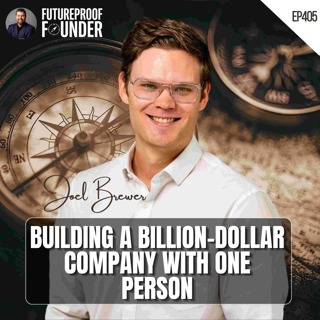
405 | Building a Billion-Dollar Company With One Person | Joel Brewer

405 | Building a Billion-Dollar Company With One Person | Joel Brewer

Joel Brewer, founder and CEO of Brewer Digital, joins Jeff Mains on Future Proof Founder to cut through the AI hype and get practical about what it actually means to build software in 2025. Joel brings a developer's perspective to a conversation that's usually dominated by non-technical voices — and the result is a grounded, honest look at how early-stage SaaS founders can work with engineering teams, avoid costly mistakes, and use AI as a tool rather than a crutch.

From rescuing failed offshore builds to helping non-technical founders navigate Claude Code, Joel shares what he's learned from 13 years in the startup trenches. The conversation covers sandbox environments, the evolving definition of a senior engineer, the difference between bootstrapped and VC-backed engineering cultures, and why clear goals — not shiny tools — are still the most valuable thing in any founder's arsenal.

Key Takeaways

3:46 — Joel shares how getting fired launched his 13-year journey building Brewer Digital from freelance Rails work to a full software development agency for early-stage founders.

6:59 — Goals before tools. Joel's antidote to AI-driven chaos: go back to basics. Know where you're headed before you pick up a tool. AI accelerates whatever you point it at — including anxiety.

11:36 — The sandbox lesson. Real-world story: a client went rogue with Claude Code and made changes directly to a production database, thinking they were just experimenting. Sandboxes exist for a reason.

14:15 — The new definition of a senior engineer. From Google I/O: senior engineers used to be defined by what they could build that others couldn't. Now, they're defined by what they understand that others don't — especially critical as AI writes more code.

15:17 — The construction metaphor. AI doesn't eliminate the need for engineers — it expands what's possible to build. We went from huts to skyscrapers with better tools. The same shift is happening in software.

19:36 — Communication breaks before code does. When Joel steps into a failed project, the first red flag he looks for isn't the codebase — it's whether communication between founders and engineers has broken down.

21:08 — Optimize for the right thing. Feedback loops are powerful — but only if you've already defined what you're optimizing for. Shipping features faster means nothing if the features aren't moving the needle.

24:21 — The Southwest Airlines principle. Joel shares a CEO quote about the real goal of flying a plane — not the technical operation, but getting someone home for Christmas. The same applies to product teams: the feature is never the goal.

25:52 — Bootstrapped vs. VC-backed engineering cultures. Bootstrappers tend toward capital efficiency and caution. VC-backed companies optimize for velocity and growth at scale. Different goals, different cultures — both valid depending on the mission.

30:21 — What gets lost when AI replaces people. When you replace humans with agents, you lose humanity and irreplaceable individual creativity. Joel argues that sitting with a notebook for 15 minutes can still outperform an hour with AI for generating genuinely inspired thinking.

33:36 — Advice for non-technical founders hiring developers. Know your goals for the product before the first engineering conversation. Engineers love solving problems — if you don't guide them with clear goals, they'll solve the wrong one brilliantly.

35:03 — The future of founder-engineering relationships. AI removes code-writing as the bottleneck. The new bottleneck is communication — rapid testing, alignment, and iteration between product, founder, and engineering.

38:24 — Complexity kills growth. AI tools are excellent at adding complexity. Founders who learn to fight that tendency — preferring simplicity and brevity — will have a structural advantage.

Tweetable Quotes"AI becomes a tool when you know where you're headed. If you don't know your destination, AI just helps you get lost faster." — Joel Brewer"A senior engineer used to be someone who could build what others couldn't. Now, they're someone who understands what others don't." — Joel Brewer"The sandbox isn't optional. You can ask Claude to change your production database, and it will. Enthusiastically." — Joel Brewer"Complexity kills growth. AI is really good at adding complexity. That's a problem worth solving on purpose." — Joel Brewer"I sat down with a notebook for 15 minutes and had more genuinely inspired ideas than an hour with AI. People can still think. That's not nothing." — Joel Brewer"If your imagination is unlimited, AI doesn't replace you — it just lets you build the skyscraper instead of the hut." — Joel Brewer"We're not very good at predicting the future. And when there's a lot of money involved in selling a specific version of it, that's worth keeping in mind." — Joel BrewerSaaS Leadership Lessons

1. Start with goals, not tools. The most expensive AI mistakes happen when founders adopt a tool and then search for a use case. Reverse the order: define what you're trying to accomplish, then evaluate whether AI actually serves that goal. Tool-first thinking creates fast, sophisticated chaos.

2. Build a sandbox culture — literally and figuratively. Non-technical founders experimenting with AI-assisted development tools need guardrails. In software, that means sandboxed environments separated from production. In leadership, it means creating space for experimentation that doesn't put the business at risk. Permission to explore is only valuable when the blast radius is contained.

3. The new competitive edge is understanding, not output. As AI commoditizes the ability to generate code, copy, and content, the strategic advantage shifts to comprehension — people who understand why something works, what the architecture actually does, and when not to build something at all. Leaders who can explain the machine are worth more than leaders who can only operate it.

4. Communication is the bottleneck AI just uncovered. Before AI, writing code was slow enough that communication gaps could hide. Now that code can be written in hours, the limiting factor is alignment — between founders and engineers, product and market, vision and execution. Founders who invest in communication infrastructure will outpace those who just invest in faster tools.

5. Tie every feature to a business outcome — before the first line of code. Engineers are problem-solvers. They will build what you put in front of them. If the problem you hand them isn't connected to a business goal, they'll build the wrong thing exceptionally well. Make the goal explicit, measurable, and understood by the whole team before any work begins.

6. The human element isn't a liability — protect it. When every company is using similar AI stacks, the differentiator becomes the people. Human creativity — particularly the kind that emerges from unstructured thinking time — is increasingly rare and undervalued. The best leaders will use AI to create more space for deep thinking, not less.

Guest Resources

joel@brewerdigital.com

www.brewerdigital.com

https://www.linkedin.com/in/joel-brewer-69680037/

Episode Sponsor

The Futureproof Series - https://www.youtube.com/playlist?list=PLfkXKUPZ5xuOqMPR7_gzGybncTtavyR1N

The Captain's Keys

Small Fish, Big Pond – https://smallfishbigpond.com/ Use the promo code ‘SaaSFuel’

Champion Leadership Group – https://championleadership.com/

https://jeffmains.com/books/

SaaS Fuel Resources

Website - https://championleadership.com/

Jeff Mains on LinkedIn - https://www.linkedin.com/in/jeffkmains/

Twitter - https://twitter.com/jeffkmains

Facebook - https://www.facebook.com/thesaasguy/

Instagram - https://instagram.com/jeffkmains

Denne episoden er hentet fra en åpen RSS-feed og er ikke publisert av Podme. Den kan derfor inneholde annonser.

Episoder(433)

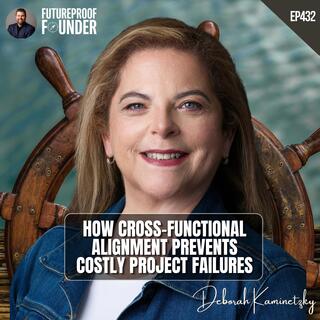
432 | How Cross-Functional Alignment Prevents Costly Project Failures | Deborah Kaminetzky

432 | How Cross-Functional Alignment Prevents Costly Project Failures | Deborah Kaminetzky

A software implementation can be delivered on time and on budget, then fail the moment people refuse to use it.In this episode, Jeff Mains talks with Deborah Kaminetzky, founder of De Facto Project Ma...

15 Okt 47min

431 | The Hidden Work Behind Cross-Border Supply Chains | Daman Grewal

431 | The Hidden Work Behind Cross-Border Supply Chains | Daman Grewal

Daman Grewal grew a logistics company from $1 million to $24 million in four years, working across dispatch, safety, accounts receivable, and sales before he fully recognized the skills he was buildin...

13 Okt 53min
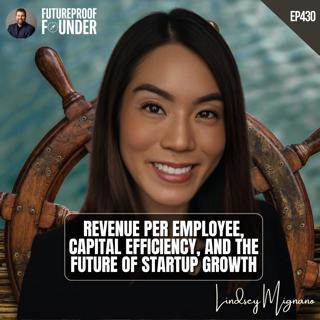
430 | Revenue Per Employee, Capital Efficiency, and the Future of Startup Growth | Lindsey Mignano

430 | Revenue Per Employee, Capital Efficiency, and the Future of Startup Growth | Lindsey Mignano

Are you raising venture capital because your business needs it—or because getting funded feels like proof you’ve made it?In this episode of Futureproof Founder, Jeff Mains sits down with Lindsey Migna...

8 Okt 54min
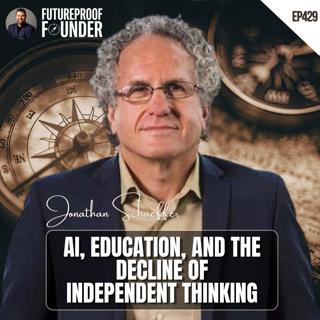
429 | AI, Education, and the Decline of Independent Thinking | Jonathan Schaeffer

429 | AI, Education, and the Decline of Independent Thinking | Jonathan Schaeffer

Are you using AI to make better decisions—or letting a confident answer do your thinking for you?In this episode of Futureproof Founder, Jeff Mains sits down with AI researcher and entrepreneur Jonath...

6 Okt 57min

428 | Intellectual Property for Founders: Trademarks, Patents, Copyright, and Trade Secrets | James Gourley

428 | Intellectual Property for Founders: Trademarks, Patents, Copyright, and Trade Secrets | James Gourley

Jeff Mains sits down with James Gourley, a patent attorney and IP litigator who has spent 20 years on both sides of intellectual property disputes — from filing patents and trademarks to defending com...

1 Okt 42min
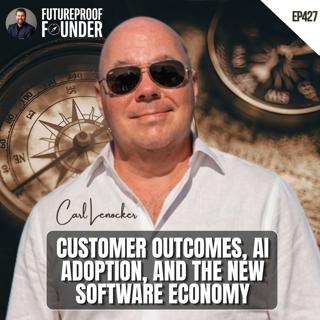
427 | Customer Outcomes, AI Adoption, and the New Software Economy | Carl Lenocker

427 | Customer Outcomes, AI Adoption, and the New Software Economy | Carl Lenocker

Jeff Mains sits down with Carl Lenocker, a 30-year enterprise software veteran who started in Silicon Valley in the '80s, survived the dot-com bust, and now consults founders on what actually creates ...

29 Sep 45min
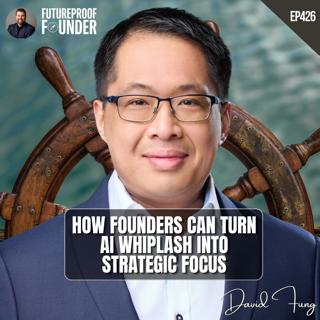
426 | How Founders Can Turn AI Whiplash Into Strategic Focus | David Fung

426 | How Founders Can Turn AI Whiplash Into Strategic Focus | David Fung

David Fung spent 15 years at Salesforce as a Senior Director before walking away from unvested RSUs to launch Coachful Coaching. He now coaches CTOs and tech leaders on the pattern he calls "AI whipla...

24 Sep 46min

425 | Product-Market Fit Starts with Understanding the User | Erin Rollenhagen

425 | Product-Market Fit Starts with Understanding the User | Erin Rollenhagen

Erin Rollenhagen learned the most expensive lesson in product development the hard way: she spent years building software without ever talking to a single end user—and people took early retirement to ...

22 Sep 46min

Populært innen Business og økonomi

stopp-verden
dine-penger-pengeradet
e24-podden
rss-penger-polser-og-politikk
rss-borsmorgen-okonominyhetene
rss-skravla-gar
rss-pa-konto
pengepodden-2
livet-pa-veien-med-jan-erik-larssen
tid-er-penger-en-podcast-med-peter-warren
utbytte
lederpodden
finansredaksjonen
stormkast-med-valebrokk-stordalen
rss-markedspuls-2
morgenkaffen-med-finansavisen
pengesnakk
rss-orjasater
okonomiamatorene
liberal-halvtime