
Walter Rodney Exposed How America and Europe Looted Africa. Then He Was Murdered by a Car Bomb.

Walter Rodney Exposed How America and Europe Looted Africa. Then He Was Murdered by a Car Bomb.

"The question as to who and what is responsible for African underdevelopment can be answered at two levels. First, the operation of the imperialist system bears major responsibility for African economic retardation."
— Walter Rodney, How Europe Underdeveloped Africa (1972)

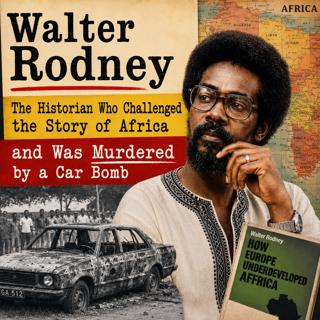
Walter Rodney remains one of the most influential and controversial historians of the twentieth century. In this episode, I examine the life of the Guyanese scholar, political activist, and author of How Europe Underdeveloped Africa. I trace Rodney's research, his views on colonialism, African history, economic development, and the political movements that shaped his career. I also follow his journey through Jamaica, Tanzania, and Guyana, where his ideas inspired supporters while drawing intense opposition.

I also examine the events leading to Walter Rodney's death in 1980, one of the most debated political assassinations in Caribbean history. The episode looks at the official investigations, later commissions of inquiry, the role of the Guyanese government, and the evidence that has emerged over the decades. Rather than relying on rumor, I compare documented historical records, witness testimony, and competing interpretations surrounding Rodney's death. The case raises difficult questions about the actions of the Guyanese – and by extension, the British and American – governments during the Cold War era. It was not until 2021 that the Government of Guyana formally apologized and accepted the findings of the Commission of Inquiry, which concluded that the state had orchestrated Walter Rodney's assassination.

If you are interested in African history, Cold War politics, decolonization, political violence, Guyana, the Caribbean, or revolutionary movements, this episode provides a chronological overview of Walter Rodney's life, scholarship, activism, and lasting influence. It also places Rodney within the broader political conflicts of the 1960s and 1970s, helping explain why his work continues to be studied, debated, and discussed around the world.

Music: [Sittin' on] The Dock of the Bay [2020 Remaster]

Ebola HOAX:

The Great Ebola Hoax

Why is Ebola infecting people at 'unprecedented speed' in DR Congo and can it be stopped? | DW News

2014: "Ebola Pandemic Smells Like a Hoax" - henrymakow.com

How Europe Underdeveloped Africa. Walter Rodney 1973

Walter Rodney - Wikipedia

How Europe Underdeveloped Africa - Wikipedia

Walter Rodney's Radical Legacy - Boston Review

About Dr. Walter Rodney — The Walter Rodney Foundation

The Walter Rodney Murder Mystery in Guyana 40 Years Later | National Security Archive

Who was Walter Rodney? | MELA

A Rebel's Guide to Walter Rodney | ROAPE

'My husband was assassinated for his activism': Patricia Rodney on injustice and doing more

How hormones work to flip sexes: Hormones

Do you have a psychopath in your life? The best way to find out is read my book. BOOK *FREE* Download – Psychopath In Your Life4

Support is Appreciated: Support the Show – Psychopath In Your Life

Download Pods here: TOP PODS – Psychopath In Your Life

My old discussion forum with last 10 years of victim stories, is back online. Psychopath Victim Support Community | Forums powered by UBB.threads™

Google Maps My HOME Address: 309 E. Klug Avenue, Norfolk, NE 68701 SMART Meters & Timelines – Psychopath In Your Life

Political Car Bombing Timeline

1920

September 16 – Wall Street bombing

  • Horse-drawn wagon filled with explosives detonates outside the J.P. Morgan building.
  • 38 killed.
  • One of the earliest major vehicle bombings in modern history (not an automobile).

1942

Reinhard Heydrich

  • Killed after an attack using a grenade against his moving car in Prague.
  • Not technically a car bomb, but one of history's most famous attacks on a vehicle.

1948

Folke Bernadotte

  • Assassinated when his UN convoy was ambushed in Jerusalem.
  • Vehicle attack rather than a car bomb.

1956

  • Khalil al-Wazir and others begin using vehicle bombs in regional conflicts.
  • Car bombs become more common in the Middle East.

1962

Wolfgang Diewerge

  • Survives an attempted car bombing.

1963

First widespread use of car bombs during conflicts in Cyprus.

Late 1960s

The Irish Republican Army increasingly adopts vehicle bombs.

  • Marks the beginning of the modern era of car bomb terrorism.

1972

"Bloody Friday," Belfast.

  • Twenty-two IRA bombs explode across the city, many placed in vehicles.

1973

Luis Carrero Blanco

  • Assassinated in Madrid.
  • A massive bomb beneath the street launched his official car over a building.
  • One of history's most famous vehicle assassinations.

1976

Orlando Letelier

  • Car bomb in Washington, D.C.
  • Assassinated along with Ronni Moffitt.
  • One of the most notorious Cold War assassinations on U.S. soil.

1979

Lord Louis Mountbatten

  • Killed when the IRA bombed his fishing boat.
  • Not a car bombing but often discussed alongside IRA bombing campaigns.

1980

Walter Rodney

  • Killed in Georgetown, Guyana.
  • A bomb concealed inside what appeared to be a communications device exploded in a car.
  • A later Commission of Inquiry concluded he was assassinated and implicated state actors.

1981

Bechir Gemayel

  • Building bomb killed him before taking office.

1982

Large vehicle bombs become common during the Lebanese Civil War.

1983

U.S. Embassy Beirut

  • Truck bomb kills 63.

1983

Beirut Marine Barracks bombing.

  • Truck bomb kills 241 U.S. service members.

1986

Basil Paterson

  • Continued IRA vehicle bombing campaign.

1989

Alfred Herrhausen

  • Sophisticated roadside bomb destroys his armored Mercedes.
  • Attributed to the Red Army Faction.

1992

Giovanni Falcone

  • Massive roadside bomb under highway kills Falcone, his wife, and security team.

1992

Paolo Borsellino

  • Car bomb in Palermo kills Borsellino and five police officers.

1995

Alfred P. Murrah Federal Building

  • Truck bomb kills 168.
  • Deadliest act of domestic terrorism in U.S. history.

1996

Khobar Towers

  • Truck bomb kills 19 U.S. personnel.

2005

Rafik Hariri

  • Massive truck bomb in Beirut.
  • One of the largest political assassinations of the 21st century.

2017

Daphne Caruana Galizia

  • Killed by a bomb placed beneath her car after years of investigating corruption.
  • Her assassination prompted major political upheaval in Malta.
Walter Rodney

His most famous work is:

  • How Europe Underdeveloped Africa

In that book, Rodney argued that Africa's poverty could not be understood simply as an internal African problem. He argued that centuries of slavery, colonial extraction, and unequal economic relationships played a major role in shaping modern Africa.

Rodney was:

  • A historian.
  • A university professor.
  • A political organizer.
  • A public intellectual.

He became influential across Africa and the Caribbean.

In 1980, he was killed in Guyana when a bomb exploded in his car. His death remains one of the most controversial political assassinations in Caribbean history.

In that sense, you could argue that many people know pieces of what Rodney wrote about Africa, but far fewer know Walter Rodney himself. His work remains influential, especially among historians of colonialism and African development, but he is nowhere near as widely known in the general public as figures such as Nelson Mandela or Martin Luther King Jr..

His most famous book, How Europe Underdeveloped Africa, became enormously influential academically and politically, especially in Africa, the Caribbean, and universities

In How Europe Underdeveloped Africa, Rodney argued that the wealth of many European states and institutions was deeply connected to centuries of extraction from Africa. Whether one agrees with all of his conclusions or not, that argument directly challenged comfortable stories about economic development, empire, and global wealth.

People whose careers, politics, or worldviews were invested in those traditional narratives often disagreed with him strongly.

Rodney was trying to explain:

  • Colonialism
  • Trade systems
  • Banking
  • Resource extraction
  • Labor systems
  • Political power

over hundreds of years and across continents.

That's much harder to turn into a popular narrative.

As for Rodney's death, it is historically true that he was killed in a car-bomb explosion in Guyana in 1980. The circumstances have been investigated and debated for decades, and many people believe his political activities played a role in why he became a target.

Rodney had made powerful enemies in Guyana's political establishment. What we cannot prove is that every institution or financial interest criticized in his writings was involved in his death.

Rodney was asking questions that some people interpreted as having implications for present-day power, wealth, international relationships, and economic structures.

Whether one agrees with Rodney's analysis or not, those kinds of questions often generate more controversy because they are not just about the past—they are also about how people understand the present.

That's one reason scholars still argue about Rodney's work more than fifty years after he wrote it. The debate is not only about African history; it's also about how we explain the modern world.

Walter Anthony Rodney was born in 1942 into a working-class family in Georgetown, Guyana. He attended the University College of the West Indies in 1960 and was awarded a first-class honours degree in history in 1963. He earned a PhD in African History in 1966 at the School of Oriental and African Studies in London, England, at the age of 24. What was new in Walter Rodney's time (1960s–1980)

Walter Rodney was not the first person to notice exploitation.
He was among the first to make three moves at once, in plain language, and inside the post-colonial moment.

He flipped the dominant story

Before Rodney, the mainstream explanation for Africa's poverty was:

  • "underdevelopment"
  • "lack of modernization"
  • "tribalism"
  • "bad governance after independence"
Rodney said something far sharper: Africa was not underdeveloped — it was actively underdeveloped.

That framing was new and dangerous because it:

  • Removed blame from Africans
  • Assigned responsibility to Europe + local elites
  • Turned poverty into a crime scene, not a condition

Why this hit differently in his era -The timing mattered

Rodney was speaking:

  • Right after African independence movements (1950s–60s)
  • When former colonial powers were claiming they had "left"
  • While extraction never actually stopped

His argument exposed the lie at the center of post-colonial politics: Independence without economic control is not independence.

That was not widely accepted in the 1960s–70s.

What elites found intolerable

Rodney did three forbidden things simultaneously:

He named collaboration

He didn't just blame Europe.
He named African elites, local rulers, and comprador classes as partners in extraction.

That shattered nationalist myths.

He made it understandable to ordinary people

His book
How Europe Underdeveloped Africa
was readable, teachable, and portable.

He brought it home (Guyana)

Rodney didn't stay in safe abstraction.

He applied the same analysis to:

  • Caribbean elites
  • Post-colonial governments
  • Cold War proxy states

That collapsed the distance between:

  • "Africa over there"
  • and "power here, now"
That's when the danger level changed.

Why it seems obvious now

Today:

  • Resource extraction is openly acknowledged
  • Multinationals admit it in annual reports
  • NGOs and textbooks repeat Rodney's conclusions

But this is retrospective normalization.

In his time:

  • Saying this threatened aid flows
  • Undermined Cold War alignments
  • Challenged both Western and local ruling classes

That's why:

  • He was banned
  • Isolated
  • And ultimately killed in 1980

What Walter Rodney said sounds obvious today only because he paid the price for saying it first, clearly, and where it mattered.

What was new in Walter Rodney's time (1960s–1980)

Walter Rodney was not the first person to notice exploitation.

He was among the first to make three moves at once, in plain language, and inside the post-colonial moment.

He flipped the dominant story

Before Rodney, the mainstream explanation for Africa's poverty was:

  • "underdevelopment"
  • "lack of modernization"
  • "tribalism"
  • "bad governance after independence"

Rodney said something far sharper:

Africa was not underdeveloped — it was actively underdeveloped.

That framing was new and dangerous because it:

  • Removed blame from Africans
  • Assigned responsibility to Europe + local elites
  • Turned poverty into a crime scene, not a condition

Why this hit differently in his era

The timing mattered

Rodney was speaking:

  • Right after African independence movements (1950s–60s)
  • When former colonial powers were claiming they had "left"
  • While extraction never actually stopped

His argument exposed the lie at the center of post-colonial politics:

Independence without economic control is not independence.

That was not widely accepted in the 1960s–70s.

What elites found intolerable

Rodney did three forbidden things simultaneously:

He named collaboration

He didn't just blame Europe.

He named African elites, local rulers, and comprador classes as partners in extraction.

That shattered nationalist myths.

He made it understandable to ordinary people

His book How Europe Underdeveloped Africa

was readable, teachable, and portable. This mattered more than academic brilliance.

He brought it home (Guyana)

Rodney didn't stay in safe abstraction.

He applied the same analysis to:

  • Caribbean elites
  • Post-colonial governments
  • Cold War proxy states

That collapsed the distance between:

  • "Africa over there"
  • and "power here, now"

That's when the danger level changed.

Why it seems obvious now

Today:

  • Resource extraction is openly acknowledged
  • Multinationals admit it in annual reports
  • NGOs and textbooks repeat Rodney's conclusions

But this is retrospective normalization.

In his time:

  • Saying this threatened aid flows
  • Undermined Cold War alignments
  • Challenged both Western and local ruling classes

That's why:

  • He was banned
  • Isolated
  • And ultimately killed in 1980

What Walter Rodney said sounds obvious today only because he paid the price for saying it first, clearly, and where it mattered.

How Europe Underdeveloped Africa is a book written by Walter Rodney, which takes the view that Africa was deliberately exploited and underdeveloped by European colonial regimes. This book was groundbreaking in that it was among the first to bring a new perspective to the question of underdevelopment in Africa. Rodney's analysis went far beyond the heretofore accepted approach in the study of Third World underdevelopment and it was met with heavy criticism.

It is based on the outlined issues sketched above that this book was written. The piece of literature is arranged in chapters from one to six with thought provoking and are stimulating issue at each chapter. A post script as well as a biography of the author is attached at the latter part of the literature. A chapter by chapter method of review have been adopted to do justice to this work for an incisive appreciation.

The conceptualization of the notion of development and underdevelopment took the central stage in the first chapter, as the author attempted a penetrating analysis into the duo concepts in order to demystify their justification of capitalism which myopically conceives economic development with little or no consideration for human social development.

Rodney had determined that the only path to true human development and liberation for the majority of the people of his country was through the transformation of their own lives in a struggle to replace and reshape the neo-colonialist government that dominated their society and prescribed their existence.

From the view point of Walter Rodney, and from the way he has been able to approach the cause of underdeveloped Africa today, it is clear that he is a Marxist, because he supports the opinion that Africa became underdeveloped due to the contact of Africa and Europe through the aid of colonialism.

This book is not without criticisms despite its wide range coverage. The author was not ignorant of certain positive features of colonialism rather he opined that they were grossly inconsequential when placed side by side it negative effects. In a much as this is contentious, critics have argued that the author was propelled by a value considered as being extreme in its bias in favour of the periphery. Critiques have further argued that contemporary African territories have come of age after years of independence, it is absurd to hinge underdevelopment issues on the mythology of imperialism and colonialism as underdevelopment and development are both states of mind".

Walter Rodney from all indications can be placed as a Marxian because in the book, he supported the Marxian perspective of why Africa is underdeveloped, he stressed the fact that it is due to European contact which is very exploitative in nature that has left Africa underdeveloped today.

Works by Walter Rodney Books and Major Historical Works

Rodney, Walter. West Africa and the Atlantic Slave Trade. Nairobi: East African Publishing House and the Historical Association of Tanzania, 1967.

Rodney, Walter. The Groundings with My Brothers. London: Bogle-L'Ouverture Publications, 1969.

Rodney, Walter. A History of the Upper Guinea Coast, 1545–1800. Oxford: Clarendon Press, 1970.

Rodney, Walter. How Europe Underdeveloped Africa. London: Bogle-L'Ouverture Publications; Dar es Salaam: Tanzania Publishing House, 1972.

Rodney, Walter. World War II and the Tanzanian Economy. Ithaca, New York: Africana Studies and Research Center, Cornell University, 1976.

Rodney, Walter, editor. Guyanese Sugar Plantations in the Late Nineteenth Century: A Contemporary Description from the Argosy. Georgetown, Guyana: Release Publishers, 1979.

Rodney, Walter. A History of the Guyanese Working People, 1881–1905. London: Heinemann Educational Books; Baltimore: Johns Hopkins University Press, 1981.

Rodney, Walter, Kapepwa Tambila, and Laurent Sago. Migrant Labour in Tanzania During the Colonial Period. Hamburg: Institute for African Studies, 1983.

Political Works, Speeches, and Pamphlets

Rodney, Walter. People's Power, No Dictator. Georgetown, Guyana: Working People's Alliance, 1979.

Rodney, Walter. Marx in the Liberation of Africa. Washington, D.C.: Howard University Press, 1981.

Rodney, Walter. Sign of the Times: Rodney's Last Speech, June 6, 1980. Georgetown, Guyana: Working People's Alliance, 1981.

Rodney, Walter. "The African Revolution." Lecture delivered at the University of Michigan, March 31, 1972. Published in Urgent Tasks, no. 12, 1981.

Rodney, Walter. "Marxism and African Liberation." Speech delivered at Queens College, New York, 1975. Later published in Yes to Marxism! Georgetown, Guyana: People's Progressive Party, 1986.

Rodney, Walter. "Aspects of the International Class Struggle in Africa, the Caribbean and America." In Pan-Africanism: Struggle Against Neo-Colonialism and Imperialism, edited by Horace Campbell. Toronto: Afro-Carib Publications, 1975.

Rodney, Walter. "African History in the Service of the Black Liberation." Lecture delivered at the Congress of Black Writers, Montreal, October 12, 1968.

Rodney, Walter. "The Role of the University in Developing Africa." Public lecture delivered to the Makerere Students' Guild, Makerere University, Uganda, October 1970.

Academic Articles and Essays

Rodney, Walter. "Portuguese Attempts at Monopoly on the Upper Guinea Coast." Journal of African History 6, no. 3 (1965): 307–322.

Rodney, Walter. "African Slavery and Other Forms of Social Oppression on the Upper Guinea Coast, 1580–1650." Journal of African History 7, no. 3 (1966): 431–443.

Rodney, Walter. "Masses in Action." New World Quarterly 2, no. 3 (1966): 30–37.

Rodney, Walter. "The Impact of the Atlantic Slave Trade in West Africa." In The Middle Age of African History, edited by Roland Oliver. Oxford: Oxford University Press, 1967.

Rodney, Walter. "Education and Tanzanian Socialism." In Tanzania: Revolution by Education, edited by Idrian Resnick. Arusha: Longmans of Tanzania, 1968.

Rodney, Walter. "European Activity and African Reaction in Angola." In Aspects of Central African History, edited by Terence Ranger. Evanston, Illinois: Northwestern University Press, 1968.

Rodney, Walter. "African Labour Under Capitalism and Imperialism." Cheche, no. 1, University of Dar es Salaam, November 1969: 4–12.

Rodney, Walter. "Ideology of the African Revolution." Paper presented at the Second Seminar of East and Central African Youth. Published in The Nationalist, Dar es Salaam, December 11, 1969.

Rodney, Walter. "Gold and Slaves on the Gold Coast." Transactions of the Historical Society of Ghana 10 (1969).

Rodney, Walter. "The Imperialist Partition of Africa." Monthly Review 21, no. 11 (April 1970): 103–114.

Rodney, Walter. "The Year 1895 in Southern Mozambique: African Resistance to the Imposition of European Colonial Rule." Journal of the Historical Society of Nigeria 5, no. 4 (1971): 509–535.

Rodney, Walter. "George Jackson: Black Revolutionary." Maji Maji, no. 5 (1971): 4–6.

Rodney, Walter. "Some Implications of the Question of Disengagement from Imperialism." Maji Maji 1 (January 1971): 3–8.

Rodney, Walter. "Tanzanian Ujamaa and Scientific Socialism." African Review 1, no. 4 (1972): 61–76.

Rodney, Walter. "State Formation and Class Formation in Tanzania." Maji Maji, no. 11 (1973): 25–32.

Rodney, Walter. "Some Implications of the Question of Disengagement from Imperialism." In The Silent Class Struggle, edited by Issa G. Shivji. Dar es Salaam: Tanzania Publishing House, 1974.

Rodney, Walter. "The Guinea Coast." In The Cambridge History of Africa, Volume 4: From c. 1600 to c. 1790, edited by Richard Gray. Cambridge: Cambridge University Press, 1975.

Rodney, Walter. "Africa in Europe and the Americas." In The Cambridge History of Africa, Volume 4: From c. 1600 to c. 1790, edited by Richard Gray. Cambridge: Cambridge University Press, 1975.

Rodney, Walter. "Slavery and Underdevelopment." In Roots and Branches: Current Directions in Slave Studies, edited by Michael Craton. New York: Pergamon Press, 1979.

Rodney, Walter. "Class Contradictions in Tanzania." In The State in Tanzania: Who Controls It and Whose Interests Does It Serve?, edited by Haroub Othman. Dar es Salaam: Dar es Salaam University Press, 1980.

Rodney, Walter. "The Political Economy of Colonial Tanganyika, 1890–1930." In Tanzania Under Colonial Rule, edited by M. H. Y. Kaniki. London: Longman, 1980.

Rodney, Walter. "The Colonial Economy." In General History of Africa, Volume VII: Africa Under Colonial Domination, 1880–1935, edited by A. Adu Boahen. Paris: UNESCO; London: Heinemann, 1985.

Books Written for Children

Rodney, Walter. Kofi Baadu Out of Africa. Georgetown, Guyana: Guyana National Lithographic Company, 1980.

Rodney, Walter. Lakshmi Out of India. Georgetown, Guyana: Guyana Book Foundation, 2000.

Rodney wrote these stories to help young people understand the African and Indian experiences that helped create Guyanese society.

Posthumously Published Lectures, Interviews, and Collections

Rodney, Walter. Walter Rodney Speaks: The Making of an African Intellectual. Edited by Robert A. Hill, with a foreword by Howard Dodson. Trenton, New Jersey: Africa World Press, 1990.

Rodney, Walter. A Tribute to Walter Rodney: One Hundred Years of Development in Africa. Based on lectures delivered at the University of Hamburg during the summer of 1978. Hamburg: University of Hamburg, Institute of Political Science, 1984.

Rodney, Walter. The Russian Revolution: A View from the Third World. Edited by Robin D. G. Kelley and Jesse Benjamin. London and New York: Verso, 2018.

Rodney, Walter. Decolonial Marxism: Essays from the Pan-African Revolution. Edited by Asha Rodney, Patricia Rodney, Benjamin Mabie, and Jesse Benjamin. London and New York: Verso, 2022.

Walter Rodney Papers and Archival Material

The Walter Rodney Papers are housed at the Archives Research Center of the Robert W. Woodruff Library at the Atlanta University Center. The collection covers approximately 1960 through 1987 and contains published and unpublished speeches, lectures, journal articles, book reviews, chapters, teaching materials, correspondence, research notes, political writings, and drafts of Rodney's books.

The Walter Rodney Foundation also maintains Rodney's papers, publications, historical material, and an expanding bibliography of works written by and about him.

Selected Books and Publications About Walter Rodney (Published After His Death) 1980

And Finally They Killed Him: Speeches and Poems at a Memorial Rally for Walter Rodney, 1942–1980.
Memorial volume from the University of Ife (Nigeria) containing speeches, tributes, and poems delivered shortly after Rodney's assassination.

1982

Walter Rodney: Revolutionary and Scholar—A Tribute.
Edited by Edward A. Alpers and others.
University of California, Los Angeles.
Collection of essays examining Rodney's scholarship, political activism, and historical legacy.

1983

James, C. L. R.
Walter Rodney and the Question of Power.
Race Today Publications.
A political assessment of Rodney's ideas on democracy, socialism, and people's power.

1984

A Tribute to Walter Rodney: One Hundred Years of Development in Africa.
University of Hamburg.
Publishes Rodney's 1978 Hamburg lectures together with scholarly commentary.

1985

Campbell, Horace.
Rasta and Resistance: From Marcus Garvey to Walter Rodney.
Africa World Press.
Examines Rodney's influence within Pan-Africanism and the Rastafari movement.

Dabydeen, David, and Andrew Salkey, editors.
Walter Rodney: Poetic Tributes.
Bogle-L'Ouverture Publications.
Poems and literary tributes honoring Rodney following his assassination.

1990

Grigsby, Daryl Russell.
The C. L. R. James–Walter Rodney Connection.
Study of the intellectual relationship between James and Rodney.

1990

Lewis, Rupert.
Walter Rodney's Intellectual and Political Thought.
One of the earliest book-length studies devoted entirely to Rodney's ideas.

2005

Walter Rodney 25th Anniversary Commemoration Volume.
Published by the Walter Rodney 25th Anniversary Commemoration Committee.
Historical essays, speeches, photographs, and reflections marking twenty-five years since Rodney's assassination.

2014–2015

Report of the Walter Rodney Commission of Inquiry.
Government of Guyana.
More than 1700 pages of testimony, documents, forensic evidence, and findings concerning Rodney's assassination.

2018

Hirji, Karim F.
The Travails of a Tanzanian Teacher.
Includes substantial discussion of Rodney's years at the University of Dar es Salaam and his influence on African scholarship.

2019

Lewis, Rupert.
Walter Rodney's Intellectual and Political Thought (Revised Edition).
Updated edition incorporating newer scholarship on Rodney's work and legacy.

Articles, Journals, and Special Issues

Numerous journals have published special issues dedicated to Rodney, including:

  • Race & Class
  • Review of African Political Economy
  • Small Axe
  • The Journal of African History
  • Social and Economic Studies
  • New West Indian Guide
  • Caribbean Quarterly

These collections examine Rodney's historical methodology, Pan-Africanism, Marxism, political activism, educational philosophy, and continuing influence on African and Caribbean studies.

Archival Resources

The Walter Rodney Papers
Robert W. Woodruff Library
Atlanta University Center

The archive contains the world's largest collection of material by and about Walter Rodney, including correspondence, unpublished manuscripts, speeches, interviews, photographs, newspaper clippings, teaching materials, and thousands of pages of research notes.

Denne episoden er hentet fra en åpen RSS-feed og er ikke publisert av Podme. Den kan derfor inneholde annonser.

Episoder(574)

Is Ivermectin a BioWeapon from Unit 731? Hundreds of Millions of People. 38 Years in Africa. Over 5 billion Treatments. Merck USA's Largest Drug Donation Program.

Is Ivermectin a BioWeapon from Unit 731? Hundreds of Millions of People. 38 Years in Africa. Over 5 billion Treatments. Merck USA's Largest Drug Donation Program.

"Are we allowing the entire world to become a kill box—where governments can identify, track, and strike people anywhere with little public oversight?"  Ivermectin: 38 Years in Africa. Over 5 Billion ...

7 Aug 4h 2min
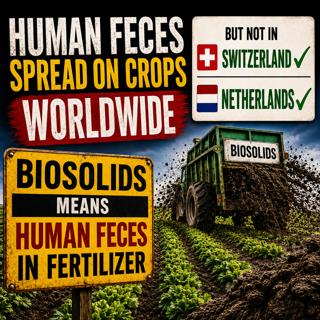
Human Feces Spread on Crops Worldwide. But not in Switzerland or Netherlands. Biosolids Means Human Feces in Fertilizer. Was Cyclospora CREATED in a lab?

Human Feces Spread on Crops Worldwide. But not in Switzerland or Netherlands. Biosolids Means Human Feces in Fertilizer. Was Cyclospora CREATED in a lab?

Why Is Everyone Getting Explosive Diarrhea?  The Answer Isn't What Most People Think. The Story Begins Decades Before Cyclospora—with The United States, Nazi Germany, Sanitation, And the Long History...

2 Aug 4h 52min

A Curious Detail About My LinkedIn Account Hacking

A Curious Detail About My LinkedIn Account Hacking

"Most people follow the story. I look for what the story left behind." Do you have a psychopath in your life? The best way to find out is read my book.  BOOK *FREE* Download – Psychopath In Your Life4...

23 Jul 6min
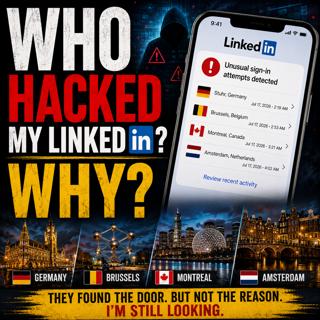
My LinkedIn Account Has Been Hacked by a Gang from Germany Belgium Amsterdam and Montreal WTH

My LinkedIn Account Has Been Hacked by a Gang from Germany Belgium Amsterdam and Montreal WTH

"The further a society drifts from the truth, the more it will hate those who speak it." I don't say this because I want this to happen to anyone else. I hope it doesn't. But at some point, all of us ...

18 Jul 19min
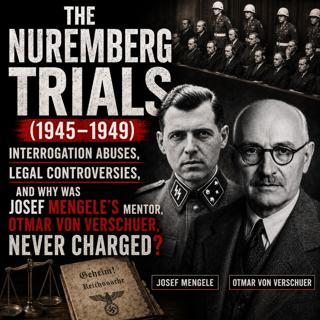
The LIES of The Nuremberg Trial. Many escaped Justice. Why Was Josef Mengele's Mentor Otmar von Verschuer Never Charged.

The LIES of The Nuremberg Trial. Many escaped Justice. Why Was Josef Mengele's Mentor Otmar von Verschuer Never Charged.

"After all, the victor will not be asked whether he told the truth or not." — Adolf Hitler, remarks to German military commanders on August 22, 1939, as quoted from the Nuremberg documentary record by...

11 Jul 3h 56min
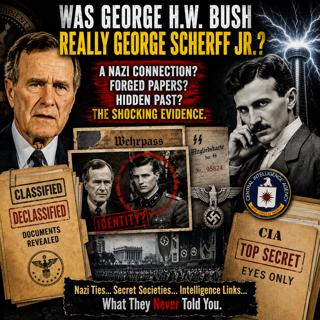
Was George H.W. Bush Really George Scherff Jr., a Nazi Agent? Was Nikola Tesla Murdered by Hitler's Commando, Otto Skorzeny?

Was George H.W. Bush Really George Scherff Jr., a Nazi Agent? Was Nikola Tesla Murdered by Hitler's Commando, Otto Skorzeny?

"The German people lost the war. Did the people who financed it, profit from it, and survived it lose anything at all?" What happens to powerful people, powerful institutions, and powerful ideas when...

5 Jul 6h 29min
Is the Killer inside your home? Iran's Nuclear Program: Forgotten U.S. and Israeli Connection.  Iran has ONE Nuclear Reactor -USA has 94

Is the Killer inside your home? Iran's Nuclear Program: Forgotten U.S. and Israeli Connection. Iran has ONE Nuclear Reactor -USA has 94

"The biggest question isn't what Iran is doing today. It's who helped build the system in the first place." What happens when we stop looking at history as a series of isolated events and start follow...

21 Jun 4h 46min

Populært innen Fakta

fastlegen
dine-penger-pengeradet
relasjonspodden-med-dora-thorhallsdottir-kjersti-idem
foreldreradet
jakt-og-fiskepodden
treningspodden
mikkels-paskenotter
rss-strid-de-norske-borgerkrigene
rss-kunsten-a-leve
rss-orjasater
tomprat-med-gunnar-tjomlid
hverdagspsyken
fryktlos
rss-var-forste-kaffe
sinnsyn
gravid-uke-for-uke
dopet
kvallm
hagespiren-podcast
diagnose