#4 - Howie Lempel on pandemics that kill hundreds of millions and how to stop them

#4 - Howie Lempel on pandemics that kill hundreds of millions and how to stop them

What disaster is most likely to kill more than 10 million human beings in the next 20 years? Terrorism? Famine? An asteroid?

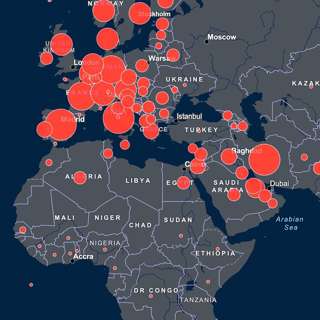
Actually it’s probably a pandemic: a deadly new disease that spreads out of control. We’ve recently seen the risks with Ebola and swine flu, but they pale in comparison to the Spanish flu which killed 3% of the world’s population in 1918 to 1920. A pandemic of that scale today would kill 200 million.

In this in-depth interview I speak to Howie Lempel, who spent years studying pandemic preparedness for the Open Philanthropy Project. We spend the first 20 minutes covering his work at the foundation, then discuss how bad the pandemic problem is, why it’s probably getting worse, and what can be done about it.

Full transcript, apply for personalised coaching to help you work on pandemic preparedness, see what questions are asked when, and read extra resources to learn more.

In the second half we go through where you personally could study and work to tackle one of the worst threats facing humanity.

Want to help ensure we have no severe pandemics in the 21st century? We want to help.

We’ve helped dozens of people formulate their plans, and put them in touch with academic mentors. If you want to work on pandemic preparedness safety, apply for our free coaching service.

APPLY FOR COACHING

2m - What does the Open Philanthropy Project do? What’s it like to work there?
16m27s - What grants did OpenPhil make in pandemic preparedness? Did they work out?
22m56s - Why is pandemic preparedness such an important thing to work on?
31m23s - How many people could die in a global pandemic? Is Contagion a realistic movie?
37m05s - Why the risk is getting worse due to scientific discoveries
40m10s - How would dangerous pathogens get released?
45m27s - Would society collapse if a billion people die in a pandemic?
49m25s - The plague, Spanish flu, smallpox, and other historical pandemics
58m30s - How are risks affected by sloppy research security or the existence of factory farming?
1h7m30s - What's already being done? Why institutions for dealing with pandemics are really insufficient.
1h14m30s - What the World Health Organisation should do but can’t.
1h21m51s - What charities do about pandemics and why they aren’t able to fix things
1h25m50s - How long would it take to make vaccines?
1h30m40s - What does the US government do to protect Americans? It’s a mess.
1h37m20s - What kind of people do you know work on this problem and what are they doing?
1h46m30s - Are there things that we ought to be banning or technologies that we should be trying not to develop because we're just better off not having them?
1h49m35s - What kind of reforms are needed at the international level?
1h54m40s - Where should people who want to tackle this problem go to work?
1h59m50s - Are there any technologies we need to urgently develop?
2h04m20s - What about trying to stop humans from having contact with wild animals?
2h08m5s - What should people study if they're young and choosing their major; what should they do a PhD in? Where should they study, and with who?
More...

Episoder(320)

#66 – Peter Singer on being provocative, effective altruism, & how his moral views have changed

#66 – Peter Singer on being provocative, effective altruism, & how his moral views have changed

In 1989, the professor of moral philosophy Peter Singer was all over the news for his inflammatory opinions about abortion. But the controversy stemmed from Practical Ethics — a book he’d actually rel...

5 Des 20192h 1min

#65 – Ambassador Bonnie Jenkins on 8 years pursuing WMD arms control, & diversity in diplomacy

#65 – Ambassador Bonnie Jenkins on 8 years pursuing WMD arms control, & diversity in diplomacy

"…it started when the Soviet Union fell apart and there was a real desire to ensure security of nuclear materials and pathogens, and that scientists with [WMD-related] knowledge could get paid so that...

19 Nov 20191h 40min

#64 – Bruce Schneier on how insecure electronic voting could break the United States — and surveillance without tyranny

#64 – Bruce Schneier on how insecure electronic voting could break the United States — and surveillance without tyranny

November 3 2020, 10:32PM: CNN, NBC, and FOX report that Donald Trump has narrowly won Florida, and with it, re-election.  November 3 2020, 11:46PM: The NY Times and Wall Street Journal report that so...

25 Okt 20192h 11min

Rob Wiblin on plastic straws, nicotine, doping, & whether changing the long-term is really possible

Rob Wiblin on plastic straws, nicotine, doping, & whether changing the long-term is really possible

Today's episode is a compilation of interviews I recently recorded for two other shows, Love Your Work and The Neoliberal Podcast.  If you've listened to absolutely everything on this podcast feed, y...

25 Sep 20193h 14min

Have we helped you have a bigger social impact? Our annual survey, plus other ways we can help you.

Have we helped you have a bigger social impact? Our annual survey, plus other ways we can help you.

1. Fill out our annual impact survey here. 2. Find a great vacancy on our job board. 3. Learn about our key ideas, and get links to our top articles. 4. Join our newsletter for an email about what's n...

16 Sep 20193min

#63 – Vitalik Buterin on better ways to fund public goods, blockchain's failures, & effective giving

#63 – Vitalik Buterin on better ways to fund public goods, blockchain's failures, & effective giving

Historically, progress in the field of cryptography has had major consequences. It has changed the course of major wars, made it possible to do business on the internet, and enabled private communicat...

3 Sep 20193h 18min

#62 – Paul Christiano on messaging the future, increasing compute, & how CO2 impacts your brain

#62 – Paul Christiano on messaging the future, increasing compute, & how CO2 impacts your brain

Imagine that – one day – humanity dies out. At some point, many millions of years later, intelligent life might well evolve again. Is there any message we could leave that would reliably help them out...

5 Aug 20192h 11min

#61 - Helen Toner on emerging technology, national security, and China

#61 - Helen Toner on emerging technology, national security, and China

From 1870 to 1950, the introduction of electricity transformed life in the US and UK, as people gained access to lighting, radio and a wide range of household appliances for the first time. Electricit...

17 Jul 20191h 54min

Populært innen Fakta

fastlegen
dine-penger-pengeradet
relasjonspodden-med-dora-thorhallsdottir-kjersti-idem
treningspodden
rss-strid-de-norske-borgerkrigene
foreldreradet
jakt-og-fiskepodden
rss-sunn-okonomi
merry-quizmas
gravid-uke-for-uke
fryktlos
sinnsyn
hverdagspsyken
rss-mann-i-krise-med-sagen
smart-forklart
generasjonspodden
rss-kunsten-a-leve
dopet
sovnlos
hr-podden-2