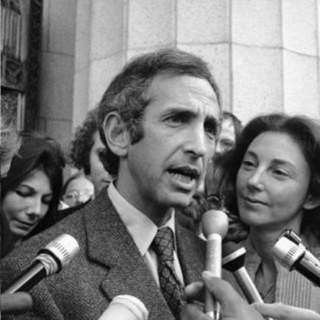

#43 - Daniel Ellsberg on the institutional insanity that maintains nuclear doomsday machines

#43 - Daniel Ellsberg on the institutional insanity that maintains nuclear doomsday machines

In Stanley Kubrick’s iconic film Dr. Strangelove, the American president is informed that the Soviet Union has created a secret deterrence system which will automatically wipe out humanity upon detection of a single nuclear explosion in Russia. With US bombs heading towards the USSR and unable to be recalled, Dr Strangelove points out that “the whole point of this Doomsday Machine is lost if you keep it a secret – why didn’t you tell the world, eh?” The Soviet ambassador replies that it was to be announced at the Party Congress the following Monday: “The Premier loves surprises”.

Daniel Ellsberg - leaker of the Pentagon Papers which helped end the Vietnam War and Nixon presidency - claims in his new book The Doomsday Machine: Confessions of a Nuclear War Planner that Dr. Strangelove might as well be a documentary. After attending the film in Washington DC in 1964, he and a colleague wondered how so many details of their nuclear planning had leaked.

Links to learn more, summary and full transcript.

The USSR did in fact develop a doomsday machine, Dead Hand, which probably remains active today.

If the system can’t contact military leaders, it checks for signs of a nuclear strike, and if it detects them, automatically launches all remaining Soviet weapons at targets across the northern hemisphere.

As in the film, the Soviet Union long kept Dead Hand completely secret, eliminating any strategic benefit, and rendering it a pointless menace to humanity.

You might think the United States would have a more sensible nuclear launch policy. You’d be wrong.

As Ellsberg explains, based on first-hand experience as a nuclear war planner in the 50s, that the notion that only the president is able to authorize the use of US nuclear weapons is a carefully cultivated myth.

The authority to launch nuclear weapons is delegated alarmingly far down the chain of command – significantly raising the chance that a lone wolf or communication breakdown could trigger a nuclear catastrophe.

The whole justification for this is to defend against a ‘decapitating attack’, where a first strike on Washington disables the ability of the US hierarchy to retaliate. In a moment of crisis, the Russians might view this as their best hope of survival.

Ostensibly, this delegation removes Russia’s temptation to attempt a decapitating attack – the US can retaliate even if its leadership is destroyed. This strategy only works, though, if the tell the enemy you’ve done it.

Instead, since the 50s this delegation has been one of the United States most closely guarded secrets, eliminating its strategic benefit, and rendering it another pointless menace to humanity.

Strategically, the setup is stupid. Ethically, it is monstrous.

So – how was such a system built? Why does it remain to this day? And how might we shrink our nuclear arsenals to the point they don’t risk the destruction of civilization?

Daniel explores these questions eloquently and urgently in his book. Today we cover:

* Why full disarmament today would be a mistake and the optimal number of nuclear weapons to hold
* How well are secrets kept in the government?
* What was the risk of the first atomic bomb test?
* The effect of Trump on nuclear security
* Do we have a reliable estimate of the magnitude of a ‘nuclear winter’?
* Why Gorbachev allowed Russia’s covert biological warfare program to continue

Get this episode by subscribing: type 80,000 Hours into your podcasting app.

The 80,000 Hours Podcast is produced by Keiran Harris.

Episoder(332)

#11 - Spencer Greenberg on speeding up social science 10-fold & why plenty of startups cause harm

#11 - Spencer Greenberg on speeding up social science 10-fold & why plenty of startups cause harm

Do most meat eaters think it’s wrong to hurt animals? Do Americans think climate change is likely to cause human extinction? What is the best, state-of-the-art therapy for depression? How can we make ...

17 Okt 20171h 29min

#10 - Nick Beckstead on how to spend billions of dollars preventing human extinction

#10 - Nick Beckstead on how to spend billions of dollars preventing human extinction

What if you were in a position to give away billions of dollars to improve the world? What would you do with it? This is the problem facing Program Officers at the Open Philanthropy Project - people l...

11 Okt 20171h 51min
#9 - Christine Peterson on how insecure computers could lead to global disaster, and how to fix it

#9 - Christine Peterson on how insecure computers could lead to global disaster, and how to fix it

Take a trip to Silicon Valley in the 70s and 80s, when going to space sounded like a good way to get around environmental limits, people started cryogenically freezing themselves, and nanotechnology l...

4 Okt 20171h 45min
#8 - Lewis Bollard on how to end factory farming in our lifetimes

#8 - Lewis Bollard on how to end factory farming in our lifetimes

Every year tens of billions of animals are raised in terrible conditions in factory farms before being killed for human consumption. Over the last two years Lewis Bollard – Project Officer for Farm An...

27 Sep 20173h 16min

#7 - Julia Galef on making humanity more rational, what EA does wrong, and why Twitter isn’t all bad

#7 - Julia Galef on making humanity more rational, what EA does wrong, and why Twitter isn’t all bad

The scientific revolution in the 16th century was one of the biggest societal shifts in human history, driven by the discovery of new and better methods of figuring out who was right and who was wrong...

13 Sep 20171h 14min
#6 - Toby Ord on why the long-term future matters more than anything else & what to do about it

#6 - Toby Ord on why the long-term future matters more than anything else & what to do about it

Of all the people whose well-being we should care about, only a small fraction are alive today. The rest are members of future generations who are yet to exist. Whether they’ll be born into a world th...

6 Sep 20172h 8min

#5 - Alex Gordon-Brown on how to donate millions in your 20s working in quantitative trading

#5 - Alex Gordon-Brown on how to donate millions in your 20s working in quantitative trading

Quantitative financial trading is one of the highest paying parts of the world’s highest paying industry. 25 to 30 year olds with outstanding maths skills can earn millions a year in an obscure set of...

28 Aug 20171h 45min

#4 - Howie Lempel on pandemics that kill hundreds of millions and how to stop them

#4 - Howie Lempel on pandemics that kill hundreds of millions and how to stop them

What disaster is most likely to kill more than 10 million human beings in the next 20 years? Terrorism? Famine? An asteroid? Actually it’s probably a pandemic: a deadly new disease that spreads out o...

23 Aug 20172h 35min

Populært innen Fakta

fastlegen
dine-penger-pengeradet
relasjonspodden-med-dora-thorhallsdottir-kjersti-idem
mikkels-paskenotter
foreldreradet
rss-strid-de-norske-borgerkrigene
treningspodden
rss-bisarr-historie
jakt-og-fiskepodden
rss-sunn-okonomi
sinnsyn
takk-og-lov-med-anine-kierulf
ukast
hverdagspsyken
rss-bak-luftfarten
gravid-uke-for-uke
lederskap-nhhs-podkast-om-ledelse
fryktlos
level-up-med-anniken-binz
tomprat-med-gunnar-tjomlid