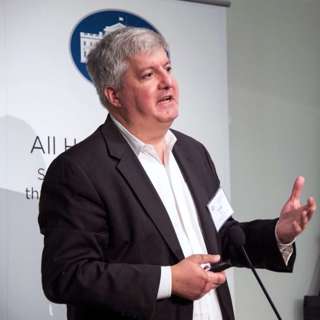

#57 – Tom Kalil on how to do the most good in government

#57 – Tom Kalil on how to do the most good in government

You’re 29 years old, and you’ve just been given a job in the White House. How do you quickly figure out how the US Executive Branch behemoth actually works, so that you can have as much impact as possible - before you quit or get kicked out?

That was the challenge put in front of Tom Kalil in 1993.

He had enough success to last a full 16 years inside the Clinton and Obama administrations, working to foster the development of the internet, then nanotechnology, and then cutting-edge brain modelling, among other things.

But not everyone figures out how to move the needle. In today's interview, Tom shares his experience with how to increase your chances of getting an influential role in government, and how to make the most of the opportunity if you get in.

Links to learn more, summary and full transcript.

Interested in US AI policy careers? Apply for one-on-one career advice here.

Vacancies at the Center for Security and Emerging Technology.

Our high-impact job board, which features other related opportunities.

He believes that Congressional gridlock leads people to greatly underestimate how much the Executive Branch can and does do on its own every day. Decisions by individuals change how billions of dollars are spent; regulations are enforced, and then suddenly they aren't; and a single sentence in the State of the Union can get civil servants to pay attention to a topic that would otherwise go ignored.

Over years at the White House Office of Science and Technology Policy, 'Team Kalil' built up a white board of principles. For example, 'the schedule is your friend': setting a meeting date with the President can force people to finish something, where they otherwise might procrastinate.

Or 'talk to who owns the paper'. People would wonder how Tom could get so many lines into the President's speeches. The answer was "figure out who's writing the speech, find them with the document, and tell them to add the line." Obvious, but not something most were doing.

Not everything is a precise operation though. Tom also tells us the story of NetDay, a project that was put together at the last minute because the President incorrectly believed it was already organised – and decided he was going to announce it in person.

In today's episode we get down to nuts & bolts, and discuss:
• How did Tom spin work on a primary campaign into a job in the next White House?
• Why does Tom think hiring is the most important work he did, and how did he decide who to bring onto the team?
• How do you get people to do things when you don't have formal power over them?
• What roles in the US government are most likely to help with the long-term future, or reducing existential risks?
• Is it possible, or even desirable, to get the general public interested in abstract, long-term policy ideas?
• What are 'policy entrepreneurs' and why do they matter?
• What is the role for prizes in promoting science and technology? What are other promising policy ideas?
• Why you can get more done by not taking credit.
• What can the White House do if an agency isn't doing what it wants?
• How can the effective altruism community improve the maturity of our policy recommendations?
• How much can talented individuals accomplish during a short-term stay in government?

Get this episode by subscribing to our podcast on the world’s most pressing problems and how to solve them: type '80,000 Hours' into your podcasting app.

The 80,000 Hours Podcast is produced by Keiran Harris.

Episoder(332)

#201 – Ken Goldberg on why your robot butler isn’t here yet

#201 – Ken Goldberg on why your robot butler isn’t here yet

"Perception is quite difficult with cameras: even if you have a stereo camera, you still can’t really build a map of where everything is in space. It’s just very difficult. And I know that sounds surp...

13 Sep 20242h 1min

#200 – Ezra Karger on what superforecasters and experts think about existential risks

#200 – Ezra Karger on what superforecasters and experts think about existential risks

"It’s very hard to find examples where people say, 'I’m starting from this point. I’m starting from this belief.' So we wanted to make that very legible to people. We wanted to say, 'Experts think thi...

4 Sep 20242h 49min

#199 – Nathan Calvin on California’s AI bill SB 1047 and its potential to shape US AI policy

#199 – Nathan Calvin on California’s AI bill SB 1047 and its potential to shape US AI policy

"I do think that there is a really significant sentiment among parts of the opposition that it’s not really just that this bill itself is that bad or extreme — when you really drill into it, it feels ...

29 Aug 20241h 12min

#198 – Meghan Barrett on upending everything you thought you knew about bugs in 3 hours

#198 – Meghan Barrett on upending everything you thought you knew about bugs in 3 hours

"This is a group of animals I think people are particularly unfamiliar with. They are especially poorly covered in our science curriculum; they are especially poorly understood, because people don’t s...

26 Aug 20243h 48min

#197 – Nick Joseph on whether Anthropic's AI safety policy is up to the task

#197 – Nick Joseph on whether Anthropic's AI safety policy is up to the task

The three biggest AI companies — Anthropic, OpenAI, and DeepMind — have now all released policies designed to make their AI models less likely to go rogue or cause catastrophic damage as they approach...

22 Aug 20242h 29min

#196 – Jonathan Birch on the edge cases of sentience and why they matter

#196 – Jonathan Birch on the edge cases of sentience and why they matter

"In the 1980s, it was still apparently common to perform surgery on newborn babies without anaesthetic on both sides of the Atlantic. This led to appalling cases, and to public outcry, and to campaign...

15 Aug 20242h 1min

#195 – Sella Nevo on who's trying to steal frontier AI models, and what they could do with them

#195 – Sella Nevo on who's trying to steal frontier AI models, and what they could do with them

"Computational systems have literally millions of physical and conceptual components, and around 98% of them are embedded into your infrastructure without you ever having heard of them. And an inordin...

1 Aug 20242h 8min

#194 – Vitalik Buterin on defensive acceleration and how to regulate AI when you fear government

#194 – Vitalik Buterin on defensive acceleration and how to regulate AI when you fear government

"If you’re a power that is an island and that goes by sea, then you’re more likely to do things like valuing freedom, being democratic, being pro-foreigner, being open-minded, being interested in trad...

26 Jul 20243h 4min

Populært innen Fakta

fastlegen
dine-penger-pengeradet
relasjonspodden-med-dora-thorhallsdottir-kjersti-idem
mikkels-paskenotter
foreldreradet
rss-strid-de-norske-borgerkrigene
treningspodden
rss-bisarr-historie
jakt-og-fiskepodden
rss-sunn-okonomi
sinnsyn
takk-og-lov-med-anine-kierulf
ukast
hverdagspsyken
rss-bak-luftfarten
gravid-uke-for-uke
lederskap-nhhs-podkast-om-ledelse
fryktlos
level-up-med-anniken-binz
tomprat-med-gunnar-tjomlid