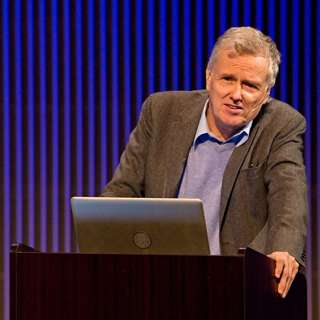
#60 - Phil Tetlock on why accurate forecasting matters for everything, and how you can do it better

#60 - Phil Tetlock on why accurate forecasting matters for everything, and how you can do it better

Have you ever been infuriated by a doctor's unwillingness to give you an honest, probabilistic estimate about what to expect? Or a lawyer who won't tell you the chances you'll win your case?

Their behaviour is so frustrating because accurately predicting the future is central to every action we take. If we can't assess the likelihood of different outcomes we're in a complete bind, whether the decision concerns war and peace, work and study, or Black Mirror and RuPaul's Drag Race.

Which is why the research of Professor Philip Tetlock is relevant for all of us each and every day.

He has spent 40 years as a meticulous social scientist, collecting millions of predictions from tens of thousands of people, in order to figure out how good humans really are at foreseeing the future, and what habits of thought allow us to do better.

Along with other psychologists, he identified that many ordinary people are attracted to a 'folk probability' that draws just three distinctions — 'impossible', 'possible' and 'certain' — and which leads to major systemic mistakes. But with the right mindset and training we can become capable of accurately discriminating between differences as fine as 56% as against 57% likely.

Links to learn more, summary and full transcript
The calibration training app
Sign up for the Civ-5 counterfactual forecasting tournament
A review of the evidence on good forecasting practices
Learn more about Effective Altruism Global

In the aftermath of Iraq and WMDs the US intelligence community hired him to prevent the same ever happening again, and his guide — Superforecasting: The Art and Science of Prediction — became a bestseller back in 2014.

That was five years ago. In today's interview, Tetlock explains how his research agenda continues to advance, today using the game Civilization 5 to see how well we can predict what would have happened in elusive counterfactual worlds we never get to see, and discovering how simple algorithms can complement or substitute for human judgement.

We discuss how his work can be applied to your personal life to answer high-stakes questions, like how likely you are to thrive in a given career path, or whether your business idea will be a billion-dollar unicorn — or fall apart catastrophically. (To help you get better at figuring those things out, our site now has a training app developed by the Open Philanthropy Project and Clearer Thinking that teaches you to distinguish your '70 percents' from your '80 percents'.)

We also bring some tough methodological questions raised by the author of a recent review of the forecasting literature. And we find out what jobs people can take to make improving the reasonableness of decision-making in major institutions that shape the world their profession, as it has been for Tetlock over many decades.

We view Tetlock's work as so core to living well that we've brought him back for a second and longer appearance on the show — his first was back in episode 15.

Get this episode by subscribing to our podcast on the world’s most pressing problems and how to solve them: type 80,000 Hours into your podcasting app.

The 80,000 Hours Podcast is produced by Keiran Harris.

Episoder(325)

#220 – Ryan Greenblatt on the 4 most likely ways for AI to take over, and the case for and against AGI in <8 years

#220 – Ryan Greenblatt on the 4 most likely ways for AI to take over, and the case for and against AGI in <8 years

Ryan Greenblatt — lead author on the explosive paper “Alignment faking in large language models” and chief scientist at Redwood Research — thinks there’s a 25% chance that within four years, AI will b...

8 Jul 20252h 50min

#219 – Toby Ord on graphs AI companies would prefer you didn't (fully) understand

#219 – Toby Ord on graphs AI companies would prefer you didn't (fully) understand

The era of making AI smarter just by making it bigger is ending. But that doesn’t mean progress is slowing down — far from it. AI models continue to get much more powerful, just using very different m...

24 Jun 20252h 48min

#218 – Hugh White on why Trump is abandoning US hegemony – and that’s probably good

#218 – Hugh White on why Trump is abandoning US hegemony – and that’s probably good

For decades, US allies have slept soundly under the protection of America’s overwhelming military might. Donald Trump — with his threats to ditch NATO, seize Greenland, and abandon Taiwan — seems hell...

12 Jun 20252h 48min

#217 – Beth Barnes on the most important graph in AI right now — and the 7-month rule that governs its progress

#217 – Beth Barnes on the most important graph in AI right now — and the 7-month rule that governs its progress

AI models today have a 50% chance of successfully completing a task that would take an expert human one hour. Seven months ago, that number was roughly 30 minutes — and seven months before that, 15 mi...

2 Jun 20253h 47min

Beyond human minds: The bewildering frontier of consciousness in insects, AI, and more

Beyond human minds: The bewildering frontier of consciousness in insects, AI, and more

What if there’s something it’s like to be a shrimp — or a chatbot?For centuries, humans have debated the nature of consciousness, often placing ourselves at the very top. But what about the minds of o...

23 Mai 20253h 34min

Don’t believe OpenAI’s “nonprofit” spin (emergency pod with Tyler Whitmer)

Don’t believe OpenAI’s “nonprofit” spin (emergency pod with Tyler Whitmer)

OpenAI’s recent announcement that its nonprofit would “retain control” of its for-profit business sounds reassuring. But this seemingly major concession, celebrated by so many, is in itself largely me...

15 Mai 20251h 12min

The case for and against AGI by 2030 (article by Benjamin Todd)

The case for and against AGI by 2030 (article by Benjamin Todd)

More and more people have been saying that we might have AGI (artificial general intelligence) before 2030. Is that really plausible? This article by Benjamin Todd looks into the cases for and against...

12 Mai 20251h

Emergency pod: Did OpenAI give up, or is this just a new trap? (with Rose Chan Loui)

Emergency pod: Did OpenAI give up, or is this just a new trap? (with Rose Chan Loui)

When attorneys general intervene in corporate affairs, it usually means something has gone seriously wrong. In OpenAI’s case, it appears to have forced a dramatic reversal of the company’s plans to si...

8 Mai 20251h 2min

Populært innen Fakta

fastlegen
dine-penger-pengeradet
relasjonspodden-med-dora-thorhallsdottir-kjersti-idem
treningspodden
rss-strid-de-norske-borgerkrigene
foreldreradet
rss-sunn-okonomi
jakt-og-fiskepodden
takk-og-lov-med-anine-kierulf
sinnsyn
rss-kunsten-a-leve
merry-quizmas
gravid-uke-for-uke
hverdagspsyken
smart-forklart
hagespiren-podcast
rss-kull
lederskap-nhhs-podkast-om-ledelse
fryktlos
uroskolen