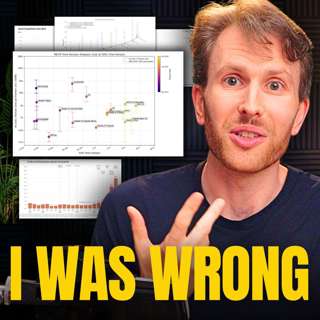

#225 – Daniel Kokotajlo on what a hyperspeed robot economy might look like

#225 – Daniel Kokotajlo on what a hyperspeed robot economy might look like

When Daniel Kokotajlo talks to security experts at major AI labs, they tell him something chilling: “Of course we’re probably penetrated by the CCP already, and if they really wanted something, they could take it.”

This isn’t paranoid speculation. It’s the working assumption of people whose job is to protect frontier AI models worth billions of dollars. And they’re not even trying that hard to stop it — because the security measures that might actually work would slow them down in the race against competitors.

Full transcript, highlights, and links to learn more: https://80k.info/dk

Daniel is the founder of the AI Futures Project and author of AI 2027, a detailed scenario showing how we might get from today’s AI systems to superintelligence by the end of the decade. Over a million people read it in the first few weeks, including US Vice President JD Vance. When Daniel talks to researchers at Anthropic, OpenAI, and DeepMind, they tell him the scenario feels less wild to them than to the general public — because many of them expect something like this to happen.

Daniel’s median timeline? 2029. But he’s genuinely uncertain, putting 10–20% probability on AI progress hitting a long plateau.

When he first published AI 2027, his median forecast for when superintelligence would arrive was 2028, rather than 2029. So what shifted his timelines recently? Partly a fascinating study from METR showing that AI coding assistants might actually be making experienced programmers slower — even though the programmers themselves think they’re being sped up. The study suggests a systematic bias toward overestimating AI effectiveness — which, ironically, is good news for timelines, because it means we have more breathing room than the hype suggests.

But Daniel is also closely tracking another METR result: AI systems can now reliably complete coding tasks that take humans about an hour. That capability has been doubling every six months in a remarkably straight line. Extrapolate a couple more years and you get systems completing month-long tasks. At that point, Daniel thinks we’re probably looking at genuine AI research automation — which could cause the whole process to accelerate dramatically.

At some point, superintelligent AI will be limited by its inability to directly affect the physical world. That’s when Daniel thinks superintelligent systems will pour resources into robotics, creating a robot economy in months.

Daniel paints a vivid picture: imagine transforming all car factories (which have similar components to robots) into robot production factories — much like historical wartime efforts to redirect production of domestic goods to military goods. Then imagine the frontier robots of today hooked up to a data centre running superintelligences controlling the robots’ movements to weld, screw, and build. Or an intermediate step might even be unskilled human workers coached through construction tasks by superintelligences via their phones.

There’s no reason that an effort like this isn’t possible in principle. And there would be enormous pressure to go this direction: whoever builds a superintelligence-powered robot economy first will get unheard-of economic and military advantages.

From there, Daniel expects the default trajectory to lead to AI takeover and human extinction — not because superintelligent AI will hate humans, but because it can better pursue its goals without us.

But Daniel has a better future in mind — one he puts roughly 25–30% odds that humanity will achieve. This future involves international coordination and hardware verification systems to enforce AI development agreements, plus democratic processes for deciding what values superintelligent AIs should have — because in a world with just a handful of superintelligent AI systems, those few minds will effectively control everything: the robot armies, the information people see, the shape of civilisation itself.

Right now, nobody knows how to specify what values those minds will have. We haven’t solved alignment. And we might only have a few more years to figure it out.

Daniel and host Luisa Rodriguez dive deep into these stakes in today’s interview.

What did you think of the episode? https://forms.gle/HRBhjDZ9gfM8woG5A

This episode was recorded on September 9, 2025.

Chapters:

  • Cold open (00:00:00)
  • Who’s Daniel Kokotajlo? (00:00:37)
  • Video: We’re Not Ready for Superintelligence (00:01:31)
  • Interview begins: Could China really steal frontier model weights? (00:36:26)
  • Why we might get a robot economy incredibly fast (00:42:34)
  • AI 2027’s alternate ending: The slowdown (01:01:29)
  • How to get to even better outcomes (01:07:18)
  • Updates Daniel’s made since publishing AI 2027 (01:15:13)
  • How plausible are longer timelines? (01:20:22)
  • What empirical evidence is Daniel looking out for to decide which way things are going? (01:40:27)
  • What post-AGI looks like (01:49:41)
  • Whistleblower protections and Daniel’s unsigned NDA (02:04:28)

Audio engineering: Milo McGuire, Simon Monsour, and Dominic Armstrong
Music: CORBIT
Coordination, transcriptions, and web: Katy Moore

Denne episoden er hentet fra en åpen RSS-feed og er ikke publisert av Podme. Den kan derfor inneholde annonser.

Episoder(340)

We can guess what intergalactic war would look like. And strangely, it matters.

We can guess what intergalactic war would look like. And strangely, it matters.

Intergalactic war is probably billions of years away — yet physics can already tell us how it ends. And strangely that conclusion is relevant to decisions people have to make today.In this video, Rob ...

18 Jun 15min

How AI could create the world’s biggest problems (article by Zershaaneh Qureshi)

How AI could create the world’s biggest problems (article by Zershaaneh Qureshi)

Imagine you’re living 15,000 years ago. Your people are hunter-gatherers and you sleep under the stars. If someone told you humans would one day build cities with millions of people, fly through the a...

11 Jun 1h 29min

What it's really like to run AGI safety at Google DeepMind (and where I disagree with 'doomers') | Rohin Shah

What it's really like to run AGI safety at Google DeepMind (and where I disagree with 'doomers') | Rohin Shah

Most people working on AI safety think without a massive effort AI systems will probably end up with goals catastrophically different from humanity’s. Today’s guest, Rohin Shah — head of AGI Safety an...

2 Jun 2h 48min

What makes for a dream job? | Benjamin Todd

What makes for a dream job? | Benjamin Todd

What actually makes a job fulfilling? It's not what most career advice tells you. "Follow your passion" sounds inspiring, but it's misleading — and the research backs that up.Drawing on hundreds of st...

28 Mai 28min

We’re updating our career advice for the strangest time in history | Benjamin Todd, author of 80,000 Hours

We’re updating our career advice for the strangest time in history | Benjamin Todd, author of 80,000 Hours

The average career is 80,000 hours long. With AI advancing so rapidly, the hours you have left in your career matter more than ever.Some leading AI researchers think there’s a 10% chance that AI syste...

26 Mai 1h 6min

Can AIs already start 'rogue deployments' inside AI companies? (Landmark new METR report)

Can AIs already start 'rogue deployments' inside AI companies? (Landmark new METR report)

A red-teamer was embedded inside Anthropic for three weeks, told to imagine he was an evil Claude, and asked to figure out how to launch a ‘rogue AI deployment’ without getting caught. It’s one part o...

20 Mai 20min

#243 – 'Godfather of AI' Yoshua Bengio: "I now see a path" to safe superintelligent AI

#243 – 'Godfather of AI' Yoshua Bengio: "I now see a path" to safe superintelligent AI

The co-inventor of modern AI and the most cited living scientist believes he's figured out how to ensure AI is honest, incapable of deception, and never goes rogue. Yoshua Bengio – Turing Award Winner...

7 Mai 2h 35min

'95% of AI Pilots Fail': The hidden agenda behind the viral stat that misled millions

'95% of AI Pilots Fail': The hidden agenda behind the viral stat that misled millions

You might have heard that '95% of corporate AI pilots' are failing. It was one of the most widely cited AI statistics of 2025, parroted by media outlets everywhere. It helped trigger a Nasdaq selloff ...

28 Apr 10min

Populært innen Fakta

fastlegen
dine-penger-pengeradet
relasjonspodden-med-dora-thorhallsdottir-kjersti-idem
foreldreradet
treningspodden
jakt-og-fiskepodden
mikkels-paskenotter
rss-strid-de-norske-borgerkrigene
rss-kunsten-a-leve
sinnsyn
hverdagspsyken
rss-kull
tomprat-med-gunnar-tjomlid
gravid-uke-for-uke
rss-bisarr-historie
rss-impressions-2
level-up-med-anniken-binz
rss-var-forste-kaffe
rss-kunstig-intelligens-med-elisabeth-maren-og-morten
dopet