

#70 - Dr Cassidy Nelson on the 12 best ways to stop the next pandemic (and limit nCoV)

#70 - Dr Cassidy Nelson on the 12 best ways to stop the next pandemic (and limit nCoV)

nCoV is alarming governments and citizens around the world. It has killed more than 1,000 people, brought the Chinese economy to a standstill, and continues to show up in more and more places. But bad though it is, it's much closer to a warning shot than a worst case scenario. The next emerging infectious disease could easily be more contagious, more fatal, or both.

Despite improvements in the last few decades, humanity is still not nearly prepared enough to contain new diseases. We identify them too slowly. We can't do enough to reduce their spread. And we lack vaccines or drugs treatments for at least a year, if they ever arrive at all.

Links to learn more, summary and full transcript.

This is a precarious situation, especially with advances in biotechnology increasing our ability to modify viruses and bacteria as we like.

In today's episode, Cassidy Nelson, a medical doctor and research scholar at Oxford University's Future of Humanity Institute, explains 12 things her research group think urgently need to happen if we're to keep the risk at acceptable levels. The ideas are:

Science

1. Roll out genetic sequencing tests that lets you test someone for all known and unknown pathogens in one go.
2. Fund research into faster ‘platform’ methods for going from pathogen to vaccine, perhaps using innovation prizes.
3. Fund R&D into broad-spectrum drugs, especially antivirals, similar to how we have generic antibiotics against multiple types of bacteria.

Response

4. Develop a national plan for responding to a severe pandemic, regardless of the cause. Have a backup plan for when things are so bad the normal processes have stopped working entirely.
5. Rigorously evaluate in what situations travel bans are warranted. (They're more often counterproductive.)
6. Coax countries into more rapidly sharing their medical data, so that during an outbreak the disease can be understood and countermeasures deployed as quickly as possible.
7. Set up genetic surveillance in hospitals, public transport and elsewhere, to detect new pathogens before an outbreak — or even before patients develop symptoms.
8. Run regular tabletop exercises within governments to simulate how a pandemic response would play out.

Oversight

9. Mandate disclosure of accidents in the biosafety labs which handle the most dangerous pathogens.
10. Figure out how to govern DNA synthesis businesses, to make it harder to mail order the DNA of a dangerous pathogen.
11. Require full cost-benefit analysis of 'dual-use' research projects that can generate global risks.

12. And finally, to maintain momentum, it's necessary to clearly assign responsibility for the above to particular individuals and organisations.

These advances can be pursued by politicians and public servants, as well as academics, entrepreneurs and doctors, opening the door for many listeners to pitch in to help solve this incredibly pressing problem.

In the episode Rob and Cassidy also talk about:

• How Cassidy went from clinical medicine to a PhD studying novel pathogens with pandemic potential.
• The pros, and significant cons, of travel restrictions.
• Whether the same policies work for natural and anthropogenic pandemics.
• Ways listeners can pursue a career in biosecurity.
• Where we stand with nCoV as of today.

Chapters:

  • Rob’s intro (00:00:00)
  • The interview begins (00:03:27)
  • Where we stand with nCov today (00:07:24)
  • Policy idea 1: A drastic change to diagnostic testing (00:34:58)
  • Policy idea 2: Vaccine platforms (00:47:08)
  • Policy idea 3: Broad-spectrum therapeutics (00:54:48)
  • Policy idea 4: Develop a national plan for responding to a severe pandemic, regardless of the cause (01:02:15)
  • Policy idea 5: A different approach to travel bans (01:15:59)
  • Policy idea 6: Data sharing (01:16:48)
  • Policy idea 7: Prevention (01:24:45)
  • Policy idea 8: transparency around lab accidents (01:33:58)
  • Policy idea 9: DNA synthesis screening (01:39:22)
  • Policy idea 10: Dual Use Research oversight (01:48:47)
  • Policy idea 11: Pandemic tabletop exercises (02:00:00)
  • Policy idea 12: Coordination (02:12:20)


Get this episode by subscribing: type 80,000 Hours into your podcasting app. Or read the linked transcript.

Producer: Keiran Harris.
Transcriptions: Zakee Ulhaq.

Episoder(322)

Rob & Luisa chat kids, the 2016 fertility crash, and how the 50s invented parenting that makes us miserable

Rob & Luisa chat kids, the 2016 fertility crash, and how the 50s invented parenting that makes us miserable

Global fertility rates aren’t just falling: the rate of decline is accelerating. From 2006 to 2016, fertility dropped gradually, but since 2016 the rate of decline has increased 4.5-fold. In many weal...

25 Nov 20251h 59min

#228 – Eileen Yam on how we're completely out of touch with what the public thinks about AI

#228 – Eileen Yam on how we're completely out of touch with what the public thinks about AI

If you work in AI, you probably think it’s going to boost productivity, create wealth, advance science, and improve your life. If you’re a member of the American public, you probably strongly disagree...

20 Nov 20251h 43min
OpenAI: The nonprofit refuses to be killed (with Tyler Whitmer)

OpenAI: The nonprofit refuses to be killed (with Tyler Whitmer)

Last December, the OpenAI business put forward a plan to completely sideline its nonprofit board. But two state attorneys general have now blocked that effort and kept that board very much alive and k...

11 Nov 20251h 56min
#227 – Helen Toner on the geopolitics of AGI in China and the Middle East

#227 – Helen Toner on the geopolitics of AGI in China and the Middle East

With the US racing to develop AGI and superintelligence ahead of China, you might expect the two countries to be negotiating how they’ll deploy AI, including in the military, without coming to blows. ...

5 Nov 20252h 20min

#226 – Holden Karnofsky on unexploited opportunities to make AI safer — and all his AGI takes

#226 – Holden Karnofsky on unexploited opportunities to make AI safer — and all his AGI takes

For years, working on AI safety usually meant theorising about the ‘alignment problem’ or trying to convince other people to give a damn. If you could find any way to help, the work was frustrating an...

30 Okt 20254h 30min

#225 – Daniel Kokotajlo on what a hyperspeed robot economy might look like

#225 – Daniel Kokotajlo on what a hyperspeed robot economy might look like

When Daniel Kokotajlo talks to security experts at major AI labs, they tell him something chilling: “Of course we’re probably penetrated by the CCP already, and if they really wanted something, they c...

27 Okt 20252h 12min
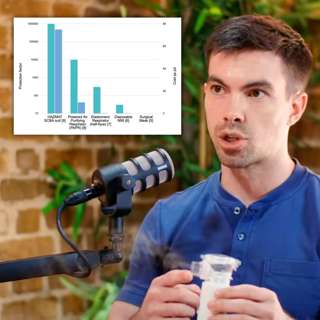
#224 – There's a cheap and low-tech way to save humanity from any engineered disease | Andrew Snyder-Beattie

#224 – There's a cheap and low-tech way to save humanity from any engineered disease | Andrew Snyder-Beattie

Conventional wisdom is that safeguarding humanity from the worst biological risks — microbes optimised to kill as many as possible — is difficult bordering on impossible, making bioweapons humanity’s ...

2 Okt 20252h 31min
Inside the Biden admin’s AI policy approach | Jake Sullivan, Biden’s NSA | via The Cognitive Revolution

Inside the Biden admin’s AI policy approach | Jake Sullivan, Biden’s NSA | via The Cognitive Revolution

Jake Sullivan was the US National Security Advisor from 2021-2025. He joined our friends on The Cognitive Revolution podcast in August to discuss AI as a critical national security issue. We thought i...

26 Sep 20251h 5min

Populært innen Fakta

fastlegen
dine-penger-pengeradet
relasjonspodden-med-dora-thorhallsdottir-kjersti-idem
treningspodden
rss-strid-de-norske-borgerkrigene
foreldreradet
jakt-og-fiskepodden
rss-kunsten-a-leve
rss-sunn-okonomi
hverdagspsyken
gravid-uke-for-uke
merry-quizmas
lederskap-nhhs-podkast-om-ledelse
rss-mann-i-krise-med-sagen
sinnsyn
fryktlos
hagespiren-podcast
rss-impressions-2
level-up-med-anniken-binz
rss-mind-body-podden