
#75 – Michelle Hutchinson on what people most often ask 80,000 Hours

#75 – Michelle Hutchinson on what people most often ask 80,000 Hours

Since it was founded, 80,000 Hours has done one-on-one calls to supplement our online content and offer more personalised advice. We try to help people get clear on their most plausible paths, the key uncertainties they face in choosing between them, and provide resources, pointers, and introductions to help them in those paths.

I (Michelle Hutchinson) joined the team a couple of years ago after working at Oxford's Global Priorities Institute, and these days I'm 80,000 Hours' Head of Advising. Since then, chatting to hundreds of people about their career plans has given me some idea of the kinds of things it’s useful for people to hear about when thinking through their careers.

So we thought it would be useful to discuss some on the show for everyone to hear.

Links to learn more, summary and full transcript.
See over 500 vacancies on our job board.
Apply for one-on-one career advising.

Among other common topics, we cover:

• Why traditional careers advice involves thinking through what types of roles you enjoy followed by which of those are impactful, while we recommend going the other way: ranking roles on impact, and then going down the list to find the one you think you’d most flourish in.
• That if you’re pitching your job search at the right level of role, you’ll need to apply to a large number of different jobs. So it's wise to broaden your options, by applying for both stretch and backup roles, and not over-emphasising a small number of organisations.
• Our suggested process for writing a longer term career plan: 1. shortlist your best medium to long-term career options, then 2. figure out the key uncertainties in choosing between them, and 3. map out concrete next steps to resolve those uncertainties.
• Why many listeners aren't spending enough time finding out about what the day-to-day work is like in paths they're considering, or reaching out to people for advice or opportunities.
• The difficulty of maintaining the ambition to increase your social impact, while also being proud of and motivated by what you're already accomplishing.

I also thought it might be useful to give people a sense of what I do and don’t do in advising calls, to help them figure out if they should sign up for it.

If you’re wondering whether you’ll benefit from advising, bear in mind that it tends to be more useful to people:

1. With similar views to 80,000 Hours on what the world’s most pressing problems are, because we’ve done most research on the problems we think it’s most important to address.
2. Who don’t yet have close connections with people working at effective altruist organisations.
3. Who aren’t strongly locationally constrained.

If you’re unsure, it doesn’t take long to apply, and a lot of people say they find the application form itself helps them reflect on their plans. We’re particularly keen to hear from people from under-represented backgrounds.

Also in this episode:

• I describe mistakes I’ve made in advising, and career changes made by people I’ve spoken with.
• Rob and I argue about what risks to take with your career, like when it’s sensible to take a study break, or start from the bottom in a new career path.
• I try to forecast how I’ll change after I have a baby, Rob speculates wildly on what motherhood is like, and Arden and I mercilessly mock Rob.

Chapters:

  • Rob’s intro (00:00:00)
  • The interview begins (00:02:50)
  • The process of advising (00:09:34)
  • We’re not just excited about our priority paths (00:14:37)
  • Common things Michelle says during advising (00:18:13)
  • Interpersonal comparisons (00:31:18)
  • Thinking about current impact (00:40:31)
  • Applying to different kinds of orgs (00:42:29)
  • Difference in impact between jobs / causes (00:49:04)
  • Common mistakes (00:55:40)
  • Career change stories (01:11:44)
  • When is advising really useful for people? (01:24:28)
  • Managing risk in careers (01:55:29)


Producer: Keiran Harris.
Audio mastering: Ben Cordell.
Transcriptions: Zakee Ulhaq.

Episoder(323)

#229 – Marius Hobbhahn on the race to solve AI scheming before models go superhuman

#229 – Marius Hobbhahn on the race to solve AI scheming before models go superhuman

We often worry about AI models “hallucinating” or making honest mistakes. But what happens when a model knows the truth, but decides to deceive you anyway to achieve a goal of its own? This isn’t sci-...

3 Des 20253h 3min

Rob & Luisa chat kids, the 2016 fertility crash, and how the 50s invented parenting that makes us miserable

Rob & Luisa chat kids, the 2016 fertility crash, and how the 50s invented parenting that makes us miserable

Global fertility rates aren’t just falling: the rate of decline is accelerating. From 2006 to 2016, fertility dropped gradually, but since 2016 the rate of decline has increased 4.5-fold. In many weal...

25 Nov 20251h 59min

#228 – Eileen Yam on how we're completely out of touch with what the public thinks about AI

#228 – Eileen Yam on how we're completely out of touch with what the public thinks about AI

If you work in AI, you probably think it’s going to boost productivity, create wealth, advance science, and improve your life. If you’re a member of the American public, you probably strongly disagree...

20 Nov 20251h 43min

OpenAI: The nonprofit refuses to be killed (with Tyler Whitmer)

OpenAI: The nonprofit refuses to be killed (with Tyler Whitmer)

Last December, the OpenAI business put forward a plan to completely sideline its nonprofit board. But two state attorneys general have now blocked that effort and kept that board very much alive and k...

11 Nov 20251h 56min
#227 – Helen Toner on the geopolitics of AGI in China and the Middle East

#227 – Helen Toner on the geopolitics of AGI in China and the Middle East

With the US racing to develop AGI and superintelligence ahead of China, you might expect the two countries to be negotiating how they’ll deploy AI, including in the military, without coming to blows. ...

5 Nov 20252h 20min

#226 – Holden Karnofsky on unexploited opportunities to make AI safer — and all his AGI takes

#226 – Holden Karnofsky on unexploited opportunities to make AI safer — and all his AGI takes

For years, working on AI safety usually meant theorising about the ‘alignment problem’ or trying to convince other people to give a damn. If you could find any way to help, the work was frustrating an...

30 Okt 20254h 30min

#225 – Daniel Kokotajlo on what a hyperspeed robot economy might look like

#225 – Daniel Kokotajlo on what a hyperspeed robot economy might look like

When Daniel Kokotajlo talks to security experts at major AI labs, they tell him something chilling: “Of course we’re probably penetrated by the CCP already, and if they really wanted something, they c...

27 Okt 20252h 12min
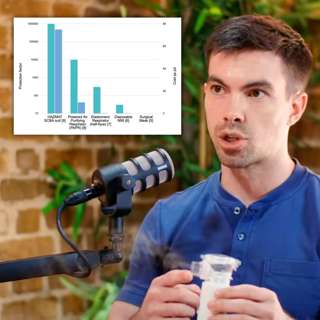
#224 – There's a cheap and low-tech way to save humanity from any engineered disease | Andrew Snyder-Beattie

#224 – There's a cheap and low-tech way to save humanity from any engineered disease | Andrew Snyder-Beattie

Conventional wisdom is that safeguarding humanity from the worst biological risks — microbes optimised to kill as many as possible — is difficult bordering on impossible, making bioweapons humanity’s ...

2 Okt 20252h 31min

Populært innen Fakta

fastlegen
dine-penger-pengeradet
relasjonspodden-med-dora-thorhallsdottir-kjersti-idem
treningspodden
rss-strid-de-norske-borgerkrigene
foreldreradet
rss-sunn-okonomi
rss-kunsten-a-leve
jakt-og-fiskepodden
hverdagspsyken
merry-quizmas
gravid-uke-for-uke
sinnsyn
lederskap-nhhs-podkast-om-ledelse
rss-mann-i-krise-med-sagen
rss-impressions-2
fryktlos
level-up-med-anniken-binz
rss-kull
hagespiren-podcast