#88 – Tristan Harris on the need to change the incentives of social media companies

#88 – Tristan Harris on the need to change the incentives of social media companies

In its first 28 days on Netflix, the documentary The Social Dilemma — about the possible harms being caused by social media and other technology products — was seen by 38 million households in about 190 countries and in 30 languages.

Over the last ten years, the idea that Facebook, Twitter, and YouTube are degrading political discourse and grabbing and monetizing our attention in an alarming way has gone mainstream to such an extent that it's hard to remember how recently it was a fringe view.

It feels intuitively true that our attention spans are shortening, we’re spending more time alone, we’re less productive, there’s more polarization and radicalization, and that we have less trust in our fellow citizens, due to having less of a shared basis of reality.

But while it all feels plausible, how strong is the evidence that it's true? In the past, people have worried about every new technological development — often in ways that seem foolish in retrospect. Socrates famously feared that being able to write things down would ruin our memory.

At the same time, historians think that the printing press probably generated religious wars across Europe, and that the radio helped Hitler and Stalin maintain power by giving them and them alone the ability to spread propaganda across the whole of Germany and the USSR. Fears about new technologies aren't always misguided.

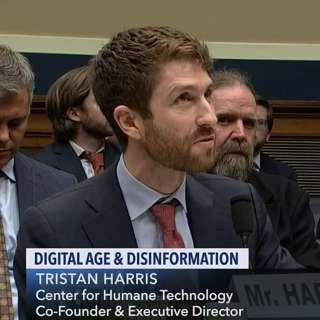
Tristan Harris, leader of the Center for Humane Technology, and co-host of the Your Undivided Attention podcast, is arguably the most prominent person working on reducing the harms of social media, and he was happy to engage with Rob’s good-faith critiques.

Links to learn more, summary and full transcript.
• FYI, the 2020 Effective Altruism Survey is closing soon: https://www.surveymonkey.co.uk/r/EAS80K2

Tristan and Rob provide a thorough exploration of the merits of possible concrete solutions – something The Social Dilemma didn’t really address.

Given that these companies are mostly trying to design their products in the way that makes them the most money, how can we get that incentive to align with what's in our interests as users and citizens?

One way is to encourage a shift to a subscription model.

One claim in The Social Dilemma is that the machine learning algorithms on these sites try to shift what you believe and what you enjoy in order to make it easier to predict what content recommendations will keep you on the site.

But if you paid a yearly fee to Facebook in lieu of seeing ads, their incentive would shift towards making you as satisfied as possible with their service — even if that meant using it for five minutes a day rather than 50.

Despite all the negatives, Tristan doesn’t want us to abandon the technologies he's concerned about. He asks us to imagine a social media environment designed to regularly bring our attention back to what each of us can do to improve our lives and the world.

Just as we can focus on the positives of nuclear power while remaining vigilant about the threat of nuclear weapons, we could embrace social media and recommendation algorithms as the largest mass-coordination engine we've ever had — tools that could educate and organise people better than anything that has come before.

The tricky and open question is how to get there.

Rob and Tristan also discuss:

• Justified concerns vs. moral panics
• The effect of social media on politics in the US and developing countries
• Tips for individuals

Chapters:

  • Rob’s intro (00:00:00)
  • The interview begins (00:01:36)
  • Center for Humane Technology (00:04:53)
  • Critics (00:08:19)
  • The Social Dilemma (00:13:20)
  • Three categories of harm (00:20:31)
  • Justified concerns vs. moral panics (00:30:23)
  • The messy real world vs. an imagined idealised world (00:38:20)
  • The persuasion apocalypse (00:47:46)
  • Revolt of the Public (00:56:48)
  • Global effects (01:02:44)
  • US politics (01:13:32)
  • Potential solutions (01:20:59)
  • Unintended consequences (01:42:57)
  • Win-win changes (01:50:47)
  • Big wins over the last 5 or 10 years (01:59:10)
  • The subscription model (02:02:28)
  • Tips for individuals (02:14:05)
  • The current state of the research (02:22:37)
  • Careers (02:26:36)


Producer: Keiran Harris.
Audio mastering: Ben Cordell.
Transcriptions: Sofia Davis-Fogel.

Episoder(332)

Will MacAskill – AI character, surviving the intelligence explosion, and the case against utopia

Will MacAskill – AI character, surviving the intelligence explosion, and the case against utopia

Hundreds of millions already turn to AI on the most personal of topics — therapy, political opinions, and how to treat others. And as AI takes over more of the economy, the character of these systems ...

22 Apr 3h 9min
Risks from power-seeking AI systems (article narration by Zershaaneh Qureshi)

Risks from power-seeking AI systems (article narration by Zershaaneh Qureshi)

Hundreds of prominent AI scientists and other notable figures signed a statement in 2023 saying that mitigating the risk of extinction from AI should be a global priority. At 80,000 Hours, we’ve consi...

16 Apr 1h 29min
How scary is Claude Mythos? 303 pages in 21 minutes

How scary is Claude Mythos? 303 pages in 21 minutes

With Claude Mythos we have an AI that knows when it's being tested, can obscure its reasoning when it wants, and is better at breaking into (and out of) computers than any human alive. Rob Wiblin work...

10 Apr 21min
Village gossip, pesticide bans, and gene drives: 17 experts on the future of global health

Village gossip, pesticide bans, and gene drives: 17 experts on the future of global health

What does it really take to lift millions out of poverty and prevent needless deaths?In this special compilation episode, 17 past guests — including economists, nonprofit founders, and policy advisors...

7 Apr 4h 6min
What everyone is missing about Anthropic vs the Pentagon. And: The Meta leaks are worse than you think.

What everyone is missing about Anthropic vs the Pentagon. And: The Meta leaks are worse than you think.

When the Pentagon tried to strong-arm Anthropic into dropping its ban on AI-only kill decisions and mass domestic surveillance, the company refused. Its critics went on the attack: Anthropic and its s...

3 Apr 20min

#241 – Richard Moulange on how now AI codes viable genomes from scratch and outperforms virologists at lab work — what could go wrong?

#241 – Richard Moulange on how now AI codes viable genomes from scratch and outperforms virologists at lab work — what could go wrong?

Last September, scientists used an AI model to design genomes for entirely new bacteriophages (viruses that infect bacteria). They then built them in a lab. Many were viable. And despite being entirel...

31 Mar 3h 7min

#240 – Samuel Charap on how a Ukraine ceasefire could accidentally set Europe up for a bigger war

#240 – Samuel Charap on how a Ukraine ceasefire could accidentally set Europe up for a bigger war

Many people believe a ceasefire in Ukraine will leave Europe safer. But today's guest lays out how a deal could potentially generate insidious new risks — leaving us in a situation that's equally dang...

24 Mar 1h 12min
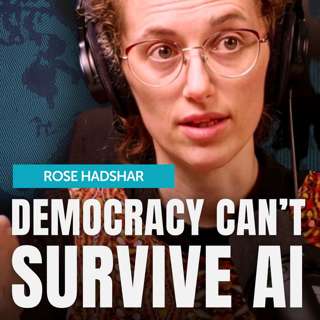
#239 – Rose Hadshar on why automating all human labour will break our political system

#239 – Rose Hadshar on why automating all human labour will break our political system

The most important political question in the age of advanced AI might not be who wins elections. It might be whether elections continue to matter at all.That’s the view of Rose Hadshar, researcher at ...

17 Mar 2h 14min

Populært innen Fakta

fastlegen
dine-penger-pengeradet
relasjonspodden-med-dora-thorhallsdottir-kjersti-idem
mikkels-paskenotter
foreldreradet
rss-strid-de-norske-borgerkrigene
treningspodden
rss-bisarr-historie
jakt-og-fiskepodden
takk-og-lov-med-anine-kierulf
sinnsyn
rss-sunn-okonomi
hverdagspsyken
tomprat-med-gunnar-tjomlid
gravid-uke-for-uke
fryktlos
hagespiren-podcast
level-up-med-anniken-binz
rss-kull
rss-bak-luftfarten