#139 – Alan Hájek on puzzles and paradoxes in probability and expected value

#139 – Alan Hájek on puzzles and paradoxes in probability and expected value

A casino offers you a game. A coin will be tossed. If it comes up heads on the first flip you win $2. If it comes up on the second flip you win $4. If it comes up on the third you win $8, the fourth you win $16, and so on. How much should you be willing to pay to play?

The standard way of analysing gambling problems, ‘expected value’ — in which you multiply probabilities by the value of each outcome and then sum them up — says your expected earnings are infinite. You have a 50% chance of winning $2, for '0.5 * $2 = $1' in expected earnings. A 25% chance of winning $4, for '0.25 * $4 = $1' in expected earnings, and on and on. A never-ending series of $1s added together comes to infinity. And that's despite the fact that you know with certainty you can only ever win a finite amount!

Today's guest — philosopher Alan Hájek of the Australian National University — thinks of much of philosophy as “the demolition of common sense followed by damage control” and is an expert on paradoxes related to probability and decision-making rules like “maximise expected value.”

Links to learn more, summary and full transcript.

The problem described above, known as the St. Petersburg paradox, has been a staple of the field since the 18th century, with many proposed solutions. In the interview, Alan explains how very natural attempts to resolve the paradox — such as factoring in the low likelihood that the casino can pay out very large sums, or the fact that money becomes less and less valuable the more of it you already have — fail to work as hoped.

We might reject the setup as a hypothetical that could never exist in the real world, and therefore of mere intellectual curiosity. But Alan doesn't find that objection persuasive. If expected value fails in extreme cases, that should make us worry that something could be rotten at the heart of the standard procedure we use to make decisions in government, business, and nonprofits.

These issues regularly show up in 80,000 Hours' efforts to try to find the best ways to improve the world, as the best approach will arguably involve long-shot attempts to do very large amounts of good.

Consider which is better: saving one life for sure, or three lives with 50% probability? Expected value says the second, which will probably strike you as reasonable enough. But what if we repeat this process and evaluate the chance to save nine lives with 25% probability, or 27 lives with 12.5% probability, or after 17 more iterations, 3,486,784,401 lives with a 0.00000009% chance. Expected value says this final offer is better than the others — 1,000 times better, in fact.

Ultimately Alan leans towards the view that our best choice is to “bite the bullet” and stick with expected value, even with its sometimes counterintuitive implications. Where we want to do damage control, we're better off looking for ways our probability estimates might be wrong.

In today's conversation, Alan and Rob explore these issues and many others:

• Simple rules of thumb for having philosophical insights
• A key flaw that hid in Pascal's wager from the very beginning
• Whether we have to simply ignore infinities because they mess everything up
• What fundamentally is 'probability'?
• Some of the many reasons 'frequentism' doesn't work as an account of probability
• Why the standard account of counterfactuals in philosophy is deeply flawed
• And why counterfactuals present a fatal problem for one sort of consequentialism

Chapters:

  • Rob’s intro (00:00:00)
  • The interview begins (00:01:48)
  • Philosophical methodology (00:02:54)
  • Theories of probability (00:37:17)
  • Everyday Bayesianism (00:46:01)
  • Frequentism (01:04:56)
  • Ranges of probabilities (01:16:23)
  • Implications for how to live (01:21:24)
  • Expected value (01:26:58)
  • The St. Petersburg paradox (01:31:40)
  • Pascal's wager (01:49:44)
  • Using expected value in everyday life (02:03:53)
  • Counterfactuals (02:16:38)
  • Most counterfactuals are false (02:52:25)
  • Relevance to objective consequentialism (03:09:47)
  • Marker 18 (03:10:21)
  • Alan’s best conference story (03:33:37)


Producer: Keiran Harris
Audio mastering: Ben Cordell and Ryan Kessler
Transcriptions: Katy Moore

Episoder(324)

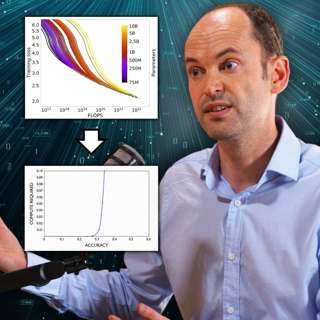
#219 – Toby Ord on graphs AI companies would prefer you didn't (fully) understand

#219 – Toby Ord on graphs AI companies would prefer you didn't (fully) understand

The era of making AI smarter just by making it bigger is ending. But that doesn’t mean progress is slowing down — far from it. AI models continue to get much more powerful, just using very different m...

24 Jun 20252h 48min
#218 – Hugh White on why Trump is abandoning US hegemony – and that’s probably good

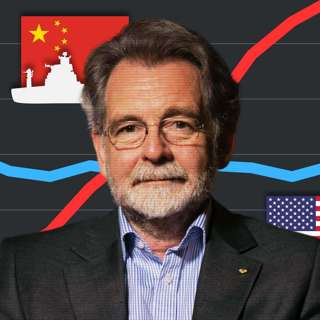
#218 – Hugh White on why Trump is abandoning US hegemony – and that’s probably good

For decades, US allies have slept soundly under the protection of America’s overwhelming military might. Donald Trump — with his threats to ditch NATO, seize Greenland, and abandon Taiwan — seems hell...

12 Jun 20252h 48min

#217 – Beth Barnes on the most important graph in AI right now — and the 7-month rule that governs its progress

#217 – Beth Barnes on the most important graph in AI right now — and the 7-month rule that governs its progress

AI models today have a 50% chance of successfully completing a task that would take an expert human one hour. Seven months ago, that number was roughly 30 minutes — and seven months before that, 15 mi...

2 Jun 20253h 47min

Beyond human minds: The bewildering frontier of consciousness in insects, AI, and more

Beyond human minds: The bewildering frontier of consciousness in insects, AI, and more

What if there’s something it’s like to be a shrimp — or a chatbot?For centuries, humans have debated the nature of consciousness, often placing ourselves at the very top. But what about the minds of o...

23 Mai 20253h 34min

Don’t believe OpenAI’s “nonprofit” spin (emergency pod with Tyler Whitmer)

Don’t believe OpenAI’s “nonprofit” spin (emergency pod with Tyler Whitmer)

OpenAI’s recent announcement that its nonprofit would “retain control” of its for-profit business sounds reassuring. But this seemingly major concession, celebrated by so many, is in itself largely me...

15 Mai 20251h 12min

The case for and against AGI by 2030 (article by Benjamin Todd)

The case for and against AGI by 2030 (article by Benjamin Todd)

More and more people have been saying that we might have AGI (artificial general intelligence) before 2030. Is that really plausible? This article by Benjamin Todd looks into the cases for and against...

12 Mai 20251h

Emergency pod: Did OpenAI give up, or is this just a new trap? (with Rose Chan Loui)

Emergency pod: Did OpenAI give up, or is this just a new trap? (with Rose Chan Loui)

When attorneys general intervene in corporate affairs, it usually means something has gone seriously wrong. In OpenAI’s case, it appears to have forced a dramatic reversal of the company’s plans to si...

8 Mai 20251h 2min
#216 – Ian Dunt on why governments in Britain and elsewhere can't get anything done – and how to fix it

#216 – Ian Dunt on why governments in Britain and elsewhere can't get anything done – and how to fix it

When you have a system where ministers almost never understand their portfolios, civil servants change jobs every few months, and MPs don't grasp parliamentary procedure even after decades in office —...

2 Mai 20253h 14min

Populært innen Fakta

fastlegen
dine-penger-pengeradet
relasjonspodden-med-dora-thorhallsdottir-kjersti-idem
treningspodden
rss-strid-de-norske-borgerkrigene
foreldreradet
rss-sunn-okonomi
jakt-og-fiskepodden
hverdagspsyken
sinnsyn
merry-quizmas
gravid-uke-for-uke
tomprat-med-gunnar-tjomlid
rss-kunsten-a-leve
smart-forklart
takk-og-lov-med-anine-kierulf
fryktlos
rss-impressions-2
hagespiren-podcast
rss-kull