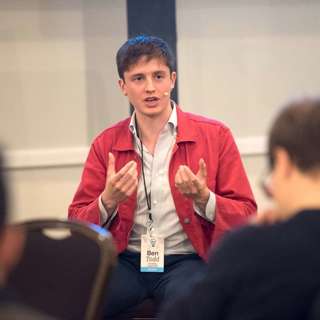

#194 – Vitalik Buterin on defensive acceleration and how to regulate AI when you fear government

#194 – Vitalik Buterin on defensive acceleration and how to regulate AI when you fear government

"If you’re a power that is an island and that goes by sea, then you’re more likely to do things like valuing freedom, being democratic, being pro-foreigner, being open-minded, being interested in trade. If you are on the Mongolian steppes, then your entire mindset is kill or be killed, conquer or be conquered … the breeding ground for basically everything that all of us consider to be dystopian governance. If you want more utopian governance and less dystopian governance, then find ways to basically change the landscape, to try to make the world look more like mountains and rivers and less like the Mongolian steppes." —Vitalik Buterin

Can ‘effective accelerationists’ and AI ‘doomers’ agree on a common philosophy of technology? Common sense says no. But programmer and Ethereum cofounder Vitalik Buterin showed otherwise with his essay “My techno-optimism,” which both camps agreed was basically reasonable.

Links to learn more, highlights, video, and full transcript.

Seeing his social circle divided and fighting, Vitalik hoped to write a careful synthesis of the best ideas from both the optimists and the apprehensive.

Accelerationists are right: most technologies leave us better off, the human cost of delaying further advances can be dreadful, and centralising control in government hands often ends disastrously.

But the fearful are also right: some technologies are important exceptions, AGI has an unusually high chance of being one of those, and there are options to advance AI in safer directions.

The upshot? Defensive acceleration: humanity should run boldly but also intelligently into the future — speeding up technology to get its benefits, but preferentially developing ‘defensive’ technologies that lower systemic risks, permit safe decentralisation of power, and help both individuals and countries defend themselves against aggression and domination.

Entrepreneur First is running a defensive acceleration incubation programme with $250,000 of investment. If these ideas resonate with you, learn about the programme and apply by August 2, 2024. You don’t need a business idea yet — just the hustle to start a technology company.

In addition to all of that, host Rob Wiblin and Vitalik discuss:

  • AI regulation disagreements being less about AI in particular, and more whether you’re typically more scared of anarchy or totalitarianism.
  • Vitalik’s updated p(doom).
  • Whether the social impact of blockchain and crypto has been a disappointment.
  • Whether humans can merge with AI, and if that’s even desirable.
  • The most valuable defensive technologies to accelerate.
  • How to trustlessly identify what everyone will agree is misinformation
  • Whether AGI is offence-dominant or defence-dominant.
  • Vitalik’s updated take on effective altruism.
  • Plenty more.

Chapters:

  • Cold open (00:00:00)
  • Rob’s intro (00:00:56)
  • The interview begins (00:04:47)
  • Three different views on technology (00:05:46)
  • Vitalik’s updated probability of doom (00:09:25)
  • Technology is amazing, and AI is fundamentally different from other tech (00:15:55)
  • Fear of totalitarianism and finding middle ground (00:22:44)
  • Should AI be more centralised or more decentralised? (00:42:20)
  • Humans merging with AIs to remain relevant (01:06:59)
  • Vitalik’s “d/acc” alternative (01:18:48)
  • Biodefence (01:24:01)
  • Pushback on Vitalik’s vision (01:37:09)
  • How much do people actually disagree? (01:42:14)
  • Cybersecurity (01:47:28)
  • Information defence (02:01:44)
  • Is AI more offence-dominant or defence-dominant? (02:21:00)
  • How Vitalik communicates among different camps (02:25:44)
  • Blockchain applications with social impact (02:34:37)
  • Rob’s outro (03:01:00)

Producer and editor: Keiran Harris
Audio engineering team: Ben Cordell, Simon Monsour, Milo McGuire, and Dominic Armstrong
Transcriptions: Katy Moore

Episoder(320)

#66 – Peter Singer on being provocative, effective altruism, & how his moral views have changed

#66 – Peter Singer on being provocative, effective altruism, & how his moral views have changed

In 1989, the professor of moral philosophy Peter Singer was all over the news for his inflammatory opinions about abortion. But the controversy stemmed from Practical Ethics — a book he’d actually rel...

5 Des 20192h 1min

#65 – Ambassador Bonnie Jenkins on 8 years pursuing WMD arms control, & diversity in diplomacy

#65 – Ambassador Bonnie Jenkins on 8 years pursuing WMD arms control, & diversity in diplomacy

"…it started when the Soviet Union fell apart and there was a real desire to ensure security of nuclear materials and pathogens, and that scientists with [WMD-related] knowledge could get paid so that...

19 Nov 20191h 40min

#64 – Bruce Schneier on how insecure electronic voting could break the United States — and surveillance without tyranny

#64 – Bruce Schneier on how insecure electronic voting could break the United States — and surveillance without tyranny

November 3 2020, 10:32PM: CNN, NBC, and FOX report that Donald Trump has narrowly won Florida, and with it, re-election.  November 3 2020, 11:46PM: The NY Times and Wall Street Journal report that so...

25 Okt 20192h 11min

Rob Wiblin on plastic straws, nicotine, doping, & whether changing the long-term is really possible

Rob Wiblin on plastic straws, nicotine, doping, & whether changing the long-term is really possible

Today's episode is a compilation of interviews I recently recorded for two other shows, Love Your Work and The Neoliberal Podcast.  If you've listened to absolutely everything on this podcast feed, y...

25 Sep 20193h 14min

Have we helped you have a bigger social impact? Our annual survey, plus other ways we can help you.

Have we helped you have a bigger social impact? Our annual survey, plus other ways we can help you.

1. Fill out our annual impact survey here. 2. Find a great vacancy on our job board. 3. Learn about our key ideas, and get links to our top articles. 4. Join our newsletter for an email about what's n...

16 Sep 20193min

#63 – Vitalik Buterin on better ways to fund public goods, blockchain's failures, & effective giving

#63 – Vitalik Buterin on better ways to fund public goods, blockchain's failures, & effective giving

Historically, progress in the field of cryptography has had major consequences. It has changed the course of major wars, made it possible to do business on the internet, and enabled private communicat...

3 Sep 20193h 18min

#62 – Paul Christiano on messaging the future, increasing compute, & how CO2 impacts your brain

#62 – Paul Christiano on messaging the future, increasing compute, & how CO2 impacts your brain

Imagine that – one day – humanity dies out. At some point, many millions of years later, intelligent life might well evolve again. Is there any message we could leave that would reliably help them out...

5 Aug 20192h 11min

#61 - Helen Toner on emerging technology, national security, and China

#61 - Helen Toner on emerging technology, national security, and China

From 1870 to 1950, the introduction of electricity transformed life in the US and UK, as people gained access to lighting, radio and a wide range of household appliances for the first time. Electricit...

17 Jul 20191h 54min

Populært innen Fakta

fastlegen
dine-penger-pengeradet
relasjonspodden-med-dora-thorhallsdottir-kjersti-idem
treningspodden
rss-strid-de-norske-borgerkrigene
foreldreradet
jakt-og-fiskepodden
rss-sunn-okonomi
merry-quizmas
gravid-uke-for-uke
fryktlos
sinnsyn
hverdagspsyken
rss-mann-i-krise-med-sagen
smart-forklart
generasjonspodden
rss-kunsten-a-leve
dopet
sovnlos
hr-podden-2