#205 – Sébastien Moro on the most insane things fish can do

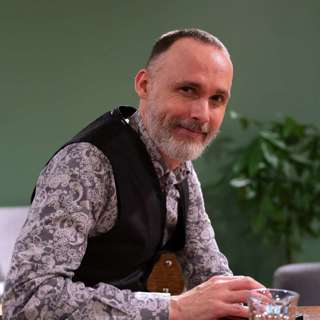
#205 – Sébastien Moro on the most insane things fish can do

"You have a tank split in two parts: if the fish gets in the compartment with a red circle, it will receive food, and food will be delivered in the other tank as well. If the fish takes the blue triangle, this fish will receive food, but nothing will be delivered in the other tank. So we have a prosocial choice and antisocial choice. When there is no one in the other part of the tank, the male is choosing randomly. If there is a male, a possible rival: antisocial — almost 100% of the time. Now, if there is his wife — his female, this is a prosocial choice all the time.

"And now a question: Is it just because this is a female or is it just for their female? Well, when they're bringing a new female, it’s the antisocial choice all the time. Now, if there is not the female of the male, it will depend on how long he's been separated from his female. At first it will be antisocial, and after a while he will start to switch to prosocial choices." —Sébastien Moro

In today’s episode, host Luisa Rodriguez speaks to science writer and video blogger Sébastien Moro about the latest research on fish consciousness, intelligence, and potential sentience.

Links to learn more, highlights, and full transcript.

They cover:

  • The insane capabilities of fish in tests of memory, learning, and problem-solving.
  • Examples of fish that can beat primates on cognitive tests and recognise individual human faces.
  • Fishes’ social lives, including pair bonding, “personalities,” cooperation, and cultural transmission.
  • Whether fish can experience emotions, and how this is even studied.
  • The wild evolutionary innovations of fish, who adapted to thrive in diverse environments from mangroves to the deep sea.
  • How some fish have sensory capabilities we can’t even really fathom — like “seeing” electrical fields and colours we can’t perceive.
  • Ethical issues raised by evidence that fish may be conscious and experience suffering.
  • And plenty more.

Producer: Keiran Harris
Audio engineering: Ben Cordell, Milo McGuire, Simon Monsour, and Dominic Armstrong
Content editing: Luisa Rodriguez, Katy Moore, and Keiran Harris
Transcriptions: Katy Moore

Episoder(324)

#59 Classic episode - Cass Sunstein on how change happens, and why it's so often abrupt & unpredictable

#59 Classic episode - Cass Sunstein on how change happens, and why it's so often abrupt & unpredictable

Rebroadcast: this episode was originally released in June 2019. It can often feel hopeless to be an activist seeking social change on an obscure issue where most people seem opposed or at best indiff...

27 Des 20211h 43min

#119 – Andrew Yang on our very long-term future, and other topics most politicians won’t touch

#119 – Andrew Yang on our very long-term future, and other topics most politicians won’t touch

Andrew Yang — past presidential candidate, founder of the Forward Party, and leader of the 'Yang Gang' — is kind of a big deal, but is particularly popular among listeners to The 80,000 Hours Podcast....

20 Des 20211h 25min

#118 – Jaime Yassif on safeguarding bioscience to prevent catastrophic lab accidents and bioweapons development

#118 – Jaime Yassif on safeguarding bioscience to prevent catastrophic lab accidents and bioweapons development

If a rich country were really committed to pursuing an active biological weapons program, there’s not much we could do to stop them. With enough money and persistence, they’d be able to buy equipment,...

13 Des 20212h 15min

#117 – David Denkenberger on using paper mills and seaweed to feed everyone in a catastrophe, ft Sahil Shah

#117 – David Denkenberger on using paper mills and seaweed to feed everyone in a catastrophe, ft Sahil Shah

If there's a nuclear war followed by nuclear winter, and the sun is blocked out for years, most of us are going to starve, right? Well, currently, probably we would, because humanity hasn't done much ...

29 Nov 20213h 8min

#116 – Luisa Rodriguez on why global catastrophes seem unlikely to kill us all

#116 – Luisa Rodriguez on why global catastrophes seem unlikely to kill us all

If modern human civilisation collapsed — as a result of nuclear war, severe climate change, or a much worse pandemic than COVID-19 — billions of people might die.That's terrible enough to contemplate....

19 Nov 20213h 45min

#115 – David Wallace on the many-worlds theory of quantum mechanics and its implications

#115 – David Wallace on the many-worlds theory of quantum mechanics and its implications

Quantum mechanics — our best theory of atoms, molecules, and the subatomic particles that make them up — underpins most of modern physics. But there are varying interpretations of what it means, all o...

12 Nov 20213h 9min

#114 – Maha Rehman on working with governments to rapidly deliver masks to millions of people

#114 – Maha Rehman on working with governments to rapidly deliver masks to millions of people

It’s hard to believe, but until recently there had never been a large field trial that addressed these simple and obvious questions:1. When ordinary people wear face masks, does it actually reduce the...

22 Okt 20211h 42min

We just put up a new compilation of ten core episodes of the show

We just put up a new compilation of ten core episodes of the show

We recently launched a new podcast feed that might be useful to you and people you know. It's called Effective Altruism: Ten Global Problems, and it's a collection of ten top episodes of this show, se...

20 Okt 20213min

Populært innen Fakta

fastlegen
dine-penger-pengeradet
relasjonspodden-med-dora-thorhallsdottir-kjersti-idem
treningspodden
rss-strid-de-norske-borgerkrigene
foreldreradet
rss-sunn-okonomi
jakt-og-fiskepodden
hverdagspsyken
sinnsyn
merry-quizmas
gravid-uke-for-uke
tomprat-med-gunnar-tjomlid
rss-kunsten-a-leve
smart-forklart
takk-og-lov-med-anine-kierulf
fryktlos
rss-impressions-2
hagespiren-podcast
rss-kull