Soumita Basu on the Evolution of the Women, Peace and Security (WPS) Agenda

Soumita Basu on the Evolution of the Women, Peace and Security (WPS) Agenda

Ever since its adoption in October 2000, the Women, Peace and Security (WPS) agenda has emerged as the landmark global framework promoting women’s participation in conflict resolution and achieving sustainable peace. Through its four pillars, participation, conflict prevention, protection, and relief and recovery, the WPS agenda aims to provide a holistic approach to international security. Since the adoption of the agenda, 103 countries have adopted National Action Plans (NAPs) to enhance women’s participation in the security domain at a domestic level. Regional Action Plans (RAPs) have also emerged as an effort to collaboratively implement the WPS agenda. However, despite the domestic and regional efforts to implement the WPS agenda, there are normative and institutional constraints that impede the full realisation of the agenda.

In this episode of Interpreting India, Soumita Basu joins Shibani Mehta to discuss how the WPS agenda has evolved since its adoption in 2000. What is its significance, and how does it operate to achieve its goal of ensuring equitable gender participation in peace-building? How is the agenda being interpreted by countries with different contextual and political settings? And finally, what steps should India undertake to advance its approach toward the WPS agenda?

--

Episode Contributors

Soumita Basu is an associate professor at the Department of International Relations at the South Asian University. She holds a PhD in International Politics from University of Wales, Aberystwyth. She has worked extensively on feminist international relations and the UN Security Council Resolutions on Women, Peace and Security. Her recent publications include New Directions in Women, Peace and Security. She has also contributed to Gendered Dimensions of the United Nations Security Council: Some Notes in View of India's Eighth Term (2021-22)’and Routledge Handbook of Feminist Peace Research.

Shibani Mehta is a research analyst with the Security Studies Program at Carnegie India. Her research focuses on India’s security and foreign policies.

--

🎙️ Check out our podcast, Interpreting India available now on YouTube, Spotify, and iTunes!

Home: https://interpreting-india.simplecast.com/

YouTube: https://www.youtube.com/playlist?list=PLeXQMWQXRkJXF71nDiX9LhlXiSkhR8JJT

Spotify: https://open.spotify.com/show/51yeOb8SimMIPe2KgIUQ8g

iTunes: https://pcr.apple.com/id1476357131

--

Carnegie India Socials:

Instagram: https://www.instagram.com/carnegieindia/ (@CarnegieIndia)

Twitter: https://twitter.com/CarnegieIndia

Website: https://carnegieindia.org

YouTube: https://www.youtube.com/c/CarnegieIndia/

Every two weeks, Interpreting India brings you diverse voices from India and around the world to explore the critical questions shaping the nation's future. We delve into how technology, the economy, and foreign policy intertwine to influence India's relationship with the global stage.

As a Carnegie India production, hosted by Carnegie scholars, Interpreting India, a Carnegie India production, provides insightful perspectives and cutting-edge by tackling the defining questions that chart India's course through the next decade.

Stay tuned for thought-provoking discussions, expert insights, and a deeper understanding of India's place in the world.

Don't forget to subscribe, share, and leave a review to join the conversation and be part of Interpreting India's journey.

Denne episoden er hentet fra en åpen RSS-feed og er ikke publisert av Podme. Den kan derfor inneholde annonser.

Episoder(153)

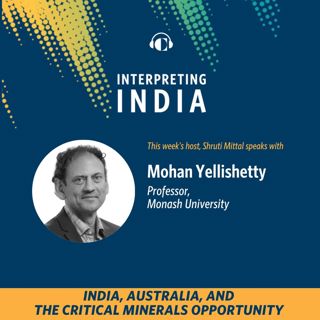
India, Australia, and the Critical Minerals Opportunity

India, Australia, and the Critical Minerals Opportunity

The conversation opens with a useful baseline on both countries. Australia has world-class mining equipment, technology, and services capabilities, and its mining sector contributes roughly 10 to 15 p...

13 Aug 49min
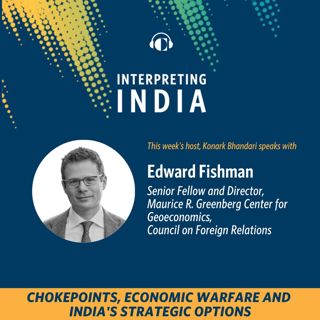
Chokepoints, Economic Warfare and India's Strategic Options

Chokepoints, Economic Warfare and India's Strategic Options

Edward lays out three criteria for what makes something a genuine choke point: dominant market share, difficulty to substitute, and the ability to weaponize it with asymmetric impact, hurting the adve...

10 Jul 33min
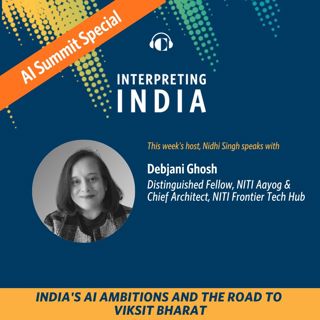
India's AI Ambitions and the Road to Viksit Bharat | AI Summit Special

India's AI Ambitions and the Road to Viksit Bharat | AI Summit Special

This is the final episode of our special series on the India AI Impact Summit, examining the conversations, decisions, and debates that are shaping global AI governance. This episode explores: India...

2 Jul 33min
Did India's AI Summit Get Safety Right? AI Summit Special

Did India's AI Summit Get Safety Right? AI Summit Special

This episode is part of our special series on the India AI Impact Summit, examining the conversations, decisions, and debates that are shaping global AI governance. Professor Ravindran addresses early...

19 Jun 40min
Subsea Cables, Trusted Networks, and India's Strategic Opportunity

Subsea Cables, Trusted Networks, and India's Strategic Opportunity

Pooja opens with a mismatch that frames the entire conversation. India consumes around 20% of global internet traffic but accounts for just 2% of global subsea cable infrastructure. Even with the expa...

4 Jun 46min
AI Literacy and the Future of Work in India

AI Literacy and the Future of Work in India

Jaspreet's framing for the AI and work debate is worth staying with. He is not dismissive of disruption: he thinks AI will destroy certain jobs, create new ones, and the rupture will be real. But he p...

26 Mai 44min
Can AI Resources Be Democratized? AI Summit Special

Can AI Resources Be Democratized? AI Summit Special

This episode is part of our special series on the India AI Impact Summit, examining the conversations, decisions, and debates that are shaping global AI governance. The working group was designed from...

15 Mai 28min

Space Security in the Age of AI

Space Security in the Age of AI

Almudena opens with a distinction that anchors the entire conversation: space security, unlike space safety, is about intentional harm. It concerns deliberate attempts to disrupt, deny, or destroy spa...

7 Mai 1h 7min

Populært innen Politikk og nyheter

giver-og-gjengen-vg
aftenpodden
forklart
popradet
aftenpodden-usa
stopp-verden
nokon-ma-ga
det-store-bildet
dine-penger-pengeradet
rss-gukild-johaug
lydartikler-fra-aftenposten
rss-espen-lee-usensurert
hanna-de-heldige
rss-ness
rss-penger-polser-og-politikk
aftenbla-bla
frokostshowet-pa-p5
unitedno
e24-podden
ta-dokumentar