

#207 – Sarah Eustis-Guthrie on why she shut down her charity, and why more founders should follow her lead

#207 – Sarah Eustis-Guthrie on why she shut down her charity, and why more founders should follow her lead

"I think one of the reasons I took [shutting down my charity] so hard is because entrepreneurship is all about this bets-based mindset. So you say, “I’m going to take a bunch of bets. I’m going to take some risky bets that have really high upside.” And this is a winning strategy in life, but maybe it’s not a winning strategy for any given hand. So the fact of the matter is that I believe that intellectually, but l do not believe that emotionally. And I have now met a bunch of people who are really good at doing that emotionally, and I’ve realised I’m just not one of those people. I think I’m more entrepreneurial than your average person; I don’t think I’m the maximally entrepreneurial person. And I also think it’s just human nature to not like failing." —Sarah Eustis-Guthrie

In today’s episode, host Luisa Rodriguez speaks to Sarah Eustis-Guthrie — cofounder of the now-shut-down Maternal Health Initiative, a postpartum family planning nonprofit in Ghana — about her experience starting and running MHI, and ultimately making the difficult decision to shut down when the programme wasn’t as impactful as they expected.

Links to learn more, highlights, and full transcript.

They cover:

  • The evidence that made Sarah and her cofounder Ben think their organisation could be super impactful for women — both from a health perspective and an autonomy and wellbeing perspective.
  • Early yellow and red flags that maybe they didn’t have the full story about the effectiveness of the intervention.
  • All the steps Sarah and Ben took to build the organisation — and where things went wrong in retrospect.
  • Dealing with the emotional side of putting so much time and effort into a project that ultimately failed.
  • Why it’s so important to talk openly about things that don’t work out, and Sarah’s key lessons learned from the experience.
  • The misaligned incentives that discourage charities from shutting down ineffective programmes.
  • The movement of trust-based philanthropy, and Sarah’s ideas to further improve how global development charities get their funding and prioritise their beneficiaries over their operations.
  • The pros and cons of exploring and pivoting in careers.
  • What it’s like to participate in the Charity Entrepreneurship Incubation Program, and how listeners can assess if they might be a good fit.
  • And plenty more.

Chapters:

  • Cold open (00:00:00)
  • Luisa’s intro (00:00:58)
  • The interview begins (00:03:43)
  • The case for postpartum family planning as an impactful intervention (00:05:37)
  • Deciding where to start the charity (00:11:34)
  • How do you even start implementing a charity programme? (00:18:33)
  • Early yellow and red flags (00:22:56)
  • Proof-of-concept tests and pilot programme in Ghana (00:34:10)
  • Dealing with disappointing pilot results (00:53:34)
  • The ups and downs of founding an organisation (01:01:09)
  • Post-pilot research and reflection (01:05:40)
  • Is family planning still a promising intervention? (01:22:59)
  • Deciding to shut down MHI (01:34:10)
  • The surprising community response to news of the shutdown (01:41:12)
  • Mistakes and what Sarah could have done differently (01:48:54)
  • Sharing results in the space of postpartum family planning (02:00:54)
  • Should more charities scale back or shut down? (02:08:33)
  • Trust-based philanthropy (02:11:15)
  • Empowering the beneficiaries of charities’ work (02:18:04)
  • The tough ask of getting nonprofits to act when a programme isn’t working (02:21:18)
  • Exploring and pivoting in careers (02:27:01)
  • Reevaluation points (02:29:55)
  • PlayPumps were even worse than you might’ve heard (02:33:25)
  • Charity Entrepreneurship (02:38:30)
  • The mistake of counting yourself out too early (02:52:37)
  • Luisa’s outro (02:57:50)

Producer: Keiran Harris
Audio engineering: Ben Cordell, Milo McGuire, Simon Monsour, and Dominic Armstrong
Content editing: Luisa Rodriguez, Katy Moore, and Keiran Harris
Transcriptions: Katy Moore

Episoder(333)

#225 – Daniel Kokotajlo on what a hyperspeed robot economy might look like

#225 – Daniel Kokotajlo on what a hyperspeed robot economy might look like

When Daniel Kokotajlo talks to security experts at major AI labs, they tell him something chilling: “Of course we’re probably penetrated by the CCP already, and if they really wanted something, they c...

27 Okt 20252h 12min
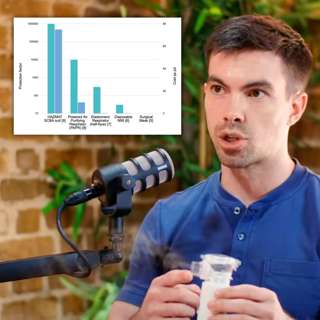
#224 – There's a cheap and low-tech way to save humanity from any engineered disease | Andrew Snyder-Beattie

#224 – There's a cheap and low-tech way to save humanity from any engineered disease | Andrew Snyder-Beattie

Conventional wisdom is that safeguarding humanity from the worst biological risks — microbes optimised to kill as many as possible — is difficult bordering on impossible, making bioweapons humanity’s ...

2 Okt 20252h 31min
Inside the Biden admin’s AI policy approach | Jake Sullivan, Biden’s NSA | via The Cognitive Revolution

Inside the Biden admin’s AI policy approach | Jake Sullivan, Biden’s NSA | via The Cognitive Revolution

Jake Sullivan was the US National Security Advisor from 2021-2025. He joined our friends on The Cognitive Revolution podcast in August to discuss AI as a critical national security issue. We thought i...

26 Sep 20251h 5min
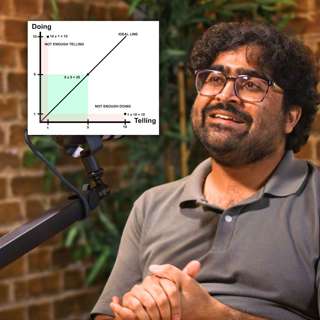
#223 – Neel Nanda on leading a Google DeepMind team at 26 – and advice if you want to work at an AI company (part 2)

#223 – Neel Nanda on leading a Google DeepMind team at 26 – and advice if you want to work at an AI company (part 2)

At 26, Neel Nanda leads an AI safety team at Google DeepMind, has published dozens of influential papers, and mentored 50 junior researchers — seven of whom now work at major AI companies. His secret?...

15 Sep 20251h 46min
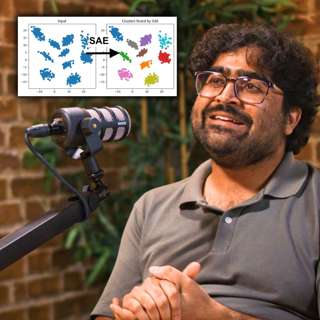
#222 – Can we tell if an AI is loyal by reading its mind? DeepMind's Neel Nanda (part 1)

#222 – Can we tell if an AI is loyal by reading its mind? DeepMind's Neel Nanda (part 1)

We don’t know how AIs think or why they do what they do. Or at least, we don’t know much. That fact is only becoming more troubling as AIs grow more capable and appear on track to wield enormous cultu...

8 Sep 20253h 1min

#221 – Kyle Fish on the most bizarre findings from 5 AI welfare experiments

#221 – Kyle Fish on the most bizarre findings from 5 AI welfare experiments

What happens when you lock two AI systems in a room together and tell them they can discuss anything they want?According to experiments run by Kyle Fish — Anthropic’s first AI welfare researcher — som...

28 Aug 20252h 28min

How not to lose your job to AI (article by Benjamin Todd)

How not to lose your job to AI (article by Benjamin Todd)

About half of people are worried they’ll lose their job to AI. They’re right to be concerned: AI can now complete real-world coding tasks on GitHub, generate photorealistic video, drive a taxi more sa...

31 Jul 202551min

Rebuilding after apocalypse: What 13 experts say about bouncing back

Rebuilding after apocalypse: What 13 experts say about bouncing back

What happens when civilisation faces its greatest tests?This compilation brings together insights from researchers, defence experts, philosophers, and policymakers on humanity’s ability to survive and...

15 Jul 20254h 26min

Populært innen Fakta

fastlegen
dine-penger-pengeradet
relasjonspodden-med-dora-thorhallsdottir-kjersti-idem
rss-strid-de-norske-borgerkrigene
mikkels-paskenotter
foreldreradet
rss-bisarr-historie
treningspodden
jakt-og-fiskepodden
sinnsyn
rss-kunsten-a-leve
hverdagspsyken
ukast
rss-sunn-okonomi
rss-bak-luftfarten
fryktlos
tomprat-med-gunnar-tjomlid
lederskap-nhhs-podkast-om-ledelse
gravid-uke-for-uke
hagespiren-podcast