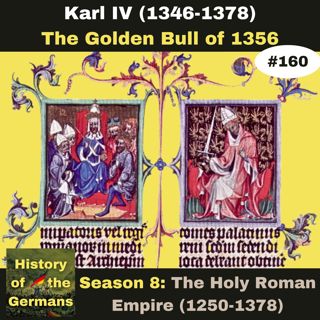
Ep. 160: Karl IV (1346-1378 - The Golden Bull of 1356

Ep. 160: Karl IV (1346-1378 - The Golden Bull of 1356

“Every realm that is divided internally will go to uin, for its princes have become the comrades of thieves. The Lord has poured out the spirit of deceit among them, so that they grope about at midday as though in darkness, and He has withdrawn the light from their dwellings, so that they are blind and leaders of the blind. And those who wander in the dark run into things, and those who are blind of spirit bring about evil deeds, which occur in disunity. [..]

You, Jealousy, have soiled the Christian Empire, which was reinforced by God with the virtues of faith hope and love, just like the indivisible Trinity, and whose foundations stand firmly on the kingdom of Christ; you have soiled it with your ancient poison that you have spewed forth like an evil snake on the Empire and its members. And to shatter the pillars and to bring the whole structure to collapse, you have incited disunity among the seven electors, who should illuminate the Empire like the light of the seven lamps of the mind.

But in the name of the office which we hold as Emperor we are obliged to act against disunity and struggle among the electors [..] for two reasons: because of our Imperial office, and because of our rights as an elector.

In order to increase the unity among them, and to bring about unanimity during elections and to avoid disgraceful divisions and to close the door to the multiple dangers that arise from them, we have issued the laws written down here at our festive Imperial Diet in Nuremberg, in the presence of all the spiritual and worldly electors, and before a large crowd of other princes, counts, free lords, lords, nobles and urban delegates. From our Imperial throne, decorated with the imperial insignias and treasures, wearing the imperial crown, after ripe deliberation, we issued them on the basis of our unrestricted imperial powers, in the year of our Lord 1356, on the 10th of January, in the tenth year of our royal power and the first of our Imperial power.”

So begins one of the most important constitutional documents of the Holy Roman Empire, the Golden Bull of 1356. But what did it actually say, and even more important, what did it not say and how does it fit into the context of the history of the Holy Roman Empire. That is what we are going to discuss in this episode.

The music for the show is Flute Sonata in E-flat major, H.545 by Carl Phillip Emmanuel Bach (or some claim it as BWV 1031 Johann Sebastian Bach) performed and arranged by Michel Rondeau under Common Creative Licence 3.0.

As always:

Homepage with maps, photos, transcripts and blog: www.historyofthegermans.com

If you wish to support the show go to: Support • History of the Germans Podcast

For do it yourself merchandise go to: Merchandise • History of the Germans Podcast

Facebook: @HOTGPod

Threads: @history_of_the_germans_podcast

Bluesky: @hotgpod.bsky.social

Instagram: history_of_the_germans

Twitter: @germanshistory

To make it easier for you to share the podcast, I have created separate playlists for some of the seasons that are set up as individual podcasts. they have the exact same episodes as in the History of the Germans, but they may be a helpful device for those who want to concentrate on only one season.

So far I have:

The Ottonians

Salian Emperors and Investiture Controversy

Fredrick Barbarossa and Early Hohenstaufen

Frederick II Stupor Mundi

Saxony and Eastward Expansion

The Hanseatic League

The Teutonic Knights

The Holy Roman Empire 1250-1356

The Reformation before the Reformation

The Empire in the 15th century

The Fall and Rise of the Habsburgs

Episoder(247)

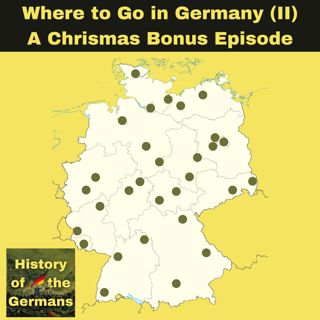
Where To Go in Germany - Part 2

Where To Go in Germany - Part 2

One of the legacies of the Holy roman empire is that Germany does not have just one place where everything happens, where politicians, entrepreneurs, bankers, artists, and actors travel on the same un...

1 Jan 37min
Where To Go in Germany - Part 1

Where To Go in Germany - Part 1

As you are still awaiting your presents, mine has already arrived, which is the chance to make this show. Despite all my occasional moaning and groaning about how much work it is, I have never enjoyed...

25 Des 202541min
Ep.219:  Maximilian I (1493-1519) – The Fall of Ghent

Ep.219: Maximilian I (1493-1519) – The Fall of Ghent

The words High and Late Middle Ages conjures up images of fog rising up over a field where knights in shining armor are trading blows with double handed swords, mighty bishops overseeing the construct...

18 Des 202539min
Ep. 218:  Maximilian I (1493-1519) – The Death of Mary of Burgundy

Ep. 218: Maximilian I (1493-1519) – The Death of Mary of Burgundy

By 1477 the rules of war that had been enshrined in the laws of chivalry are gone. The contest between the French and the Habsburgs over the inheritance of the Grand Dukes of the West gives us a foret...

11 Des 202540min
Ep. 217:  Maximilian I (1493-1519) – When Mary Met Maxi

Ep. 217: Maximilian I (1493-1519) – When Mary Met Maxi

How often have you heard this phrase “Let others wage war; you, happy Austria, marry". It goes back to a whole string of marriages, first Maximilian of Habsburg married the heiress of the duchy of Bur...

4 Des 202539min
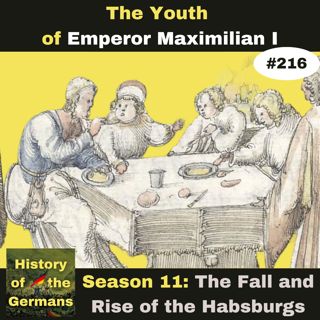
Ep. 216:  Maximilian I (1493-1519) - The Youth of an Emperor

Ep. 216: Maximilian I (1493-1519) - The Youth of an Emperor

What is it like to grow up the son of the emperor? For most of the rulers of the Holy Roman Empire we have covered so far, no idea. There are scarce reports about the way the princes grew up, safe for...

27 Nov 202532min
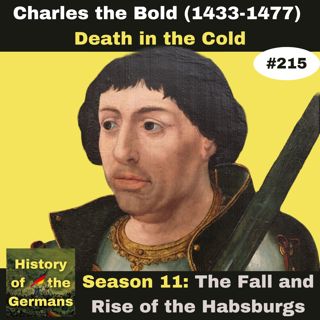
Ep. 215: Charles the Bold  (1433-1477) - Death in the Cold

Ep. 215: Charles the Bold (1433-1477) - Death in the Cold

The rise of the Habsburgs to world domination pivots on one crucial moment, the marriage of Maximilian of Habsburg to Mary of Burgundy, the daughter of Charles the Bold, last of the Grand Dukes of the...

20 Nov 202540min
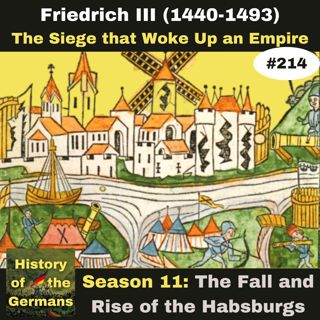
Ep. 214: Friedrich III (1440-1493) - The Siege that Woke up an Empire

Ep. 214: Friedrich III (1440-1493) - The Siege that Woke up an Empire

The venerable city of Neuss between Cologne and Düsseldorf was founded in 16 BC as a Roman army camp, making it one of the oldest in Germany. Its history is marked by the usual mix of feuds with its a...

13 Nov 202539min

Populært innen Fakta

fastlegen
dine-penger-pengeradet
relasjonspodden-med-dora-thorhallsdottir-kjersti-idem
mikkels-paskenotter
foreldreradet
rss-strid-de-norske-borgerkrigene
treningspodden
rss-bisarr-historie
jakt-og-fiskepodden
takk-og-lov-med-anine-kierulf
sinnsyn
rss-sunn-okonomi
hverdagspsyken
tomprat-med-gunnar-tjomlid
gravid-uke-for-uke
fryktlos
rss-bak-luftfarten
ukast
lederskap-nhhs-podkast-om-ledelse
level-up-med-anniken-binz