Assistant Superintendent Greg Wolcott on "Building Relationships in Today's Classrooms"

Assistant Superintendent Greg Wolcott on "Building Relationships in Today's Classrooms"

Welcome back to the “Neuroscience Meets SEL Podcast” this is Andrea Samadi. This interview will be broadcast on YouTube as well as on the regular podcast channel, so be sure to look for the YouTube link in the show notes if you would like to view the video.

Our special guest today is Greg Wolcott. He is someone who is “always on the cutting edge of education.” Greg is the author of the book Significant 72: Unleashing the Power of Relationships in Today’s Schools[i] and is on a serious mission to impact our schools with this movement. Greg currently serves as the Assistant Superintendent for Teaching and Learning in a suburb of Chicago as well as an adjunct professor. As an educator in the Chicago area for over 20 years, he is passionate about developing opportunities for all students to succeed as well as finding ways for all teachers and staff members to utilize their strengths to maximize learning. I’m excited to have Greg share more about the “Significant 72” initiative that’s implemented in over two hundred schools across the United States and Canada. Welcome Greg.

Q1: As we dive into the relationship competency, I know there isn’t anyone I could think of that could cover this topic better than you. Can you give some background on the reason why you wrote this book? I remember hearing you talking about the concept of “Significant 72” on an SEL Webinar back in 2016. I remember you mentioned it had to do with the importance of relationship building after 3-day weekends. Where did the concept begin, what does Significant 72 look like in a school (every day, every month and after long breaks)?

Q2: When you mentioned the research you had done, and found the key attribute that all great teachers do—their ability to form strong, caring relationships with students, how did you take this information to help build on this strength to connect with students on a deeper level?

Q3: We know from the research that “When students perceive that their teacher knows them both academically and personally, they are better positioned to take ownership of their learning.” (Edwards & Edick, 2013). We can all recall are favorite teachers who inspired us to learn, but how did they do it? There’s that fine line of showing you care and being too intrusive when asking students about their feelings or personal lives. How did you handle this to get the results you were looking for? GREG: It all began with John Hattie’s research on effect size and how relationship building yielded a gain of 2 years.[ii]

Q5: Can you give us your TOP tips used in “Significant 72” for improving relationships with students?

Q4: What are the outcomes and results from the schools using this method? How are you measuring this data? GREG: They use Panorama Education Surveys[iii]

Q5: What is your 3-5 year vision of where you see “Significant 72” going?

Q 6: To sum this all up, what are some final words of wisdom that you think we can all do (parents, as well as educators) to build stronger, meaningful relationships that foster that home/school connection? GREG: Connections Before Curriculum!

Thank you Greg, for taking the time out of your day to speak with us and share your Significant 72 book, ideas and resources. If someone wants to learn more, they can go to www.significant72.com and find you on Twitter @GregJWolcott to reach you.

[i] www.significant72.com

[ii] https://visible-learning.org/hattie-ranking-influences-effect-sizes-learning-achievement/

[iii] www.PanoramaEd.com

Denne episoden er hentet fra en åpen RSS-feed og er ikke publisert av Podme. Den kan derfor inneholde annonser.

Episoder(414)

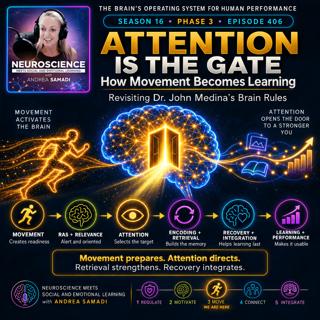
Attention Is the Gate—How Movement Becomes Lasting Learning with Dr. John Medina

Attention Is the Gate—How Movement Becomes Lasting Learning with Dr. John Medina

Episode 406 explains how movement prepares the brain but does not guarantee learning. It traces the full sequence—movement, RAS-driven readiness, salience and relevance, focused attention, encoding, r...

6 Sep 46min
The 4:00 AM Tradeoff: Movement, REM and Recovery (Bonus Episode)

The 4:00 AM Tradeoff: Movement, REM and Recovery (Bonus Episode)

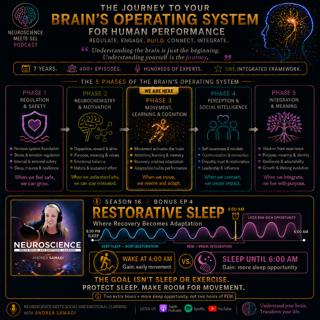
In this episode Andrea Samadi explores how movement and sleep work together in a "brain operating system" for human performance, focusing on restorative sleep (deep + REM), personal WHOOP data, and th...

30 Aug 29min
The Hidden Story Behind Your Resting Heart Rate: What Your RHR Can Reveal About Stress, Recovery & Adaptation

The Hidden Story Behind Your Resting Heart Rate: What Your RHR Can Reveal About Stress, Recovery & Adaptation

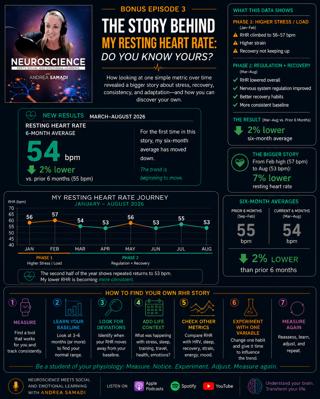
Andrea Samadi shares her personal resting heart rate data to show why measuring over time matters more than fixating on a single score. She explains how trends reveal stress, recovery, and adaptation,...

23 Aug 30min
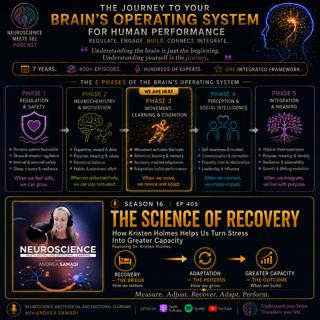
The Science of Recovery—How Dr. Kristen Holmes Helps Us Turn Stress Into Greater Capacity

The Science of Recovery—How Dr. Kristen Holmes Helps Us Turn Stress Into Greater Capacity

In this episode Andrea Samadi explores Phase 3 of the Brain's Operating System—movement, learning, and cognition—focusing on the recovery and adaptation side of the "movement loop." She revisits Dr. K...

16 Aug 45min
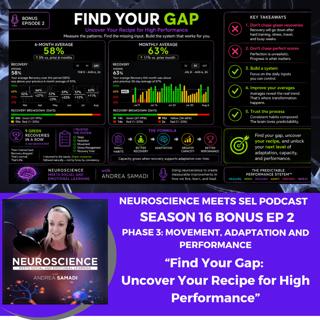
Find Your Gap: How Recovery Unlocks Predictable Performance (Bonus Episode)

Find Your Gap: How Recovery Unlocks Predictable Performance (Bonus Episode)

In this bonus episode Andrea Samadi introduces the Predictable Performance System, a practical roadmap from her Brain’s Operating System. She shows how measuring patterns—not chasing daily scores—plus...

9 Aug 30min
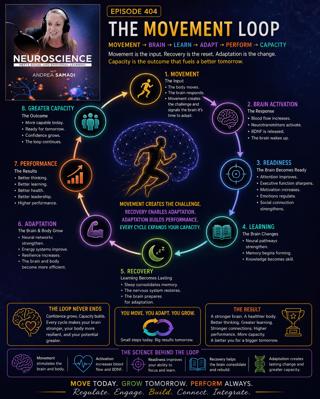
Dr. John Ratey and The Movement Loop: How Movement Becomes Human Performance

Dr. John Ratey and The Movement Loop: How Movement Becomes Human Performance

In this episode Andrea Samadi explores Phase Three of the Brain’s Operating System — how movement acts as the essential input that activates the brain, sharpens attention, boosts learning, and improve...

2 Aug 21min
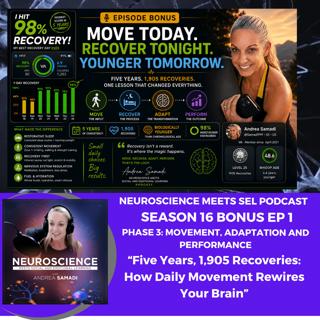
Five Years, 1,905 Recoveries: How Daily Movement Rewires Your Brain (Bonus Episode)

Five Years, 1,905 Recoveries: How Daily Movement Rewires Your Brain (Bonus Episode)

Andrea Samadi shares a five-year self-experiment using a WHOOP wearable to track sleep, recovery, movement, and biological age. She reveals how daily low-intensity movement and consistent recovery—not...

25 Jul 16min
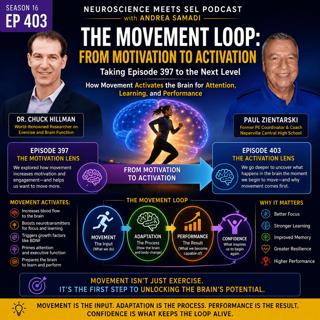
The Movement Loop: How Movement Activates the Brain for Learning, Adaptation & Performance

The Movement Loop: How Movement Activates the Brain for Learning, Adaptation & Performance

Welcome back to Season 16 of the Neuroscience Meets Social and Emotional Learning Podcast. I'm Andrea Samadi, and this is where we bridge neuroscience, social and emotional learning, and human perform...

19 Jul 34min

Populært innen Fakta

fastlegen
dine-penger-pengeradet
relasjonspodden-med-dora-thorhallsdottir-kjersti-idem
foreldreradet
treningspodden
rss-orjasater
jakt-og-fiskepodden
rss-strid
rss-kunsten-a-leve
hverdagspsyken
mikkels-paskenotter
sinnsyn
tomprat-med-gunnar-tjomlid
rss-var-forste-kaffe
gravid-uke-for-uke
lederskap-nhhs-podkast-om-ledelse
babyverden
branncast
fryktlos
rss-det-virker-en-podkast-om-spesialpedagogikk