Neuroleadership Pioneer, Friederike Fabritius on "Achieving Peak Performance"

Neuroleadership Pioneer, Friederike Fabritius on "Achieving Peak Performance"

This is episode #27 with a Pioneer in the field of Neuroleadership and author of the book, The Leading Brain, Friederike Fabritius,[i] all the way from Dusseldorf, Germany. You can watch the interview on YouTube here.

Welcome to the “Neuroscience Meets SEL” podcast, my name is Andrea Samadi, a former educator who has been fascinated with understanding the science behind high performance strategies in schools, sports and the workplace for the past 20 years. Today we have an inspiring speaker who I’ve been following for the past 3 years.

FRIEDERIKE FABRITIUS, MS, is a neuroscientist and pioneer in the field of neuroleadership. She trained at the Max Planck Institute for Brain Research and is an alumna of McKinsey & Company (helping organizations to create change). Friederike delivers brain-based leadership programs to Fortune 500 executives and organizations around the globe to transform how they think, innovate, and navigate change. Her book The Leading Brain: Neuroscience Hacks to Work Smarter, Better, Happier has been translated into several languages and has received numerous awards. Her most recent presentation this year was at Talks at Google[ii] where she describes the recipe for achieving peak performance.

Welcome Friederike! I am beyond excited to be speaking with you today. A warm welcome today as you join us here in Arizona, USA all the way from Germany!

I wanted to let the listeners know that I recorded an episode yesterday[iii] “Simple Strategies for Avoiding the Pitfalls of the 3 Parts of the Brain” so that today we could dive a bit deeper with our time together. If you are listening now and have not heard that episode, be sure to go back and listen to episode #26 as an overview for today.

Q1: I first found you on YouTube when I was searching for a way to understand how our neurotransmitters work in peak performance. I found this video where you explained neuroleadership[iv] just beautifully to top executives in Barcelona, Spain and how we can create peak performance[v] or that flow state we all seek for those high levels of achievement. Can you explain what we need to do to get into peak performance/flow state whether we are an employee looking for improved results in the workplace, an athlete in the field, or a student in the classroom?

Q2: What does flow look and feel like? What can we do to stay in this flow state longer to experience that increased productivity you mention in your book where productivity increases by fivefold?[vi] What is guaranteed to throw us out of flow—so that we don’t do that?

Q3: On our podcast here “The Neuroscience of SEL” we have spoken a lot about self-awareness and understanding our self so we can make the changes needed for improved results. Can you explain why some people need to be challenged in order to perform at their very best, while others need to have less challenge and less stress to do their best work, and what do these people look like in an organization so people listening can recognize what type of person they are on that performance/stress scale?

Q4: We know that the PFC is important for executive functions (like logical thinking, decision-making, or planning) and it’s the part of our brain that determines our level of success in life and with our careers. What strategies do you personally do to strengthen this part of your brain to operate at its best for these high levels of performance?

Q5: What do you think are the next most important parts of the brain for anyone to understand specifically for those who are looking to take new actions or create new habits to achieve higher levels of performance?

Q6: What about mindfulness and meditation? In your book, you mention that “mindfulness has been shown to physically change several regions of the brain in as little as 8 weeks.” Can you explain what parts of the brain mindfulness improves and how this could help people improve their results in life and at work

Q7: In your book, you mention 2 examples of people who didn’t rely on their conscious thinking brain, but they used their unconscious brain to increase the speed, efficiency and accuracy of their performance. The first example was with Sully Sullenberger’s quick thinking with his emergency landing of that plane in the Hudson River and the other was with Wayne Gretzky, who used his unique “hockey sense” to “skate where the puck will be, not where it is.” Can you explain the parts of the brain that are responsible for this gut-instinct or “expert intuition?” and maybe the difference between expert intuition vs just our wishful thinking?

Q8: I could ask you so many more questions but will stick to just one more. It’s about inhibition or the strategy we often use to hide or hold back our real thoughts or feelings about someone or a situation instead of just dealing with them openly with transparency. Can you explain why inhibition is a bad idea, what happens to the brain when we are doing this, what happens to our productivity and a better strategy for people to embrace and acknowledge their thoughts and feelings rather than hide or ignore them?

Q9: Is there anything that you think is important that I might have missed to help listeners implement some hacks for peak performance that will help them to work smarter, better, and happier?

Dr. Freiderike Fabritius it’s been such a pleasure getting to know you. I seriously could have asked you another 10 questions as I found your book fascinating! I love how it offers practical tips and short cuts that anyone can understand and then apply for improved results. The end of chapter summary section was also very helpful for a review of everything covered. For those who would like to learn more about your work they can find your book “The Leading Brain” on Amazon, or Barnes and Noble.[vii] What’s the best way for someone to reach you?

Learn more through your website at https://www.fabulous-brain.com/ , or find you on Linkedin (with your name) and Twitter and Instagram @fabulous_brain

REFERENCES:

[i] https://www.fabulous-brain.com/

[ii] Friederike Fabritius: "Fun, Fear, and Focus: The Neurochemical Recipe for Achieving Peak Performance" | Talks at Google Published Jan.15, 2019 https://www.youtube.com/watch?v=pWi-oCySuFA

[iii]EPISODE 26 “Strategies for Overcoming the Pitfalls of the 3 Parts of Your Brain” https://podcasts.apple.com/us/podcast/strategies-for-overcoming-pitfalls-3-parts-your-brain/id1469683141?i=1000454366492

[iv] Freiderike Fabritius “Neuroleadership: A New Approach” YouTube Published Dec. 11th, 2016 https://www.youtube.com/watch?v=2g4XhlLZ5ak

[v]Friederike Fabritius –“The Leading Brain: Neuroscience hacks to work smarter, better, happier” Published Sept. 29, 2019 https://www.youtube.com/watch?v=bOK612_n2Y0

[vi] Friedrike Fabritius “The Leading Brain: Neuroscience Hacks to Work Smarter, Better, Happier” (Feb.21, 2017) https://www.fabulous-brain.com/the-leading-brain (page 108)

[vii]Friedrike Fabritius “The Leading Brain: Neuroscience Hacks to Work Smarter, Better, Happier” (Feb.21, 2017) https://www.fabulous-brain.com/the-leading-brain

Denne episoden er hentet fra en åpen RSS-feed og er ikke publisert av Podme. Den kan derfor inneholde annonser.

Episoder(405)

Trust as the Foundation with Greg Hill: How Great Leaders Create the Conditions for Learning, Growth and Performance

Trust as the Foundation with Greg Hill: How Great Leaders Create the Conditions for Learning, Growth and Performance

In episode 401 Andrea Samadi welcomes Greg Hill to explore why trust is the essential foundation for learning, growth, and high performance. They discuss how trust creates psychological safety, encour...

27 Jun 37min

Episode 400: Sales Leadership Under Pressure with Majid Samadi: 7 Lessons Learned from 7 Years of Neuroscience

Episode 400: Sales Leadership Under Pressure with Majid Samadi: 7 Lessons Learned from 7 Years of Neuroscience

In this milestone episode (400), Andrea Samadi celebrates seven years of the Neuroscience Meets SEL Podcast with her husband Majid Samadi. They reflect on the journey of translating neuroscience into ...

20 Jun 47min

Phase 2 Review: The Motivation Loop: How to Keep Effort Worthwhile

Phase 2 Review: The Motivation Loop: How to Keep Effort Worthwhile

Episode 399 reviews Phase 2 of Season 15 and introduces the Motivation Loop — the sequence of meaning, belief, attention, action, reward, and recovery that drives sustained effort. The episode explain...

14 Jun 28min

Fun, Fear, Focus: Closing the Motivation Loop with Friederike Fabritius

Fun, Fear, Focus: Closing the Motivation Loop with Friederike Fabritius

Episode 398 revisits neuroscientist Friederike Fabritius (from November 2022) to explain how three ingredients — fun (dopamine), fear (productive challenge), and focus — create the neurochemical condi...

9 Jun 23min

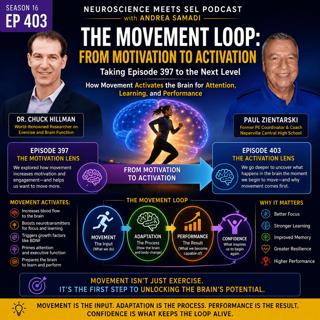
Move to Learn: How Movement Activates the Brain and Fuels Motivation (with Dr. Chuck Hillman and Paul Zientarski)

Move to Learn: How Movement Activates the Brain and Fuels Motivation (with Dr. Chuck Hillman and Paul Zientarski)

Season 15, Episode 397 revisits research and real-world practice showing movement is more than fitness: it activates the brain, boosts attention, enhances learning, and sustains motivation. Dr. Chuck ...

31 Mai 35min

Dopamine, Motivation and Why the Brain Repeats Behavior with Dr. Anna Lembke

Dopamine, Motivation and Why the Brain Repeats Behavior with Dr. Anna Lembke

Host Andrea Samadi welcomes Dr. Anna Lembke to explain how pleasure and pain share the same neural circuitry and how dopamine governs motivation. The episode explores why overconsumption of easy rewar...

24 Mai 23min

Theory of Mind: The Missing Link Between Attention, Reward, and Motivation with John Medina

Theory of Mind: The Missing Link Between Attention, Reward, and Motivation with John Medina

Episode 395 explores how theory of mind — our ability to understand others' intentions — drives attention, emotional relevance, and reward, shaping motivation and behavior. Dr. John Medina explains wh...

17 Mai 37min

Thought Patterns & Neurochemistry — The Hidden Drivers of Your Life (Revisiting Dr. Caroline Leaf)

Thought Patterns & Neurochemistry — The Hidden Drivers of Your Life (Revisiting Dr. Caroline Leaf)

In this episode Andrea Samadi revisits her October 2022 interview with Dr. Caroline Leaf about how our thought patterns act as biological instructions that shape brain chemistry, behavior, and results...

26 Apr 25min

Populært innen Fakta

fastlegen
dine-penger-pengeradet
relasjonspodden-med-dora-thorhallsdottir-kjersti-idem
rss-kunsten-a-leve
foreldreradet
treningspodden
mikkels-paskenotter
sinnsyn
rss-strid-de-norske-borgerkrigene
jakt-og-fiskepodden
hverdagspsyken
rss-var-forste-kaffe
gravid-uke-for-uke
fryktlos
level-up-med-anniken-binz
uroskolen
rss-impressions-2
rss-sarbar-med-lotte-erik
hr-podden-2
rss-mind-body-podden