Irene Lyon, Msc on "The Science Behind Trauma and a Healthy Immune System for an Improved Life"

Irene Lyon, Msc on "The Science Behind Trauma and a Healthy Immune System for an Improved Life"

Welcome back to the Neuroscience Meets Social and Emotional Learning podcast, episode #99 with Irene Lyon[i], MSC. who teaches the world’s leaders and coaches how to work with the nervous system to heal trauma, and live full and productive lives. To date her online programs[ii] have reached people in over 63 countries and Irene clearly has a knack for making complex information easy for ALL of us to understand and apply to our lives, which is exactly the type of person I am always looking for on this podcast.

Watch the interview on YouTube here.

My name is Andrea Samadi, and if you are new here, I’m a former educator who created this podcast to bring the most current neuroscience research, along with high performing experts who have risen to the top of their field, with specific strategies or ideas that you can implement immediately, whether you are an educator, or in the corporate space, to take your results to the next level. If we want to improve our social, emotional and cognitive abilities, it all starts with an understanding of our brain.

Welcome Irene, thank you so much for taking the time to speak with me today, as we are approaching our 100th episode! We are always looking for people who can take complex concepts and help explain them so that we can all use them in our daily lives for improved results, so thank you for being here to help us to better understand trauma, our nervous system and our results.

INTRO: Before we get to the questions, can you explain exactly what you do as a nervous system specialist and somatic neuroplasticity expert and perhaps who some of your mentors were for you when you began this work?

Q1: Since this topic is of high interest, I’m looking forward to diving deeper into the area of trauma so we can all gain more awareness and understanding of what trauma looks like for each person as an individual. I’ve just started to scrape the surface of this topic in the yearlong neurocoaching program I am taking with the study of Joseph LeDoux on trauma, fears, anxiety and memory consolidation. LeDoux says that each person has their own anxiety level, and we respond to trauma or difficult situations in different ways because our brains are “one of a kind, they are wired differently from our genes and our life experiences.” (LeDoux). Can you explain the science of trauma, and why one person could easily walk away from an accident or traumatic situation, yet another person’s life completely unravels with the same incident? What’s happening on the brain level for this to occur?

Q2: Can you explain what you learned from Steven Hoskinson, that pretty much ALL chronic and mental illness (conditions that affect our thinking, feeling, mood and behavior) can be connected to dysregulation of the nervous system and unresolved traumatic stress?

Q3: What is your 21 Day Nervous System Tune Up[iii] where you take people from a sick nervous system with emotional symptoms like depression, anxiety, stress, fatigue, immune system troubles to a healthy nervous system that includes improved sleep, a boosted immunity, elevated energy levels, and a regulated gut health?

We’ve looked closely at Dr. Stephen Porges’ Polyvagal Theory on our episode #59[iv] and most listeners who follow this podcast know of the importance of understanding our Central Nervous System when it comes to managing our stress response, but can you share how you show people how to break through anxiety, burnout and chronic symptoms by healing the nervous system—what you teach in your Smart Body, Smart Mind Course[v]?

Q4: I have to ask you just one question on your dissertation that you wrote in 2008 while pursuing your Masters in Research in Australia within the biomedical and health sciences, since the topic of your dissertation ties into where we have ended the year on this podcast, with a focus on health and anti-aging strategies. I know this area is of high interest for our listeners since episodes that focus on health and the brain has been very popular. You quote the statistic that in 2030, 70 million people in the US will be 65 years and over, what would you say would be the TOP 3 health staples that you have found to be crucial for longevity, mental well-being and health?

Irene, I want to thank you so much for your time and knowledge today. Now more than ever, we all need to understand these strategies to deal with the daily challenges that we are all facing in today’s world. We all need to be intentional about our mental wellbeing and health.

If someone wants to learn more about you, and your courses, they can go to https://irenelyon.com/ or visit your YouTube channel where you have thousands of followers and videos that dive deep into the courses that you offer https://www.youtube.com/c/IreneLyon

https://www.facebook.com/groups/nervoussystem

https://twitter.com/Irene_Lyon

Q6: What closing thoughts do you have that you think we should all be aware of these days when it comes to mental health, well-being and the brain?

RESOURCES:

Using Neuroscience to Understand Fear and Anxiety: A 2 Step Framework by Joseph Ledoux, Ph.D. https://www.cns.nyu.edu/ledoux/pdf/LeDoux%20Pine%20Two%20Systsem.pdf

Neuroscientist Jospeh LeDoux on Anxiety and Fear published on YouTube Sept.28, 2016 https://www.youtube.com/watch?v=87xF-wB9LEs

The Feldenkrais Method for https://feldenkrais.com/

REFERENCES:

[i] Irene Lyon YouTube Channel https://www.youtube.com/watch?v=bO5MneHxOKA

[ii] Irene’s Online Programs https://irenelyon.com/programs/

[iii] 21 Day Nervous System Tune-up https://21daytuneup.com/#cta-1

[iv] Neuroscience Meets Social and Emotional Learning Podcast EPISODE #59 with Suzanne Gundersen https://www.achieveit360.com/suzanne-gundersen-on-the-polyvagal-theory-in-practice/

[v] Smart Body, Smart Mind https://smartbodysmartmind.com/

Denne episoden er hentet fra en åpen RSS-feed og er ikke publisert av Podme. Den kan derfor inneholde annonser.

Episoder(415)

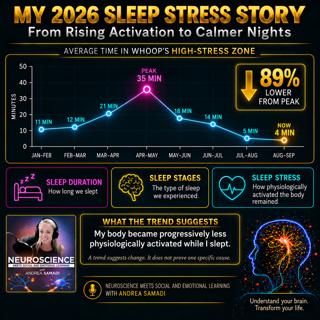
When Sleep Isn't Rest: What 'Sleep Stress' Reveals About Recovery (Bonus Episode)

When Sleep Isn't Rest: What 'Sleep Stress' Reveals About Recovery (Bonus Episode)

In this episode Andrea Samadi explains the concept of sleep stress — a wearable-device measured how physiologically activated your body remains during sleep — and places it within a neuroscience-based...

13 Sep 41min
Attention Is the Gate—How Movement Becomes Lasting Learning with Dr. John Medina

Attention Is the Gate—How Movement Becomes Lasting Learning with Dr. John Medina

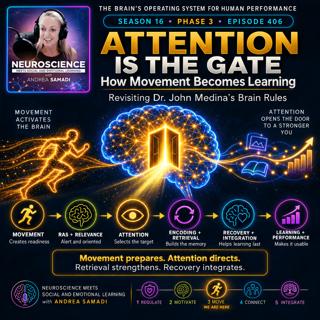
Episode 406 explains how movement prepares the brain but does not guarantee learning. It traces the full sequence—movement, RAS-driven readiness, salience and relevance, focused attention, encoding, r...

6 Sep 46min
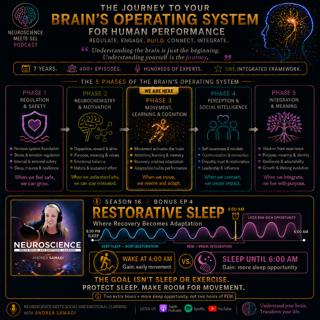
The 4:00 AM Tradeoff: Movement, REM and Recovery (Bonus Episode)

The 4:00 AM Tradeoff: Movement, REM and Recovery (Bonus Episode)

In this episode Andrea Samadi explores how movement and sleep work together in a "brain operating system" for human performance, focusing on restorative sleep (deep + REM), personal WHOOP data, and th...

30 Aug 29min
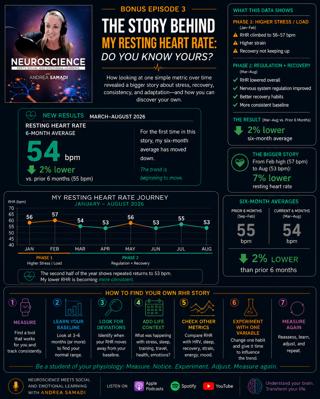
The Hidden Story Behind Your Resting Heart Rate: What Your RHR Can Reveal About Stress, Recovery & Adaptation (Bonus Episode)

The Hidden Story Behind Your Resting Heart Rate: What Your RHR Can Reveal About Stress, Recovery & Adaptation (Bonus Episode)

Andrea Samadi shares her personal resting heart rate data to show why measuring over time matters more than fixating on a single score. She explains how trends reveal stress, recovery, and adaptation,...

23 Aug 30min
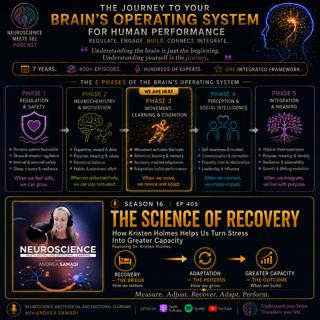
The Science of Recovery—How Dr. Kristen Holmes Helps Us Turn Stress Into Greater Capacity

The Science of Recovery—How Dr. Kristen Holmes Helps Us Turn Stress Into Greater Capacity

In this episode Andrea Samadi explores Phase 3 of the Brain's Operating System—movement, learning, and cognition—focusing on the recovery and adaptation side of the "movement loop." She revisits Dr. K...

16 Aug 45min
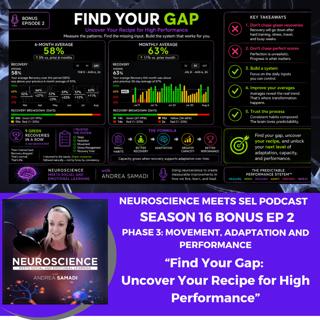
Find Your Gap: How Recovery Unlocks Predictable Performance (Bonus Episode)

Find Your Gap: How Recovery Unlocks Predictable Performance (Bonus Episode)

In this bonus episode Andrea Samadi introduces the Predictable Performance System, a practical roadmap from her Brain’s Operating System. She shows how measuring patterns—not chasing daily scores—plus...

9 Aug 30min
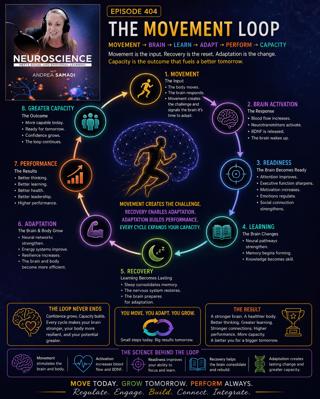
Dr. John Ratey and The Movement Loop: How Movement Becomes Human Performance

Dr. John Ratey and The Movement Loop: How Movement Becomes Human Performance

In this episode Andrea Samadi explores Phase Three of the Brain’s Operating System — how movement acts as the essential input that activates the brain, sharpens attention, boosts learning, and improve...

2 Aug 21min
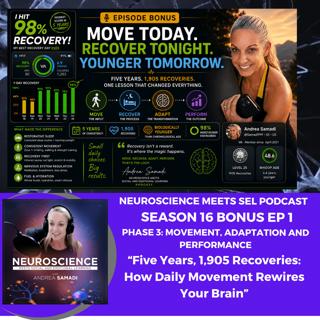
Five Years, 1,905 Recoveries: How Daily Movement Rewires Your Brain (Bonus Episode)

Five Years, 1,905 Recoveries: How Daily Movement Rewires Your Brain (Bonus Episode)

Andrea Samadi shares a five-year self-experiment using a WHOOP wearable to track sleep, recovery, movement, and biological age. She reveals how daily low-intensity movement and consistent recovery—not...

25 Jul 16min

Populært innen Fakta

fastlegen
dine-penger-pengeradet
relasjonspodden-med-dora-thorhallsdottir-kjersti-idem
rss-strid
treningspodden
foreldreradet
rss-orjasater
jakt-og-fiskepodden
rss-kunsten-a-leve
hverdagspsyken
rss-bisarr-historie
rss-impressions-2
mikkels-paskenotter
sinnsyn
level-up-med-anniken-binz
takk-og-lov-med-anine-kierulf
rss-var-forste-kaffe
gravid-uke-for-uke
nevropodden
fryktlos