Dr. Kelley Munger and Megan Marcus from FuelEd Schools "Developing Emotionally Intelligent Educators Who Create Relationship-Driven Schools"

Dr. Kelley Munger and Megan Marcus from FuelEd Schools "Developing Emotionally Intelligent Educators Who Create Relationship-Driven Schools"

Welcome back to the Neuroscience Meets Social and Emotional Learning Podcast, episode #105 with Dr. Keeley Munger (researcher) and Megan Marcus, (founder) of FuelEd, a non-profit organization that builds educator emotional intelligence and relationship-driven schools.

Watch the interview on YouTube here.

Here’s some background on our guests today, before we get into the questions:

Megan Marcus holds a bachelor’s degree in psychology from the University of California at Berkeley and masters’ degrees in psychology from Pepperdine University and in education, policy, & management from Harvard University. She served as lead researcher for the book, The Social Neuroscience of Education: Optimizing Attachment & Learning in the Classroom,[i] which explores how teacher-student relationships trigger neural plasticity and optimal academic, social and emotional learning. Her experiences working on this book while training to be a counselor served as both inspiration and the research foundations for FuelEd.

Dr. Kelley Munger crafts and executes research projects that enhance our understanding of social and emotional development in educational environments while also bridging the gap between science and practice. What a perfect match for the Neuroscience Meets Social and Emotional Learning podcast. Welcome Megan and Kelley.

When I saw that you were focused on educator SEL at FuelEd and that my career began as a classroom teacher over 20 years ago with a classroom of behavioral students that I couldn’t manage, I knew I had to speak with you and learn more about what you have built with FuelEd that is having such a significant impact on our schools. Thanks so much for being here today.

    I know how important educator SEL is from not only all of the SEL experts that I have been interviewing on this podcast, but personally since I found my first year of teaching behavioral students to be extremely difficult without any emotional intelligence skills to draw from, since these skills were left out of my teacher training. Can you tell me more about why you decided to focus on working directly with educators instead of students at FuelEd? I did an episode when I first launched this podcast on the Why Behind Implementing an SEL program in your school or District, or an emotional intelligence program in the workplace, but with all of your research, What do you think is the best starting place when it comes to helping educators grow socially and emotionally? We all know that it was an incredibly difficult year (last year) with many schools thrown into distance learning last spring with the start of the Pandemic. How do you see this year impacting the emotional lives of educators specifically? What do you think educators will need in order to address the large-scale trauma and stress they have experienced this year? It’s been a few years now, but in 2018 I entered an educational policy contest to see if I could help put more of a focus on educator well-being with this awareness.

The premise of the paper that I wrote that didn’t win the contest, but was a great learning experience, was that “Teaching has become a high-stress occupation, leading to educator burnout, demoralization1 in the profession, and eventual instructor dropout, creating a negative impact on society and costing $7.3B in the United States with all of the training that needs to occur. Recent studies have shown that “students’ cortisol levels were much higher if the educator was overwhelmed or experiencing burn-out.”3 “People are finally seeing what negative stress does to the body, what that does to the psyche, and what it does to school engagement. I spent hours researching this topic and met some incredible people who were doing research in this area. When I first began presenting on the topic of stress and the brain in 2016, I saw that schools in Canada seemed to be ahead of us here in the US, putting a huge focus on this topic back then. Why do you think this is such an important topic, and what do you think teachers wish that their leaders understood about educator mental health?

    You mentioned a story about A veteran teacher who has always loved teaching told you recently that, after the stress of this year, he hates his job now. What are your most innovative ideas for restoring teachers and preventing them from leaving the field? For Megan: What inspired you to launch FuelEd and how did you meet Kelley?

For those who want to learn more about your programs, they can go to https://www.fueledschools.org/ click on programs and schedule a call with you to learn more. Can you give an overview of the programs that you offer at FuelEd?

FuelEd Programs:

Core Educator Collective, Empathy School and Trauma and Transitions https://www.fueledschools.org/our-programs

For webinars from FuelEd https://www.fueledschools.org/events

Kelley Munger on LinkedIn https://www.linkedin.com/in/kelley-munger-phd-lpc-ncc-836190107/

Megan Marcus on LinkedIn https://www.linkedin.com/in/megan-marcus-99517921/

@FuelEd on Instagram https://www.instagram.com/fueledschools

RESOURCES:

Neuroscience Meets SEL Podcast EPISODE #7 “Building Relationships in Today’s Schools” with Assistant Superintendent Greg Wolcott https://www.achieveit360.com/assistant-superintendent-greg-wolcott-on-building-relationships-in-todays-classrooms/

Neuroscience Meets SEL Podcast EPISODE #64 Assistant Superintendent Greg Wolcott on “Making Connections with Neuroscience and SEL” https://www.achieveit360.com/assistant-superintendent-greg-wolcott-on-making-connections-with-neuroscience-and-sel/

Unleashing the Power of Relationships in Today’s Schools https://www.significant72.com/

Attachment Theory with Dr. Daniel Siegel Published on YouTube March 3, 2011 https://www.youtube.com/watch?v=zovtRq4e2E

Dr. Daniel J Siegel “Name it to Tame it” Published on YouTube December 8, 2014. https://www.youtube.com/watch?v=ZcDLzppD4Jc&ab_channel=DalaiLamaCenterforPeaceandEducation

“Social and Emotional Learning, Teacher Well-Being, and Student Success: What Do We Know? And Where do We Go From Here?” Webinar June 5th 2018 with Dr. Mark Greenber, Penn State and Dr. Kimberly A. Schonert-Reichl https://vimeo.com/275147739

Stress Contagion Possible Amongst Students and Teachers: UBC Study https://news.ubc.ca/2016/06/27/ubc-study-finds-stress-contagion-amongst-students-and-teachers/

Dr. Kimberly Schonert-Reichl (UBC Faculty of Education) and Advisory Board Member for FuelEd https://sel.ecps.educ.ubc.ca/dr-kimberly-schonert-reichl/

Neuroscience Meets SEL Podcast Episode #2 “Self-Awareness: Know Thyself” https://andreasamadi.podbean.com/e/self-awareness-know-thyself/

(#5 most listened to podcast of all time).

Neuroscience Meets SEL Podcast Episode #9 “Using Your Brain to Build and Sustain Effective Relationships” https://andreasamadi.podbean.com/e/how-to-build-and-sustain-effective-relationships/

REFERENCES:

[i] The Social Neuroscience of Education: Optimizing Attachment & Learning in the Classroom by Louis Cozolino (Norton & Company, January 7, 2013). Why https://wwnorton.com/books/9780393706093

Denne episoden er hentet fra en åpen RSS-feed og er ikke publisert av Podme. Den kan derfor inneholde annonser.

Episoder(415)

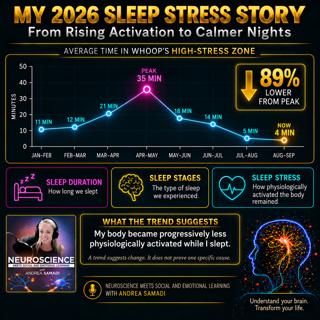
When Sleep Isn't Rest: What 'Sleep Stress' Reveals About Recovery (Bonus Episode)

When Sleep Isn't Rest: What 'Sleep Stress' Reveals About Recovery (Bonus Episode)

In this episode Andrea Samadi explains the concept of sleep stress — a wearable-device measured how physiologically activated your body remains during sleep — and places it within a neuroscience-based...

13 Sep 41min
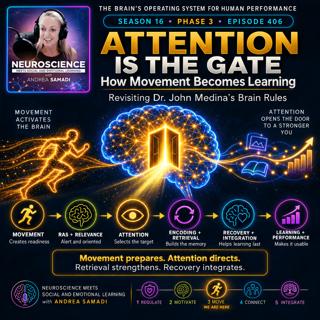
Attention Is the Gate—How Movement Becomes Lasting Learning with Dr. John Medina

Attention Is the Gate—How Movement Becomes Lasting Learning with Dr. John Medina

Episode 406 explains how movement prepares the brain but does not guarantee learning. It traces the full sequence—movement, RAS-driven readiness, salience and relevance, focused attention, encoding, r...

6 Sep 46min
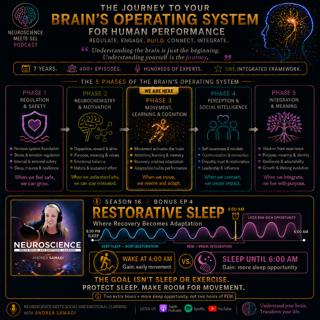
The 4:00 AM Tradeoff: Movement, REM and Recovery (Bonus Episode)

The 4:00 AM Tradeoff: Movement, REM and Recovery (Bonus Episode)

In this episode Andrea Samadi explores how movement and sleep work together in a "brain operating system" for human performance, focusing on restorative sleep (deep + REM), personal WHOOP data, and th...

30 Aug 29min
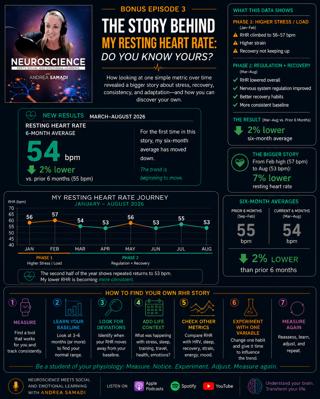
The Hidden Story Behind Your Resting Heart Rate: What Your RHR Can Reveal About Stress, Recovery & Adaptation (Bonus Episode)

The Hidden Story Behind Your Resting Heart Rate: What Your RHR Can Reveal About Stress, Recovery & Adaptation (Bonus Episode)

Andrea Samadi shares her personal resting heart rate data to show why measuring over time matters more than fixating on a single score. She explains how trends reveal stress, recovery, and adaptation,...

23 Aug 30min
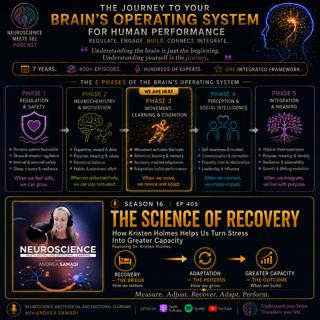
The Science of Recovery—How Dr. Kristen Holmes Helps Us Turn Stress Into Greater Capacity

The Science of Recovery—How Dr. Kristen Holmes Helps Us Turn Stress Into Greater Capacity

In this episode Andrea Samadi explores Phase 3 of the Brain's Operating System—movement, learning, and cognition—focusing on the recovery and adaptation side of the "movement loop." She revisits Dr. K...

16 Aug 45min
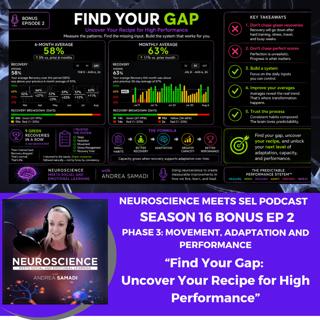
Find Your Gap: How Recovery Unlocks Predictable Performance (Bonus Episode)

Find Your Gap: How Recovery Unlocks Predictable Performance (Bonus Episode)

In this bonus episode Andrea Samadi introduces the Predictable Performance System, a practical roadmap from her Brain’s Operating System. She shows how measuring patterns—not chasing daily scores—plus...

9 Aug 30min
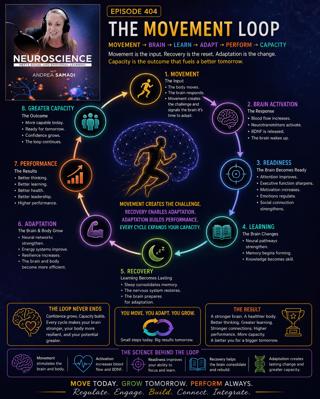
Dr. John Ratey and The Movement Loop: How Movement Becomes Human Performance

Dr. John Ratey and The Movement Loop: How Movement Becomes Human Performance

In this episode Andrea Samadi explores Phase Three of the Brain’s Operating System — how movement acts as the essential input that activates the brain, sharpens attention, boosts learning, and improve...

2 Aug 21min
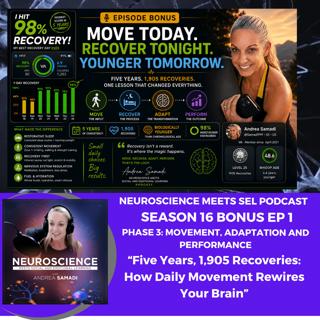
Five Years, 1,905 Recoveries: How Daily Movement Rewires Your Brain (Bonus Episode)

Five Years, 1,905 Recoveries: How Daily Movement Rewires Your Brain (Bonus Episode)

Andrea Samadi shares a five-year self-experiment using a WHOOP wearable to track sleep, recovery, movement, and biological age. She reveals how daily low-intensity movement and consistent recovery—not...

25 Jul 16min

Populært innen Fakta

fastlegen
dine-penger-pengeradet
relasjonspodden-med-dora-thorhallsdottir-kjersti-idem
rss-strid
treningspodden
foreldreradet
rss-orjasater
jakt-og-fiskepodden
rss-bisarr-historie
rss-kunsten-a-leve
takk-og-lov-med-anine-kierulf
hverdagspsyken
sinnsyn
rss-impressions-2
mikkels-paskenotter
rss-var-forste-kaffe
level-up-med-anniken-binz
gravid-uke-for-uke
nevropodden
fryktlos