Brain Fact Friday on "Training Your Brain to Self-Regulate Automatic Negative Thoughts and Emotions"

Brain Fact Friday on "Training Your Brain to Self-Regulate Automatic Negative Thoughts and Emotions"

Welcome back to the Neuroscience Meets Social and Emotional Learning Podcast, for our second Brain Fact Friday! When we recorded episode #109[i] we announced we would be pulling out an important Brain Fact every Friday to dive deep into some of the brain-based strategies we are offering in each episode, so we can be sure to implement these important concepts in our schools, workplaces and lives.

BRAIN FACT: Here’s our Brain Fact for this week from Horacio Sanchez, who we had an insightful interview with for Episode #111[ii] on his new book “Finding Solutions to the Poverty Problem.”

“Did you know that when we engage in inner speech, all the mechanisms of outer speech and the auditory process activate in the brain. Therefore, what we say to ourselves is just like hearing it said by someone else to us. Inform students (and ourselves) that inner speech can build them up or destroy them.” (Horacio Sanchez)[iii]

I brought up the damaging effects of Automatic Negative Thinking on one of our early episodes, #14 on Self-Regulation[iv]. The skill of managing our thoughts, emotions and behavior comes under the competency of self-regulation (one of the 6 social and emotional learning competencies that we covered in the beginning episodes of this podcast).

What is Self-Regulation and Why is it So Important?

It’s “the ability to manage your emotions and behavior in accordance with the demands of the situation. It includes being able to resist highly emotional reactions to upsetting stimuli, to calm yourself down when you get upset, adjust to a change in expectations and (the ability) to handle frustration”[v] In other words, it’s the ability to bounce back after a setback or disappointment, and the ability to stay in congruence with your inner value system.

Using Self-Regulation to Manage Negative Thinking in the Workplace

I’ve got to say, this topic has come up recently as stress in the workplace is at an all-time high. Things are going to happen on a day to basis that you might not like, and you might have the urge to say every negative thought in your head, out loud, in the heat of the moment, to get your point across. Then, we could spend the rest of the day brewing over the incident and playing the negative thoughts over and over again. We must have a strategy to stop them from ruminating or continuing in a loop, since we know that switching off these negative thoughts is an important step towards self-regulation, moving forward and preventing further problems. Besides, Horacio’s quote tells us that this type of negative thinking can destroy us.

An effective strategy used in cognitive behavioral therapy[vi] is to say the word “SWITCH” in your head as you focus on switching the negative emotion that you feel to something more positive. This takes some practice, that’s for sure. I’ve always used the strategy of saying “STOP” when this happens and changing the thought pattern in my head to something more productive.

Also, remembering to RESPOND to situations with questions to dig deeper, and learn more, instead of REACTING with emotion is always a better solution.

When difficult situations arise, we have three choices. We can approach (by asking questions), avoid, or attack.[vii] The best results obviously occur when we are able to respond to a situation (approaching it with understanding) rather than react (by avoidance or attack) by asking questions to uncover more and see if there might be something we are missing or some sort of miscommunication that could explain the conflict. We always have a choice on how we respond to situations. The research is clear that mindfulness and meditation can help increase the gap between a stimulus and our response to it, so those who have developed their own practice, will find making this choice to respond vs react, much easier.[viii]

How to Teach Self-Regulation to Our Children or Students?

The ability to control one's behavior, emotions, and thoughts is an integral skill to be taught to young children as well, so they can form and maintain healthy relationships and connections later in life.[ix] This skill is crucial to develop as we all know that life is full of ups and downs and we must be able to navigate through challenging situations before we can reach any level of achievement and success. We all know people who seem to bounce back after adversity. It’s not by luck or chance, it’s because they have learned how to self-regulate and intentionally get back on course. This is a learned skill and one that we must teach or model to our students/children for them to be able to master it as adults.

Why is This Such an Important Skill?

Horacio Sanchez’s brain fact says it all. If we don’t teach children (or ourselves) a strategy to stop automatic negative thoughts, or ways to respond instead of react to distressing situations, our brain will hear these thoughts, and think they are true. We all know of the impact of negative thinking on our results. Our inner speech has the ability to build us up or destroy us.

“Keep my words positive. Words become my behaviors. Keep my behaviors positive. Behaviors become my habits. Keep my habits positive. Habits become my values. Keep my values positive. Values become my destiny.” (Mahatma Gandhi)

I hope you have enjoyed our second episode of Brain Fact Friday! Stay tuned for episode #112 next week with Troy Busot, the founder of Athlinks.com[x] on “Health, Chasing 50, and The Secrets to Launching a Successful Business.”

RESOURCES:

Your Brain Can Be Trained to Self-Regulate Negative Thinking January 10, 2016 by Christopher Bergland-The Athlete’s Way https://www.psychologytoday.com/us/blog/the-athletes-way/201601/your-brain-can-be-trained-self-regulate-negative-thinking?amp

ANTS Workbook Grades 1-12 https://www.teacherspayteachers.com/Product/Automatic-Negative-Thoughts-ANTs-Workbook-1103094

REFERENCES:

[i] Neuroscience Meets SEL Podcast Episode #109 with Andrea Samadi https://andreasamadi.podbean.com/e/achieving-quantum-leap-results-using-price-pritchetts-you-squared-principles/

[ii] Neuroscience Meets SEL Podcast Episode #11 with Horacio Sanchez on “Finding Solutions to The Poverty Problem” https://andreasamadi.podbean.com/e/resiliency-expert-and-author-horacio-sanchez-on-finding-solutions-to-the-poverty-problem/

[iii] Horacio Sanchez on LinkedIn https://www.linkedin.com/posts/hsanchezceo_neuroscience-education-activity-6770706945264386048-BDCn

[iv] Neuroscience Meets SEL Episode #14 with Andrea Samadi on “Self-Regulation: The Foundational Learning Skill for Future Success” https://andreasamadi.podbean.com/e/self-regulation-the-foundational-learning-skill-for-future-success/

[v] Edutopia article “Teaching Self-Regulation by Modeling” (January, 2019) https://www.edutopia.org/video/teaching-self-regulation-modeling

[vi] What is Cognitive Behavioral Therapy with Therapist Kati Morton YouTube uploaded Sept. 23, 2013 https://www.youtube.com/watch?v=g7B3n9jobus

[vii] How to Practice Self-Regulation https://www.verywellmind.com/how-you-can-practice-self-regulation-4163536

[viii] Mindfulness, Meditation and Executive Control https://academic.oup.com/scan/article/8/1/85/1694475

[ix] How to Practice Self-Regulation https://www.verywellmind.com/how-you-can-practice-self-regulation-4163536

[x] www.athlinks.com

Denne episoden er hentet fra en åpen RSS-feed og er ikke publisert av Podme. Den kan derfor inneholde annonser.

Episoder(407)

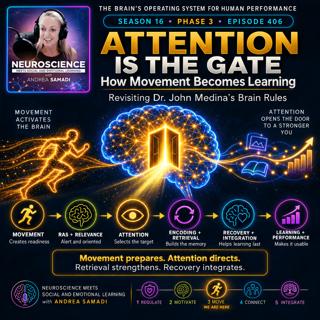
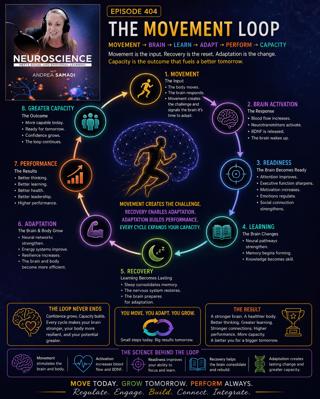
The Movement Loop: How Movement Activates the Brain for Learning, Adaptation & Performance

The Movement Loop: How Movement Activates the Brain for Learning, Adaptation & Performance

Welcome back to Season 16 of the Neuroscience Meets Social and Emotional Learning Podcast. I'm Andrea Samadi, and this is where we bridge neuroscience, social and emotional learning, and human perform...

19 Jul 34min

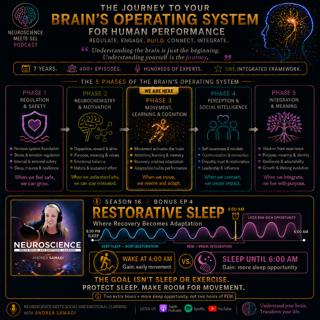
How Movement Builds the Brain, the Body & Human Performance (Phase 3 Introduction)

How Movement Builds the Brain, the Body & Human Performance (Phase 3 Introduction)

Season 16, Episode 402 explores the Brain's Operating System for Human Performance, focusing on Phase 3: movement, adaptation, and performance. Andrea Samadi explains how movement triggers neurochemic...

12 Jul 25min

Trust as the Foundation with Greg Hill: How Great Leaders Create the Conditions for Learning, Growth and Performance

Trust as the Foundation with Greg Hill: How Great Leaders Create the Conditions for Learning, Growth and Performance

In episode 401 Andrea Samadi welcomes Greg Hill to explore why trust is the essential foundation for learning, growth, and high performance. They discuss how trust creates psychological safety, encour...

27 Jun 37min

Episode 400: Sales Leadership Under Pressure with Majid Samadi: 7 Lessons Learned from 7 Years of Neuroscience

Episode 400: Sales Leadership Under Pressure with Majid Samadi: 7 Lessons Learned from 7 Years of Neuroscience

In this milestone episode (400), Andrea Samadi celebrates seven years of the Neuroscience Meets SEL Podcast with her husband Majid Samadi. They reflect on the journey of translating neuroscience into ...

20 Jun 47min

Phase 2 Review: The Motivation Loop: How to Keep Effort Worthwhile

Phase 2 Review: The Motivation Loop: How to Keep Effort Worthwhile

Episode 399 reviews Phase 2 of Season 15 and introduces the Motivation Loop — the sequence of meaning, belief, attention, action, reward, and recovery that drives sustained effort. The episode explain...

14 Jun 28min

Fun, Fear, Focus: Closing the Motivation Loop with Friederike Fabritius

Fun, Fear, Focus: Closing the Motivation Loop with Friederike Fabritius

Episode 398 revisits neuroscientist Friederike Fabritius (from November 2022) to explain how three ingredients — fun (dopamine), fear (productive challenge), and focus — create the neurochemical condi...

9 Jun 23min

Move to Learn: How Movement Activates the Brain and Fuels Motivation (with Dr. Chuck Hillman and Paul Zientarski)

Move to Learn: How Movement Activates the Brain and Fuels Motivation (with Dr. Chuck Hillman and Paul Zientarski)

Season 15, Episode 397 revisits research and real-world practice showing movement is more than fitness: it activates the brain, boosts attention, enhances learning, and sustains motivation. Dr. Chuck ...

31 Mai 35min

Dopamine, Motivation and Why the Brain Repeats Behavior with Dr. Anna Lembke

Dopamine, Motivation and Why the Brain Repeats Behavior with Dr. Anna Lembke

Host Andrea Samadi welcomes Dr. Anna Lembke to explain how pleasure and pain share the same neural circuitry and how dopamine governs motivation. The episode explores why overconsumption of easy rewar...

24 Mai 23min

Populært innen Fakta

fastlegen
dine-penger-pengeradet
relasjonspodden-med-dora-thorhallsdottir-kjersti-idem
foreldreradet
mikkels-paskenotter
rss-kunsten-a-leve
treningspodden
rss-strid-de-norske-borgerkrigene
sinnsyn
gravid-uke-for-uke
rss-sarbar-med-lotte-erik
tomprat-med-gunnar-tjomlid
hverdagspsyken
rss-var-forste-kaffe
fryktlos
dopet
tid-for-historie
hva-er-greia-med
rss-kunstig-intelligens-med-elisabeth-maren-og-morten
babyverden