Brain Fact Friday: "Understanding How We Learn: Declarative vs Procedural Systems"

Brain Fact Friday: "Understanding How We Learn: Declarative vs Procedural Systems"

Welcome back to the Neuroscience Meets Social and Emotional Learning Podcast, for Brain Fact Friday and episode #131. Of all the Brain Fact Fridays, so far, this one really made me stop, think and make connections to past episodes, and how the brain learns.

To view images in the show notes, click here.

Welcome back, I'm Andrea Samadi, a former educator who has been fascinated with understanding the science behind high performance strategies in schools, sports, and the workplace for the past 20 years. If you have been listening to our podcast, you will know that we’ve uncovered that if we want to improve our social and emotional skills, and experience success in our work and personal lives, it all begins with an understanding of our brain.

This week’s brain fact came to me when I was asked to appear this past weekend, on Naomi Toland’s[i] Live Q and A with Barbara Oakley[ii] the author of many books, including Learning How to Learn[iii] to ask her a question related to how the brain learns.

In this episode, you will learn:

✔︎ The 2 Major Ways the Brain Learns

✔︎ The difference between these 2 modes of Learning: Declarative and Procedural Learning

✔︎ Why one of type of learning might work better for one student than the other.

✔︎ Aha Moments for the Classroom, Sports and Beyond.

The first question for Barbara on this call caught my attention, and it was from Phil Stringer[iv], a Department Head of Math, Research Chair of Applied Cognitive Science from Vancouver, Canada, and it was his question that got me thinking. He asked, “how can we move away from a grades-based culture, to a learning culture…or the idea of using points and grades verses just feedback for students” and I got my pencil out right away, knowing that there are a few schools near me who don’t use grades at all. Students just complete assignments, receive feedback, and work at their own pace. Some students are very happy working in this environment, and I wondered what Barbara, the expert on teaching and learning, would say.

How the Brain Learns:

Her answer blew us all away. The feedback after this event continued all night. She shared her screen and explained that the brain learns through two major systems:

The Declarative System: which is like when I am teaching something. Declarative links in the brain occur because we have listened to an explanation of something. The information goes from the working memory, through the hippocampus and puts the new information into long-term memory. I thought back to EPISODE #127[v] “How Emotions Impact Learning and the Brain” and thought how important it is to be sure that students are making connections with their learning with what’s important to them, to sear the new learning and information at the brain level using emotion. Since we “feel” therefore we learn.[vi]

The Procedural System: Is built when we practice a skill over and over again without thinking about it. This new information goes through the Basal Ganglia in the brain and deposits the new learning or new skill learned into the long-term memory. Todd Woodcroft talked about this idea on EPISODE #38[vii] with “The Daily Grind in the NHL” and Dr. John Dunlosky mentioned it in EPISODE #37[viii] when he spoke about the importance of spaced repetition as the most effective cognitive strategy for student success.

We need both types of learning when learning a new language, math, sports, or when we are learning anything, but Barbara reminds us that some people like to learn declaratively, (with an explanation) like people with Dyslexia, and others on the Autism Spectrum Disorder prefer to learn more procedurally, (with practice) if you are applying this to the classroom.

(Source: Barbara Oakley with Naomi Toland and Phil Stringer) https://www.youtube.com/watch?v=pAwzdCc8EPY

This brings us to this week’s Brain Fact Friday:

“We want people to learn both declaratively (through an explanation) or procedurally (by practicing a skill over and over again) but what we learn procedurally, we cannot explain.” Barbara Oakley

AHA Moments for the Classroom

If you have been asking your students to explain every step with their math problems, remember that some mathematical concepts have been acquired procedurally, and they won’t be able to explain it. This doesn’t mean they don’t understand the concept, they just cannot explain it back to you declaratively. Barbara Oakley further explains that “you could even destroy their interest in learning the subject if you force them to explain every step.”

Think About This:

Have you ever asked a student or your own child to explain something and they say, “Oh this is just how I do it?” This is because they were taught the skill using the procedural system and they cannot explain it to you.

Making Connections:

Friederike Fabritius, from EPISODE #27[ix], covers in her book, The Leading Brain: Neuroscience Hacks to Work Smarter, Better, Happier the process of procedural learning or “Intuitive Decisions” as she calls it. She offers the example of when Captain “Sully” Sullenberger explained that he was able to make that safe, emergency landing in the Hudson River that saved all 155 passengers, because he said “for forty-two years, I’ve been making small, regular deposits in this bank of experience, education and training. And on January 15th the balance was sufficient that I was able to make a withdrawal.”[x] He acted intuitively, after years of experience.

She also explained this concept with Wayne Gretzky, who is considered to be the greatest hockey player of all time because his years of experience and practice on the ice gave him what many fans consider “hockey sense” or knowing how to be in the right place at the right time. These “intuitive decisions” come without thinking and Friederike shares that it could even be “disruptive” if you ask someone to explain “how” exactly they do what they do.

To Sum up Brain Fact Friday:

“We want people to learn both declaratively (through an explanation) or procedurally (by practicing a skill over and over again) but what we learn procedurally, we cannot explain.” Barbara Oakley

The procedural system recognizes patterns and helps you to react quickly, so don’t eliminate rote learning from the classroom, just don’t call it Drill and Kill. Call it something more positive, Barbara suggests, like Drill and Skill. And don’t forget that when learning procedurally, you need to provide feedback immediately. Don’t delay the feedback as this breaks the pattern made, and will make it harder for the student to learn the new skill effectively.

We all learned from Phil Stringer’s question: and were reminded that too much focus on grades or points has a detrimental impact on student learning, but testing a student is one of the most effective ways to help students to learn, since it provides the perfect amount of stress to motivate the student to perform.

I hope you can see the importance of thinking about these 2 ways that our brains acquire new information, and that it opens up your thinking, like it opened up mine. I’m no longer going to ask my children to explain every step in their math problems, and trust that they have learned the steps procedurally.

See you next week where we will have another Case Study, of a fascinating woman, from my hometown of Toronto, who is otherwise known as “The Woman Who Changed Her Brain.”[xi]

REFERENCES:

[i] Naomi Toland’s Live Q and A with Barbara Oakley https://www.youtube.com/watch?v=pAwzdCc8EPY

[ii] https://barbaraoakley.com/books/

[iii] Learning How to Learn by Barbara Oakley Published August 7, 2018 https://barbaraoakley.com/books/learning-how-to-learn/

[iv] Phil Stringer on Twitter https://twitter.com/xphils and YouTube https://www.youtube.com/user/StringerCHS

[v] Neuroscience Meets Social and Emotional Learning Podcast EPISODE #127 “The Impact of Emotions on Learning and the Brain” https://andreasamadi.podbean.com/e/brain-fact-friday-how-emotions-impact-learning-memory-and-the-brain/

[vi] Mary Helen Immordino Yang Emotions, Learning and the Brain (November 16, 2015) https://www.amazon.com/Emotions-Learning-Brain-Implications-Neuroscience/dp/0393709817

[vii] Neuroscience Meets Social and Emotional Learning Podcast EPISODE #38 with Todd Woodcroft on “The Daily Grind in the NHL” https://andreasamadi.podbean.com/e/assistant-coach-to-the-winnipeg-jets-todd-woodcroft-on-the-daily-grind-in-the-nhl/

[viii] Neuroscience Meets Social and Emotional Learning Podcast EPISODE #37 https://andreasamadi.podbean.com/e/kent-states-dr-john-dunlosky-on-improving-student-success-some-principles-from-cognitive-science/

[ix] Neuroscience Meets Social and Emotional Learning Podcast EPISODE #27 with Friederike Fabritius on “Achieveing Peak Performance” https://andreasamadi.podbean.com/e/pioneer-in-the-field-of-neuroleadership-friederike-fabritius-on-the-recipe-for-achieving-peak-performance/

[x] The Leading Brain by Friederike Fabritius page 147 https://www.amazon.com/Leading-Brain-Science-Based-Strategies-Performance/dp/014312935X

[xi] The Woman Who Changed Her Brain TEDx Toronto Published April 27, 2013 https://www.youtube.com/watch?v=o0td5aw1KXA

Denne episoden er hentet fra en åpen RSS-feed og er ikke publisert av Podme. Den kan derfor inneholde annonser.

Episoder(407)

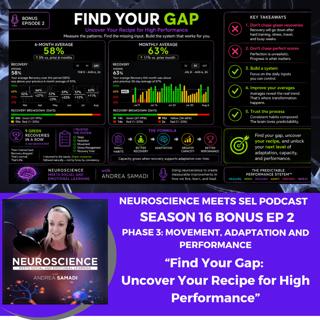
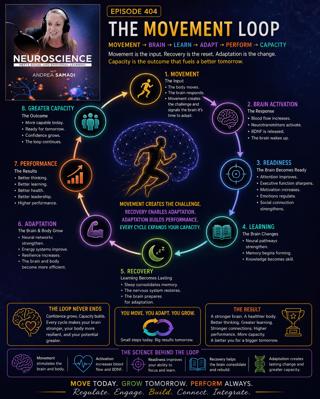
The Movement Loop: How Movement Activates the Brain for Learning, Adaptation & Performance

The Movement Loop: How Movement Activates the Brain for Learning, Adaptation & Performance

Welcome back to Season 16 of the Neuroscience Meets Social and Emotional Learning Podcast. I'm Andrea Samadi, and this is where we bridge neuroscience, social and emotional learning, and human perform...

19 Jul 34min

How Movement Builds the Brain, the Body & Human Performance (Phase 3 Introduction)

How Movement Builds the Brain, the Body & Human Performance (Phase 3 Introduction)

Season 16, Episode 402 explores the Brain's Operating System for Human Performance, focusing on Phase 3: movement, adaptation, and performance. Andrea Samadi explains how movement triggers neurochemic...

12 Jul 25min

Trust as the Foundation with Greg Hill: How Great Leaders Create the Conditions for Learning, Growth and Performance

Trust as the Foundation with Greg Hill: How Great Leaders Create the Conditions for Learning, Growth and Performance

In episode 401 Andrea Samadi welcomes Greg Hill to explore why trust is the essential foundation for learning, growth, and high performance. They discuss how trust creates psychological safety, encour...

27 Jun 37min

Episode 400: Sales Leadership Under Pressure with Majid Samadi: 7 Lessons Learned from 7 Years of Neuroscience

Episode 400: Sales Leadership Under Pressure with Majid Samadi: 7 Lessons Learned from 7 Years of Neuroscience

In this milestone episode (400), Andrea Samadi celebrates seven years of the Neuroscience Meets SEL Podcast with her husband Majid Samadi. They reflect on the journey of translating neuroscience into ...

20 Jun 47min

Phase 2 Review: The Motivation Loop: How to Keep Effort Worthwhile

Phase 2 Review: The Motivation Loop: How to Keep Effort Worthwhile

Episode 399 reviews Phase 2 of Season 15 and introduces the Motivation Loop — the sequence of meaning, belief, attention, action, reward, and recovery that drives sustained effort. The episode explain...

14 Jun 28min

Fun, Fear, Focus: Closing the Motivation Loop with Friederike Fabritius

Fun, Fear, Focus: Closing the Motivation Loop with Friederike Fabritius

Episode 398 revisits neuroscientist Friederike Fabritius (from November 2022) to explain how three ingredients — fun (dopamine), fear (productive challenge), and focus — create the neurochemical condi...

9 Jun 23min

Move to Learn: How Movement Activates the Brain and Fuels Motivation (with Dr. Chuck Hillman and Paul Zientarski)

Move to Learn: How Movement Activates the Brain and Fuels Motivation (with Dr. Chuck Hillman and Paul Zientarski)

Season 15, Episode 397 revisits research and real-world practice showing movement is more than fitness: it activates the brain, boosts attention, enhances learning, and sustains motivation. Dr. Chuck ...

31 Mai 35min

Dopamine, Motivation and Why the Brain Repeats Behavior with Dr. Anna Lembke

Dopamine, Motivation and Why the Brain Repeats Behavior with Dr. Anna Lembke

Host Andrea Samadi welcomes Dr. Anna Lembke to explain how pleasure and pain share the same neural circuitry and how dopamine governs motivation. The episode explores why overconsumption of easy rewar...

24 Mai 23min

Populært innen Fakta

fastlegen
dine-penger-pengeradet
relasjonspodden-med-dora-thorhallsdottir-kjersti-idem
foreldreradet
treningspodden
mikkels-paskenotter
rss-kunsten-a-leve
rss-strid-de-norske-borgerkrigene
sinnsyn
hverdagspsyken
rss-sarbar-med-lotte-erik
gravid-uke-for-uke
tomprat-med-gunnar-tjomlid
dopet
fryktlos
rss-kunstig-intelligens-med-elisabeth-maren-og-morten
hva-er-greia-med
tid-for-historie
rss-var-forste-kaffe
babyverden