Expert in Psychology, Cognitive Neuroscience and Neurotechnology, Howard Rankin Ph.D. on ”How Not to Think”

Expert in Psychology, Cognitive Neuroscience and Neurotechnology, Howard Rankin Ph.D. on ”How Not to Think”

Welcome back to the Neuroscience Meets Social and Emotional Learning Podcast for episode #146 with Dr. Howard Rankin, the host of the “How Not to Think Podcast” that runs on the premise that "People aren't logical, they're psychological with the emphasis on the psycho," which made me laugh at the same time as it made me think “How are we NOT supposed to think?” and the research on this topic began.

Watch the interview on YouTube here. https://www.youtube.com/watch?v=1DlnOXE39aQ

Learn more about Dr. Howard Rankin here https://hownottothink.com/

See past episodes here https://www.achieveit360.com/episodes/

On this episode, you will learn:

✔︎ What is the problem with our thinking, and why is it illogical?

✔︎ How awareness is important when making any decision.

✔︎ The importance of looking at things from a different perspective.

✔︎ Why "the more we know, the more we realize we know nothing at all."

✔︎ Why new knowledge opens up our world to new possibilities.

✔︎ How to motivate anyone to learn something new.

✔︎ Why reality is an illusion.

✔︎ Common problems that occur with our human thinking process and how to be aware of them.

✔︎ How self-limiting beliefs influence our results.

I'm Andrea Samadi, author and educator from Toronto, now in Arizona, and like many of our listeners, have been fascinated with learning and understanding the science behind high performance strategies in our schools, sports, and the workplace with ideas that we can all use, understand and implement immediately, for improved results.

This week’s guest, Dr. Rankin, an expert in cognitive neuroscience, recently published his book I Think Therefore I Am Wrong[i] which looks at the many ways we can sabotage our thinking through cognitive biases, binary thinking, false assumptions and numerous other strategies. The How Not To think Podcast[ii] based on his book, examines how this false reasoning manifests itself in many areas of society through myths, and 'conventional wisdom.' On his podcast that I will be a guest on, Howard speaks with leaders in their fields to examine the impact of faulty thinking that occurs in every sphere of life.

Dr. Rankin has extensive expertise and knowledge in the areas of psychology, cognitive neuroscience and neurotechnology. He is also an experienced speaker and best-selling and award-winning author. Dr. Rankin has written 12 books in his own name, co-written another 9, and ghostwritten 30 others, all non-fiction. He has also published more than 30 scientific articles and been a consultant to the NIH and WHO (World Health Organization). His work has been featured in many newspapers and magazines and he has appeared on national networks including CNN, ABC, CBS, BBC, and on “The View” and “20/20”. He hosts the podcast How Not To Think and is the author of I Think Therefore I Am Wrong: A Guide to Bias, Political Correctness, Fake News and The Future of Mankind.

Let’s meet Dr. Rankin and see what we can learn about improving how we think.

Welcome Dr. Rankin, thank you for being here today to share your knowledge and insights on your recent book, I Think, Therefore I am Wrong that you say is about Epistemology, what our past speaker, Tom Beakbane, on episode #144 said was the origin of his book How to Understand Everything[iii]. Can we start right away with the most obvious question?

Q1: What is the problem with our thinking, how is it illogical, and why are people psychological, with an emphasis on the psycho?

Q2: What inspired you to write your book, and launch your podcast on this topic?

Q3: I love making connections with past speakers and what I see with your work, I connected with Tom Beakbane’s book on How to Understand Everything where he talks a lot about looking at things from a different angle. With all the books you’ve written, you’ve got the knack for uncovering ways to tell something from a different angle, in a way that someone might not have heard it in that way. Why is it important to be able to see things from a different perspective? What does this do to our thinking?

Q4: I was talking with my good friend Greg Link from Stephen Covey’s organization the other day, after one of my last podcasts, and after some discussion I came to the realization that the more I am learning through these interviews, the more I realize I don’t know anything at all! Greg told me that quote originated from the American author Warner Ehrhard who was quoting the Greek Stoic Philosopher Epictetus What do you think about this? The more we are learning, why does it take us into a rabbit hole where we realize we have no idea about anything at all?

Q5: Chapter 1 of your book is titled “Is Reality an Illusion” and Einstein said this. What does that mean?

Q6: What is logic and why do you think it’s involved with some of the problems you see with our thinking?

Q7: What about our beliefs or more specifically, our self-limiting beliefs? What are they and how do they influence our results?

Q8: How does neuroscience or an understanding of how our brain works tie into our thinking and behavior?

Q9: What should we all know and understand about “How Not to Think” for educators, or those in the corporate workspace?

Thank you very much Dr. Rankin for your time today to share your thoughts, ideas, books and podcast as tools and resources for those who would like to learn more about How Not to Think.

To learn more about Dr. Howard Rankin

Facebook page; https://www.facebook.com/HowardRankinBooks/

A website where he posts blogs: https://ithinkthereforeiamwrong.com/

LinkedIn and Instagram

Email: DrHRankin@gmail.com

WEBSITE FOR THIS TOPIC www.hownottothink.com

FOLLOW ANDREA SAMADI:

YouTube Channel: https://www.youtube.com/c/AndreaSamadi

Website https://www.achieveit360.com/

LinkedIn: https://www.linkedin.com/in/samadi/

Facebook: https://www.facebook.com/Achieveit360com

Neuroscience Meets SEL Facebook Group https://www.facebook.com/groups/2975814899101697

Twitter: https://twitter.com/andreasamadi

Instagram: https://www.instagram.com/andreasamadi/

RESOURCES:

Daniel Kahneman’s Grip with Behavioral Economics April 26, 2013 https://www.thedailybeast.com/daniel-kahnemans-gripe-with-behavioral-economics

Power Talk, the Art of Effective Communication by Howard Rankin, Ph.D. Published Feb. 24, 2021 https://www.amazon.com/dp/B08XJLJ6SN/ref=dp-kindle-redirect?_encoding=UTF8&btkr=1

REFERENCES:

[i] https://ithinkthereforeiamwrong.com/the-book/

[ii] https://podcasts.apple.com/us/podcast/how-not-to-think/id1488982079

[iii] Neuroscience Meets Social and Emotional Learning Podcast EPISODE #144 with Tom Beakbane on “How to Understand Everything” https://andreasamadi.podbean.com/e/author-and-marketer-tom-beakbane-on-how-to-understand-everything-consilience-a-new-way-to-look-at-the-world/

Denne episoden er hentet fra en åpen RSS-feed og er ikke publisert av Podme. Den kan derfor inneholde annonser.

Episoder(407)

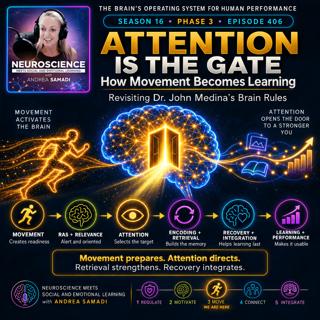
The Movement Loop: How Movement Activates the Brain for Learning, Adaptation & Performance

The Movement Loop: How Movement Activates the Brain for Learning, Adaptation & Performance

Welcome back to Season 16 of the Neuroscience Meets Social and Emotional Learning Podcast. I'm Andrea Samadi, and this is where we bridge neuroscience, social and emotional learning, and human perform...

19 Jul 34min

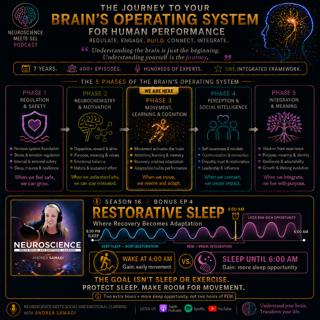
How Movement Builds the Brain, the Body & Human Performance (Phase 3 Introduction)

How Movement Builds the Brain, the Body & Human Performance (Phase 3 Introduction)

Season 16, Episode 402 explores the Brain's Operating System for Human Performance, focusing on Phase 3: movement, adaptation, and performance. Andrea Samadi explains how movement triggers neurochemic...

12 Jul 25min

Trust as the Foundation with Greg Hill: How Great Leaders Create the Conditions for Learning, Growth and Performance

Trust as the Foundation with Greg Hill: How Great Leaders Create the Conditions for Learning, Growth and Performance

In episode 401 Andrea Samadi welcomes Greg Hill to explore why trust is the essential foundation for learning, growth, and high performance. They discuss how trust creates psychological safety, encour...

27 Jun 37min

Episode 400: Sales Leadership Under Pressure with Majid Samadi: 7 Lessons Learned from 7 Years of Neuroscience

Episode 400: Sales Leadership Under Pressure with Majid Samadi: 7 Lessons Learned from 7 Years of Neuroscience

In this milestone episode (400), Andrea Samadi celebrates seven years of the Neuroscience Meets SEL Podcast with her husband Majid Samadi. They reflect on the journey of translating neuroscience into ...

20 Jun 47min

Phase 2 Review: The Motivation Loop: How to Keep Effort Worthwhile

Phase 2 Review: The Motivation Loop: How to Keep Effort Worthwhile

Episode 399 reviews Phase 2 of Season 15 and introduces the Motivation Loop — the sequence of meaning, belief, attention, action, reward, and recovery that drives sustained effort. The episode explain...

14 Jun 28min

Fun, Fear, Focus: Closing the Motivation Loop with Friederike Fabritius

Fun, Fear, Focus: Closing the Motivation Loop with Friederike Fabritius

Episode 398 revisits neuroscientist Friederike Fabritius (from November 2022) to explain how three ingredients — fun (dopamine), fear (productive challenge), and focus — create the neurochemical condi...

9 Jun 23min

Move to Learn: How Movement Activates the Brain and Fuels Motivation (with Dr. Chuck Hillman and Paul Zientarski)

Move to Learn: How Movement Activates the Brain and Fuels Motivation (with Dr. Chuck Hillman and Paul Zientarski)

Season 15, Episode 397 revisits research and real-world practice showing movement is more than fitness: it activates the brain, boosts attention, enhances learning, and sustains motivation. Dr. Chuck ...

31 Mai 35min

Dopamine, Motivation and Why the Brain Repeats Behavior with Dr. Anna Lembke

Dopamine, Motivation and Why the Brain Repeats Behavior with Dr. Anna Lembke

Host Andrea Samadi welcomes Dr. Anna Lembke to explain how pleasure and pain share the same neural circuitry and how dopamine governs motivation. The episode explores why overconsumption of easy rewar...

24 Mai 23min

Populært innen Fakta

fastlegen
dine-penger-pengeradet
relasjonspodden-med-dora-thorhallsdottir-kjersti-idem
foreldreradet
treningspodden
mikkels-paskenotter
rss-strid-de-norske-borgerkrigene
rss-kunsten-a-leve
hverdagspsyken
sinnsyn
rss-sarbar-med-lotte-erik
gravid-uke-for-uke
dopet
fryktlos
tomprat-med-gunnar-tjomlid
rss-bisarr-historie
hva-er-greia-med
rss-impressions-2
jakt-og-fiskepodden
rss-var-forste-kaffe