Brain Fact Friday ”Using Neuroscience to Improve Our Work Lives”

Brain Fact Friday ”Using Neuroscience to Improve Our Work Lives”

“Did you know that the brains of people who are chronically burnt-out show similar damage as people who have experienced trauma”[i] and that “burnout reduces the connectivity between different parts of the brain which can lead to decreased creativity, working memory, and problem solving skills?” (Vanessa Van Edwards).

It’s incorrect to assume that burnout is just an emotional response to long hours or a challenging job. Instead, scientific evidence shows that burnout takes a profound physical toll that ripples well beyond our professional lives.

For this week’s Brain Fact Friday, I want to cover the importance of understanding how serious workplace burnout is at the brain level. After releasing our 3rd interview this season on work burnout, I realized just how important this topic is to you, the listener, with all the comments that came in to me this week on this topic. There is a serious need for us to ALL recognize when we have too much on our plate, so that we take immediate action without feeling like we are giving up on our company, ourselves, our goals or dreams. I also don’t want to discourage anyone from putting in the extra work, or effort that is required to reach the top of your industry, or whatever it is that you are working on that might require a push at this time, so, my hope with this episode is that we can find the right balance to get to wherever it is we are going, in one piece, so that we can enjoy life when we get there, and have enough energy left so that we can continue moving forward and attain new goals, reaching new heights and achievement along the way.

For returning guests, welcome back, and for those who are new here, I’m Andrea Samadi, author, and educator, with a passion for learning, understanding difficult concepts, and breaking them down so that we can all use and apply the most current research to improve our productivity and results in our schools, sports environments, and modern workplaces. On today’s EPISODE #213, “The Neuroscience Behind Work Burnout” we are going to look at what’s happening in the brain when we are under considerable workplace stress, so that we can recognize this often swept under the rug concept, and put some solutions into place immediately, to prevent the effects of this epidemic called burnout, with an understanding of what’s happening at the brain level.

“Using cutting-edge techniques, integrative research teams are demonstrating that burnout is not just a state of mind, but a condition that leaves its mark on the brain as well as the body. Just as the impact of burnout that stifles healthy professional growth, emerging research shows that the chronic psychosocial stress that characterizes burnout not only impairs people’s personal and social functioning, it also can overwhelm their cognitive skills and neuroendocrine systems — eventually leading to distinctive changes in the anatomy and functioning of the brain.”[ii]

Dr. Bessel van der Kolk[iii] (psychiatrist, author of the book The Body Keeps the Score[iv]) draws on more than thirty years at the forefront of research and clinical practice, to show the characteristics of the brain of someone who has experienced trauma and research now shows these characteristics are showing up in the brains of employees who are chronically burnt out.

What to look for:

    Fear-Driven Brain: People who have experienced trauma (or are under chronic stress) will have a brain with enhanced threat perception (or see danger where others see things can be manageable). (Van der Kolk)

THINK ABOUT THIS…

If you are under chronic stress, do you see threat or danger often? For example—do you think others are out to get you? This could be that your threat perception has been enhanced from chronic stress and a signal for you to slow down.

    Unusual Outbursts or Increased Moodiness: Burnout Enlarges Our Amygdala (our emotional center in the brain) and can increase moodiness. (Vanessa Van Edwards).

THINK ABOUT THIS…

If you notice someone around you is unusually moody, it might be their brain’s reaction to their increased stress. Instead of snapping back at them, see if you can help them to find ways to decrease their stress levels. When we work with our brain in mind, we can find solutions to problems, instead of jumping to conclusions or assumptions (which is easy to do).

    Inability to Think: Burnout reduces the neural connections in the brain, causing decreased creativity, working memory and problem solving skills. (Vanessa Van Edwards).

THINK ABOUT THIS…

While under stress, do you find it difficult to think? I relate to this one the most because I cannot write these podcast episodes unless the house is quiet. In order for thinking, creativity, problem solving and memory consolidation to occur, our brain must be working optimally. I know we have said it often on this podcast—“when our brain works right, we work right” (Dr. Daniel Amen) and if you can’t think, this is a red flag that something needs to change.

All of this seems common sense, but just because we know something, it doesn’t mean it’s common practice. How many of you have noticed these stress related situations, and pushed through, ignoring all of the stressors that face us daily. Most of us…

But did you know that The World Health Organization added burnout to the International Classification of Diseases Index in 2019. It defines burnout as “resulting from chronic workplace stress that has not been successfully managed”[v] and in our last interview with Dr. Sharon Grossman[vi] this week, being able to recognize when we are feeling stressed, is the first step towards being able to better manage ourselves, before it becomes chronic, impacting our brain and cognition.

Christina Maslach, a professor emerita of psychology at University of California Berkeley developed a way to measure burnout with an inventory[vii] that can predict burnout before it occurs and two of her inventory items we spoke about on our last episode.

Control: Do workers have enough autonomy (like the example we used with the employee with no control over their schedule). How does control work in your organization? Do employees ever get double booked on calls, (adding stress and pressure to their day) or do they have the ability to set boundaries for what they can and cannot do in the day (making their schedule manageable)?

Reward: Does the company recognize when employees go above and beyond with recognition, and rewards that motivate employees to work harder, and put in that extra effort? Do they reward hard working employees outside of their working hours? If not, employees will eventually tire of this hard work, without any reward, and engagement will decrease.

Both of these situations can lead to an employee disengaging from their work. The first example, the worker becomes over-engaged and without the needed breaks, their cognition will be affected, and eventually their health, (which I watched happen to someone I know this week, while writing this episode and thinking “that person is showing the classic signs of burn out” and sure enough, they did, before the week ended and they were forced to slow down) or the second example, will lead to under-engagement, without a challenging, stimulating environment, leading the employee to check out mentally from their work which means their health will also be at risk, in addition to their productivity.

What Should We All Know About Work Burnout?

“It is estimated that 40% of office workers in the United States and Canada are burnt-out and this statistic is even higher in industries like medicine and athletics which have 50% and 60% burnout rates respectively.”[viii] This is exactly what we heard from Dr. Sharon Grossman who works mostly with doctors and high level CEOs, not to mention even the highly successful journalist, Arianna Huffington who learned the hard way that ignoring these red flags connected to our wellness will not allow any of to escape unscathed as she “collapsed from exhaustion, hit her head on her desk, and broke her cheekbone”[ix] when she ignored these signs.

For this week’s Brain Fact Friday, I didn’t want to paint the picture that there is something wrong with hard work. I watch hard workers excel all the time, and they amaze me with their ability to perform at high levels, consistently, without complaining, just quietly working and hitting goal after goal, moving them forward one step at a time, with the tenacity that comes from a mix of their vision, and being dedicated to their craft. I just want to highlight that in this quest for whatever it is we are working on, if we notice something in off where we are either overly engaged, or under engaged with our work, that ignoring these signs won’t get us anywhere.

Putting our brain health and well-being first, which is the theme of our podcast this season,

REMEMBER FOR THIS WEEK’S BRAIN FACT FRIDAY:

“That the brains of people who are chronically burnt-out show similar damage as people who have experienced trauma”[x] and that “burnout reduces the connectivity between different parts of the brain which can lead to decreased creativity, working memory, and problem solving skills” (Vanessa Van Edwards) and if we want to be at our best, increase our creativity, solve problems and have a stellar memory, then it all begins with optimizing our brain by managing our levels of stress.

And with that, I hope everyone has a relaxing weekend, and we will see you next week with Dr. Marie Gervais[xi], who specializes in the future of work, workplace communication and productivity, as well as the well known Chey and Pav[xii], my good friends from Toronto from the @staffpodcast.

Our interview with Harvard’s Dr. Baland Jalal[xiii] on the bizarre lessons we can learn from our dream world will be coming at the end of the following week, as he is traveling, but this interview is one that you won’t want to miss. It’s going to be an exciting month. Rest up, and See you next week.

FOLLOW ANDREA SAMADI:

YouTube Channel: https://www.youtube.com/c/AndreaSamadi

Website https://www.achieveit360.com/

LinkedIn: https://www.linkedin.com/in/samadi/

Facebook: https://www.facebook.com/Achieveit360com

Neuroscience Meets SEL Facebook Group https://www.facebook.com/groups/2975814899101697

Twitter: https://twitter.com/andreasamadi

Instagram: https://www.instagram.com/andreasamadi/

REFERENCES:

[i]How to Fight Burnout and Get Unstuck by Vanessa Van Edwards https://www.scienceofpeople.com/burnout/#:~:text=The%20brains%20of%20people%20who,memory%20and%20problem%20solving%20skills.

[ii] Burnout and the Brain January 29, 2016 by Alexandra Michel https://www.psychologicalscience.org/observer/burnout-and-the-brain

[iii] https://www.besselvanderkolk.com/

[iv] The Body Keeps the Score by Bessel van der Kolk https://www.besselvanderkolk.com/resources/the-body-keeps-the-score

[v] Experiencing Job Burnout by Orlando Mayorquin May 2, 2022 https://www.usatoday.com/story/life/health-wellness/2022/05/02/what-is-job-burnout-stress/7411686001/

[vi] Neuroscience Meets Social and Emotional Learning Podcast EPISODE #212 with Dr. Sharon Grossman https://andreasamadi.podbean.com/e/the-burnout-doc-sharon-grossman-phd-on-a-research-based-approach-to-preventing-work-burnout-from-the-inside-out/

[vii] Factor structure of the Maslach Burnout Inventory: An analysis of data from large scale cross-sectional surveys of nurses from eight countries Published 2009, April 10 https://www.ncbi.nlm.nih.gov/pmc/articles/PMC2700194/

[viii] How to Fight Burnout and Get Unstuck by Vanessa Van Edwards https://www.scienceofpeople.com/burnout/#:~:text=The%20brains%20of%20people%20who,memory%20and%20problem%20solving%20skills.

[ix] Arianna Huffington: What You Need to Know to Prevent Burnout By Brit Morse, INC. https://www.inc.com/brit-morse/arianna-huffington-wellbeing-stress-burnout.html

[x]How to Fight Burnout and Get Unstuck by Vanessa Van Edwards https://www.scienceofpeople.com/burnout/#:~:text=The%20brains%20of%20people%20who,memory%20and%20problem%20solving%20skills.

[xi] https://shiftworkplace.com/the-spirit-of-work/

[xii] www.cheyandpav.com

[xiii] Dr. Baland Jalal https://psychology.fas.harvard.edu/people/baland-jalal

Denne episoden er hentet fra en åpen RSS-feed og er ikke publisert av Podme. Den kan derfor inneholde annonser.

Episoder(408)

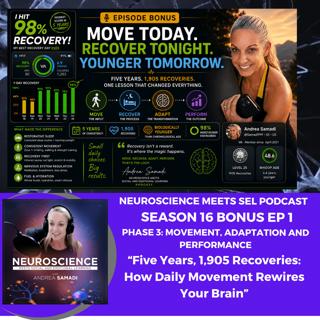
Five Years, 1,905 Recoveries: How Daily Movement Rewires Your Brain (Bonus Episode)

Five Years, 1,905 Recoveries: How Daily Movement Rewires Your Brain (Bonus Episode)

Andrea Samadi shares a five-year self-experiment using a WHOOP wearable to track sleep, recovery, movement, and biological age. She reveals how daily low-intensity movement and consistent recovery—not...

25 Jul 0s

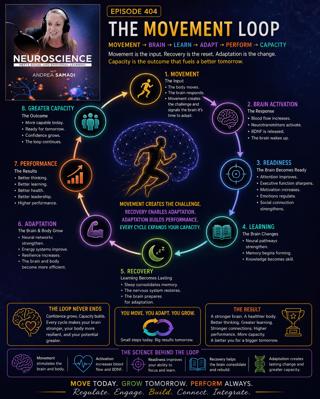
The Movement Loop: How Movement Activates the Brain for Learning, Adaptation & Performance

The Movement Loop: How Movement Activates the Brain for Learning, Adaptation & Performance

Welcome back to Season 16 of the Neuroscience Meets Social and Emotional Learning Podcast. I'm Andrea Samadi, and this is where we bridge neuroscience, social and emotional learning, and human perform...

19 Jul 34min

How Movement Builds the Brain, the Body & Human Performance (Phase 3 Introduction)

How Movement Builds the Brain, the Body & Human Performance (Phase 3 Introduction)

Season 16, Episode 402 explores the Brain's Operating System for Human Performance, focusing on Phase 3: movement, adaptation, and performance. Andrea Samadi explains how movement triggers neurochemic...

12 Jul 25min

Trust as the Foundation with Greg Hill: How Great Leaders Create the Conditions for Learning, Growth and Performance

Trust as the Foundation with Greg Hill: How Great Leaders Create the Conditions for Learning, Growth and Performance

In episode 401 Andrea Samadi welcomes Greg Hill to explore why trust is the essential foundation for learning, growth, and high performance. They discuss how trust creates psychological safety, encour...

27 Jun 37min

Episode 400: Sales Leadership Under Pressure with Majid Samadi: 7 Lessons Learned from 7 Years of Neuroscience

Episode 400: Sales Leadership Under Pressure with Majid Samadi: 7 Lessons Learned from 7 Years of Neuroscience

In this milestone episode (400), Andrea Samadi celebrates seven years of the Neuroscience Meets SEL Podcast with her husband Majid Samadi. They reflect on the journey of translating neuroscience into ...

20 Jun 47min

Phase 2 Review: The Motivation Loop: How to Keep Effort Worthwhile

Phase 2 Review: The Motivation Loop: How to Keep Effort Worthwhile

Episode 399 reviews Phase 2 of Season 15 and introduces the Motivation Loop — the sequence of meaning, belief, attention, action, reward, and recovery that drives sustained effort. The episode explain...

14 Jun 28min

Fun, Fear, Focus: Closing the Motivation Loop with Friederike Fabritius

Fun, Fear, Focus: Closing the Motivation Loop with Friederike Fabritius

Episode 398 revisits neuroscientist Friederike Fabritius (from November 2022) to explain how three ingredients — fun (dopamine), fear (productive challenge), and focus — create the neurochemical condi...

9 Jun 23min

Move to Learn: How Movement Activates the Brain and Fuels Motivation (with Dr. Chuck Hillman and Paul Zientarski)

Move to Learn: How Movement Activates the Brain and Fuels Motivation (with Dr. Chuck Hillman and Paul Zientarski)

Season 15, Episode 397 revisits research and real-world practice showing movement is more than fitness: it activates the brain, boosts attention, enhances learning, and sustains motivation. Dr. Chuck ...

31 Mai 35min

Populært innen Fakta

fastlegen
dine-penger-pengeradet
relasjonspodden-med-dora-thorhallsdottir-kjersti-idem
treningspodden
foreldreradet
mikkels-paskenotter
rss-strid-de-norske-borgerkrigene
hverdagspsyken
rss-kunsten-a-leve
sinnsyn
gravid-uke-for-uke
fryktlos
rss-sarbar-med-lotte-erik
dopet
rss-bisarr-historie
tomprat-med-gunnar-tjomlid
jakt-og-fiskepodden
sovnlos
rss-impressions-2
rss-renters-rente