UPDATE: One Year Later on ”My Personal Review of the Fisher Wallace Wearable Sleep Device for Anxiety, Depression, and Sleep Management”

UPDATE: One Year Later on ”My Personal Review of the Fisher Wallace Wearable Sleep Device for Anxiety, Depression, and Sleep Management”

Welcome back to The Neuroscience Meets Social and Emotional Learning Podcast, where we cover the science-based evidence behind social and emotional learning (for schools) and emotional intelligence training (in the workplace) with tools, ideas and strategies that we can all use for increased results.

I’m Andrea Samadi, an author, and educator with a passion for learning specifically on the topics of health, wellbeing and productivity, and launched this podcast to share how important an understanding of our brain is for our everyday life and results--whether we are a teacher in the classroom, or in the modern workplace.

For today’s episode, I wanted to look back over the past 3 years and cover the most asked question that I receive via email, which stems from EPISODE #120 from last April 2021, on “My Personal Review of the Fisher Wallace Wearable Medical Device for Anxiety, Depression, Sleep and Stress Management”[i] which remains our most listened to episode of all time. We do have all of our past interviews that you can watch on YouTube[ii] and I would like to review our Top 25 in the near future (as chosen by YOU) because this is one very powerful list, with some surprises, and others who have remained at the top of the list every time I look. Until then, I thought I’d answer the most asked question that comes in to me via email since it has to do with this most downloaded episode.

It’s no surprise that EPISODE #120 of “My Personal Review of the Fisher Wallace Wearable Medical Device” has had over 5,500+ downloads since we know that there has been “a global increase in depression and anxiety with tens of millions of additional cases reported globally in 2020”[iii] and from the emails I’ve received, it’s clear that people are searching for answers.

The question that I’ve answered the most since publishing that episode is:

“Do you still use the Fisher Wallace Device that you reviewed last year? If so, why?”

If you want to review our interview with Kelly Roman, the CEO of Fisher Wallace[iv] that markets this wearable medical device, that’s cleared by the FDA, for depression, insomnia and anxiety, I’ll link our interview from last February 2021[v] in the show notes and you can learn directly from Kelly Roman on why this device was described by Forbes as “one of four technologies innovating mental health.”

But to answer this question:

I absolutely, 100% still use the Fisher Wallace wearable device, every day for two 20 minute intervals.

***It’s important to note that this is not a paid endorsement of the product. When I interviewed Kelly Roman, I had not yet tried the device, and during the interview I mentioned that my brain scan with Amen Clinics showed signs of sleep deprivation,[vi] and I didn’t know how exactly I should fix that, other than “get more sleep.” At the end of the interview, Kelly offered to send me a device to try and see what I noticed, and I agreed. While the details of this interview I had to review to remember, I didn’t forget that I I didn’t plan on wearing the device past the trial period. I remember thinking “I’ll see what happens” and just couldn’t imagine that this device would become a part of my daily routine along with my morning meditation.

***Also, another important reminder that I am not a medical doctor, and none of the advice, ideas or strategies I offer on this podcast should be taken as medical advice.

Back to the question…Do you still use the Fisher Wallace device, and why?

When I went back and reviewed the interview myself, I remember that I had never heard of a wearable device that was designed for anxiety, depression and insomnia. Even though these devices are not new, Kelly Roman shared with me that they actually originated from Russia in the 1960s and were called “electrosleep” devices, yet I still had never heard of a device like this for home use.

While I knew my sleep could use improving, I definitely didn’t suffer from insomnia, that neuroscientist Matt Walker dives deep into on his most recent podcast where he reminds us that insomnia, the most common sleep disorder affects ½ people and is classified when we have either “difficulty falling asleep, difficulty staying asleep or not feeling refreshed or restored by our sleep the next day.”[vii]

None of these were me, but I had been measuring my sleep for months before trying the device and knew I could improve the time I was waking up at night, without knowing it, (which is called our WASO score- or wakefulness after sleep onset) so I took Kelly up on his offer to try the device to see if it could help me to stay asleep longer.

He was right with how simple and easy it was to try it out. While my device was gifted to me, I would have gladly paid the $500 fee to try it out. I recently saw for people who are on their mailing list, the price was to just a couple of hundred dollars since this interview, and remains at a discounted price on their website. Kelly did mention that the more products they sold, the more they could reduce the pricing to make this wearable device comparable to something like the Whoop that we’ve talked about often. The device arrived 2 days after the interview, via FEDEX and I began my clinical trial testing the product at home, using a FITBIT.

RECAP of 2021 RESULTS: Sleep Results After Using the Fisher Wallace Device for Five Weeks

I took this study seriously, and measured sleep each night for 5 weeks, with one week establishing my baseline. When I sent Kelly Roman my results, he suggested that I look at each week using the device, compared to the baseline of 5 hours and 28 minutes of sleep. In week 1 there was not much change due to that one night I worked late, week 2 showed an increase in 35 minutes of sleep, Week 3 an increase of 23 minutes, week 4, an increase of 42 minutes, and week 5, the same increase of 42 minutes above the baseline. According to Kelly Roman, 20 minutes of sleep increase is what he says would be the gold standard minimum that doesn’t seem like a lot but allows for improved REM sleep and over time he says reduces sleep debt.

This was powerful to hear that my study showed an increase of much more that this gold standard of 20 minutes’ improvement showing me that the device worked better than I realized before I had shown Kelly these results.

When asked, “what results did you get from your trial?”, I share this fact, and just tell people to try it out, and see what it does for you. If you like it, keep using it, if not, they have a very simple, hassle free 30-day return. 85% of those who try the device, end up keeping it in the end, like I did.

RECAP of 2021 RESULTS: Mood and Anxiety

I did notice some other improvements in addition to sleep, and I know the device also helps to improve your mood, anxiety and depression. While depression does run in my family, and it’s something I am fully aware of, it’s not something I’ve encountered any symptoms with to date, and I think this might that I’m aware of the fact this runs in my family, so I maintain a certain amount of exercise to keep the endorphins and neurotransmitters flowing. I mentioned to Kelly in the interview that the device could save someone’s mental health if they didn’t have access to exercise, were in a wheelchair, elderly or disabled as it’s a healthier way to calm the mind and entrain the Alpha Brain state that is attained with meditation. Studies show the device helps to increase serotonin and melatonin, while decreasing cortisol, the stress hormone.

While using the device in the initial experiment, I also noticed that I had more patience, was less high strung or anxious, and was calmer with my day-to-day activities. This change was noticed immediately and along with an increase of energy, I was able to complete more tasks, in less time, and felt less stressed before going to sleep.

FAST FORWARD: From April 2021 to July 2022

Over a year later, I still use the device, like I mentioned, it’s a part of my morning routine. It can be used at any time of the day to calm the brain. Kelly Roman did suggest using it before bedtime it you want to improve insomnia. I chose to add it to my morning routine because I didn’t have the symptoms of insomnia, just wanted to improve overall sleep health.

Sleep (AFTER) Where am I now, a year later? From 50% range to 60 and 70%

While I no longer use the FITBIT, and can’t do a side by comparison like my home study, I now use the Whoop device, and can easily look at where my sleep was showing up when I began using this device in April 2021. Whoop gives you a sleep score every day that shows how much time you were awake, in light sleep, deep sleep and REM sleep and it took me some after the study for significant changes to show up, but by November of 2021, my low sleep score in the 50s jumped up to the 60s and 70s and a 70% sleep score is the parameter that WHOOP gives if you are getting “enough sleep” based on the amount of strain you have in your day, to properly recover your body.

Just from looking at the graphs in the show notes, you can see the lighter days represented lower sleep performance and darker days represented higher sleep performance. The darker days (higher sleep performance) started to become more often after with time, and improved sleep became more consistent. To me, my sleep has clearly improved but it did take some time to jump from 50% scores using to scores in the 60s and 70s.

FIGURE 1: April 2021-January 2022

Sleep scores jumped from high 50s to mid 70s

FIGURE 2: February 2022- June 2022

Sleep scores remained in the 60-70% range.

Mood and Anxiety (AFTER):

One of the reasons I kept using the device was that I just felt more even keeled with it. During the interview Kelly Roman mentioned that the device “helps to increase serotonin (the neurotransmitter that mediates satisfaction, happiness and optimism) and melatonin (a hormone associated with the sleep-wake cycle), while decreasing cortisol (the stress hormone)” so it made sense to me why I felt a calming effect. Kelly further explained that the device “helps to modulate the Default Mode Network and regulate the parasympathetic nervous system” which is quick and simple way to destress the brain and body.

CONCLUSIONS:

Using the device has a similar effect as meditation, calming the brain in two 20 minute sessions. While everyday life stressors seem to be easier to combat with daily meditation, I’m not planning on give up another tool that can help me to stay calm during stressful times.

So, when asked “Do you still use the Fisher Wallace device” my answer is 100% yes. It’s something I plan to continue using.

While I can clearly see that I’m not the model for perfect sleep, (that I can attain only while on vacation) I think that for something that targets improvements for “the most common sleep disorder that impacts 1 out of 2 people” (Matthew Walker) it’s worth giving it a shot.

If you want to learn more about this device, go to their website and click on the research tab to see their most recent studies.https://www.fisherwallace.com/pages/research

If you would like to try the device, just go to their website and do some research of your own. If you do try the device, I’d love to know what results YOU noticed. Send me an email and let me know.

I’ll see you later this week.

FOLLOW ANDREA SAMADI:

YouTube Channel: https://www.youtube.com/c/AndreaSamadi

Website https://www.achieveit360.com/

LinkedIn: https://www.linkedin.com/in/samadi/

Facebook: https://www.facebook.com/Achieveit360com

Neuroscience Meets SEL Facebook Group https://www.facebook.com/groups/2975814899101697

Twitter: https://twitter.com/andreasamadi

Instagram: https://www.instagram.com/andreasamadi/

REFERENCES:

[i]Neuroscience Meets Social and Emotional Podcast EPISODE #120 on “My Personal Review of the Fisher Wallace Wearable Medical Device” https://andreasamadi.podbean.com/e/personal-review-of-the-fisher-wallace-wearable-medical-device-for-anxiety-depression-and-sleepstress-management/

[ii] Watch ALL Past Neuroscience Meets Social and Emotional Learning Podcast EPISODES here https://www.youtube.com/playlist?list=PLb5Z3cA_mnKhiYc5glhacO9k9WTrSgjzW

[iii] Global Increase in Depression and Anxiety Oct. 21, 2021 by Karen O’Leary https://www.nature.com/articles/d41591-021-00064-y

[iv] https://www.fisherwallace.com/

[v] Neuroscience Meets Social and Emotional Learning Podcast EPISODE #108 on YouTube with Kelly Roman, CEO of Fisher Wallace https://www.youtube.com/watch?v=jCtbngfXoYg

[vi]Neuroscience Meets Social and Emotional Podcast EPISODE #84 PART 3 “How a SPECT Image Brain Scan Can Change Your Life” https://andreasamadi.podbean.com/e/how-a-spect-scan-can-change-your-life-part-3-with-andrea-samadi/

[vii] Matt Walker Podcast Insomnia PART 1 https://themattwalkerpodcast.buzzsprout.com/1821163/10976547-26-insomnia-part-1

Denne episoden er hentet fra en åpen RSS-feed og er ikke publisert av Podme. Den kan derfor inneholde annonser.

Episoder(408)

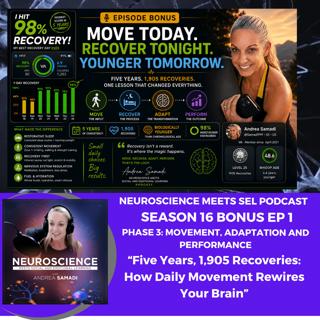
Five Years, 1,905 Recoveries: How Daily Movement Rewires Your Brain (Bonus Episode)

Five Years, 1,905 Recoveries: How Daily Movement Rewires Your Brain (Bonus Episode)

Andrea Samadi shares a five-year self-experiment using a WHOOP wearable to track sleep, recovery, movement, and biological age. She reveals how daily low-intensity movement and consistent recovery—not...

25 Jul 0s

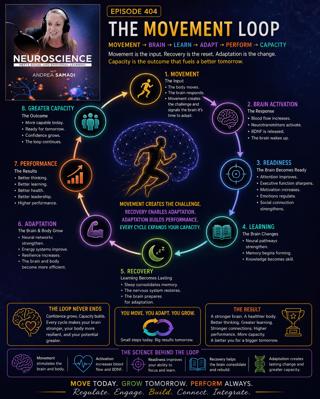
The Movement Loop: How Movement Activates the Brain for Learning, Adaptation & Performance

The Movement Loop: How Movement Activates the Brain for Learning, Adaptation & Performance

Welcome back to Season 16 of the Neuroscience Meets Social and Emotional Learning Podcast. I'm Andrea Samadi, and this is where we bridge neuroscience, social and emotional learning, and human perform...

19 Jul 34min

How Movement Builds the Brain, the Body & Human Performance (Phase 3 Introduction)

How Movement Builds the Brain, the Body & Human Performance (Phase 3 Introduction)

Season 16, Episode 402 explores the Brain's Operating System for Human Performance, focusing on Phase 3: movement, adaptation, and performance. Andrea Samadi explains how movement triggers neurochemic...

12 Jul 25min

Trust as the Foundation with Greg Hill: How Great Leaders Create the Conditions for Learning, Growth and Performance

Trust as the Foundation with Greg Hill: How Great Leaders Create the Conditions for Learning, Growth and Performance

In episode 401 Andrea Samadi welcomes Greg Hill to explore why trust is the essential foundation for learning, growth, and high performance. They discuss how trust creates psychological safety, encour...

27 Jun 37min

Episode 400: Sales Leadership Under Pressure with Majid Samadi: 7 Lessons Learned from 7 Years of Neuroscience

Episode 400: Sales Leadership Under Pressure with Majid Samadi: 7 Lessons Learned from 7 Years of Neuroscience

In this milestone episode (400), Andrea Samadi celebrates seven years of the Neuroscience Meets SEL Podcast with her husband Majid Samadi. They reflect on the journey of translating neuroscience into ...

20 Jun 47min

Phase 2 Review: The Motivation Loop: How to Keep Effort Worthwhile

Phase 2 Review: The Motivation Loop: How to Keep Effort Worthwhile

Episode 399 reviews Phase 2 of Season 15 and introduces the Motivation Loop — the sequence of meaning, belief, attention, action, reward, and recovery that drives sustained effort. The episode explain...

14 Jun 28min

Fun, Fear, Focus: Closing the Motivation Loop with Friederike Fabritius

Fun, Fear, Focus: Closing the Motivation Loop with Friederike Fabritius

Episode 398 revisits neuroscientist Friederike Fabritius (from November 2022) to explain how three ingredients — fun (dopamine), fear (productive challenge), and focus — create the neurochemical condi...

9 Jun 23min

Move to Learn: How Movement Activates the Brain and Fuels Motivation (with Dr. Chuck Hillman and Paul Zientarski)

Move to Learn: How Movement Activates the Brain and Fuels Motivation (with Dr. Chuck Hillman and Paul Zientarski)

Season 15, Episode 397 revisits research and real-world practice showing movement is more than fitness: it activates the brain, boosts attention, enhances learning, and sustains motivation. Dr. Chuck ...

31 Mai 35min

Populært innen Fakta

fastlegen
dine-penger-pengeradet
relasjonspodden-med-dora-thorhallsdottir-kjersti-idem
foreldreradet
treningspodden
mikkels-paskenotter
rss-strid-de-norske-borgerkrigene
hverdagspsyken
rss-kunsten-a-leve
sinnsyn
rss-sarbar-med-lotte-erik
gravid-uke-for-uke
fryktlos
dopet
rss-bisarr-historie
tomprat-med-gunnar-tjomlid
jakt-og-fiskepodden
rss-impressions-2
rss-renters-rente
sovnlos