"Opening the Door to the Future: Biocomputers and AI with Dr. Fred Jordan"

"Opening the Door to the Future: Biocomputers and AI with Dr. Fred Jordan"

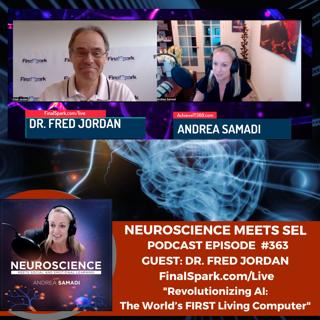
In this enlightening episode of the Neuroscience Meets Social and Emotional Learning podcast, we delve into groundbreaking territory with Dr. Fred Jordan, CEO and co-founder of Alt Vision and FinalSpark, as he joins us from Switzerland. Dr. Jordan introduces us to a revolutionary emerging technology where living neurons—nature's own processors—are set to transform the landscape of technology and artificial intelligence.

Explore how bioprocessors, derived from human stem cells using advanced lab techniques, could potentially outperform traditional semiconductor devices by significantly reducing power consumption, particularly in AI computations. Understand the implications of such innovations and the ethical considerations they entail, as we navigate a future where biocomputers might fundamentally alter our technological capabilities.

Join us in opening our minds to the possibilities of neuroscience-driven tech advancements, as we discuss the practical applications and visionary future that Dr. Jordan and his team are shaping, inviting curiosity and critical thinking into our evolving technological world.

Watch our Interview on YouTube here https://www.youtube.com/watch?v=8D3eKkd3L4w

For today’s episode #363, we meet with Dr Fred Jordan, where we looked at:

✔ What is the biocomputer?

✔ What does this NEW innovative technology, make obsolete, from our past?

✔ What are the benefits of a biocomputer, and how exactly does it work?

✔ What is the vision of FinalSpark, and how can this change the future of AI?

Welcome back to SEASON 13 of The Neuroscience Meets Social and Emotional Learning Podcast, where we connect the science-based evidence behind social and emotional learning and emotional intelligence training for improved well-being, achievement, productivity and results—using what I saw as the missing link (since we weren’t taught this when we were growing up in school), the application of practical neuroscience. I’m Andrea Samadi, an author, and an educator with a passion for learning and launched this podcast 7 years ago now, with the goal of bringing ALL the leading experts together (in one place) to help us to APPLY this research in our daily lives.

For today’s episode #363, we meet with the CEO and Co-Founder of AlpVision and FinalSpark, Dr. Fred Jordan who will be joining us all the way from Switzerland. I met Dr. Jordan through LinkedIn, where he introduced his work to me, and my attention was caught. When I asked him what he does in his lab at FinalSpark, he wrote back to me that his lab has developed an emerging technology that would redefine the status quo in technology and in the ways that people work. Of course I asked him if he could explain this to me, and he wrote back that “we use living neurons, the building blocks in the brain, for processing information” and sent me the link to his website[i] where there is a live camera view of living neurons placed on electrodes, and you can see the signal from them.

He went on to explain that neurons in the brain communicate using electrical and chemical stimulations and that his lab was focused on building a new generation of bioprocessors.

At this point, I am sure he would know that I’m interested to learn more, mostly to understand what exactly does this mean? I wonder:

    Does Dr. Jordan mean that his lab is building a computer processor out of living neurons (cells from our brain)? How do they do this? What are the advantages of a bioprocessor vs using transistors (that are semiconductor devices used to amplify or switch electrical signals and power)? How does this connect to AI? What does his lab envision for the future?

I have a lot of questions for Dr. Jordan, and I am coming from the point of view that I really want to learn and understand what his lab has created. I want to be able to explain his idea to our audience in a way that we can all come away with some new knowledge and understanding about the future, and how keeping an open mind while learning can set us apart from others, and even give us a razor’s edge advantage in whatever work we are doing in the world.

Let’s meet Dr. Fred Jordan, and together, learn about the work they are doing at FinalSpark in Switzerland, and see if it can expand of thinking, and take us to new heights with the new awareness we will gain today.

INTRO Q: Welcome Dr. Fred Jordan. Thank you for reaching out to me, and opening up my mind to something that while writing these questions, I still didn’t completely understand. Can you explain what exactly is a biocomputer and why would anyone want to have a computer that uses living neurons instead of transistors to process information?

Q1: As someone who loves entrepreneurship, or those people in the world who create new ideas that change the world, can you tell me how where this idea began?

Q2: I did listen to one of your podcast episodes[ii] about “The Future of AI: How Biocomputers Will Change Everything” so I could wrap my head around what you do at FinalSpark, and it brought me to something I heard longevity researcher Dr. David Sinclair say that I will never forget. He said “we can make a mouse in a lab out of stem cells.” Can you explain where these neurons come that you are using come from and also help me to understand what Dr. Sinclair meant when he said they can make a mouse out of stem cells?

Q3: For someone who doesn’t have a formal background in science, but I want to learn difficult concepts, and be able to explain them to others, can you explain how these living neurons work?

Q4: What is the advantage of using a biocomputer and what problems does this solve?

They consume 1 million X less than digital computers, quantum computers still in R&D stage

Q5: What industries will be changed with the biocomputer? (semi-conductor industry) or what other applications can you think of that this type of computer can have (maybe medical applications)?

Q6: What types of feedback are you hearing about the biocomputer? Do people think it’s acceptable to use living neurons for computation?

Q7: Who are the leaders in this type of research? What other countries do you know of, where labs are working on this type of computer?

Q8: What Universities have approached you to learn more about this neuro-platform?

Q9: What is your vision for FinalSpark, and how do you think this will change the future workforce?

Q10: This topic made me think and I found it difficult to grasp, but am very interested in learning more about how this concept could change everything that we know about the way we work and use computers. What would you say to me to show me that having an open mind will set me apart from others, or give me an advantage maybe in the future?

Q11: Is there anything I have missed, or anything important that our listeners should know about?

Dr. Jordan, I want to thank you for taking the time to speak with me about what you have created at FinalSpark. I’m very interested in NEW ideas, especially those that will change the way we operate and live our lives, exponentially. I remember hearing a quote from Gordon Moore, Intel’s co-founder and the author of Moore’s law many years ago in reference to the fact that “the number of transistors in an integrated circuit doubles roughly every 2 years” and this trend has driven the exponential growth of computing power and efficiency , leading to faster processors and smaller devices. He said “frankly, I didn’t expect to be so precise” with his prediction. What do you think when you have the power of the biocomputer, and George Moore’s quote, of the potential of what you have created at FinalSpark?

For people to connect with you and learn more, what is the best way?

CONNECT with Dr. Fred Jordan

LinkedIn https://www.linkedin.com/in/fred-jordan-anticounterfeiting-brandprotection-authentication/

REFERENCES:

[i] https://finalspark.com/live/

[ii] Dr. Fred Jordan on the Future of AI: How Bio-Computers Will Change Everything https://podcasts.apple.com/us/podcast/season-5-ep1-dr-fred-jordan-co-founder-of-finalspark/id1756198461?i=1000686503506

Denne episoden er hentet fra en åpen RSS-feed og er ikke publisert av Podme. Den kan derfor inneholde annonser.

Episoder(414)

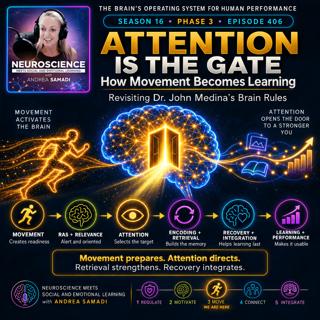
Attention Is the Gate—How Movement Becomes Lasting Learning with Dr. John Medina

Attention Is the Gate—How Movement Becomes Lasting Learning with Dr. John Medina

Episode 406 explains how movement prepares the brain but does not guarantee learning. It traces the full sequence—movement, RAS-driven readiness, salience and relevance, focused attention, encoding, r...

6 Sep 46min
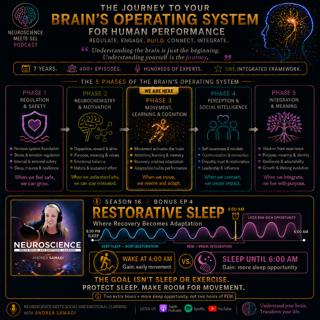
The 4:00 AM Tradeoff: Movement, REM and Recovery (Bonus Episode)

The 4:00 AM Tradeoff: Movement, REM and Recovery (Bonus Episode)

In this episode Andrea Samadi explores how movement and sleep work together in a "brain operating system" for human performance, focusing on restorative sleep (deep + REM), personal WHOOP data, and th...

30 Aug 29min
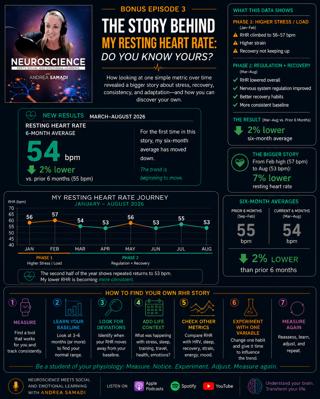
The Hidden Story Behind Your Resting Heart Rate: What Your RHR Can Reveal About Stress, Recovery & Adaptation

The Hidden Story Behind Your Resting Heart Rate: What Your RHR Can Reveal About Stress, Recovery & Adaptation

Andrea Samadi shares her personal resting heart rate data to show why measuring over time matters more than fixating on a single score. She explains how trends reveal stress, recovery, and adaptation,...

23 Aug 30min
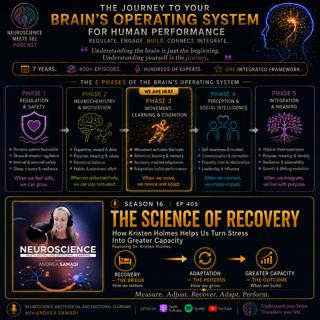
The Science of Recovery—How Dr. Kristen Holmes Helps Us Turn Stress Into Greater Capacity

The Science of Recovery—How Dr. Kristen Holmes Helps Us Turn Stress Into Greater Capacity

In this episode Andrea Samadi explores Phase 3 of the Brain's Operating System—movement, learning, and cognition—focusing on the recovery and adaptation side of the "movement loop." She revisits Dr. K...

16 Aug 45min
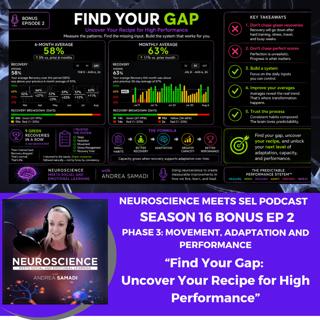
Find Your Gap: How Recovery Unlocks Predictable Performance (Bonus Episode)

Find Your Gap: How Recovery Unlocks Predictable Performance (Bonus Episode)

In this bonus episode Andrea Samadi introduces the Predictable Performance System, a practical roadmap from her Brain’s Operating System. She shows how measuring patterns—not chasing daily scores—plus...

9 Aug 30min
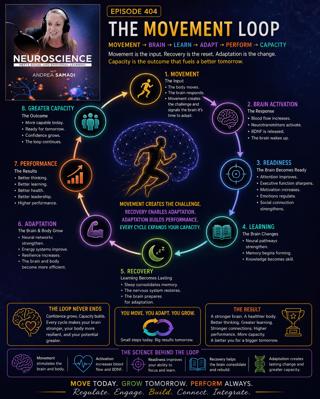
Dr. John Ratey and The Movement Loop: How Movement Becomes Human Performance

Dr. John Ratey and The Movement Loop: How Movement Becomes Human Performance

In this episode Andrea Samadi explores Phase Three of the Brain’s Operating System — how movement acts as the essential input that activates the brain, sharpens attention, boosts learning, and improve...

2 Aug 21min
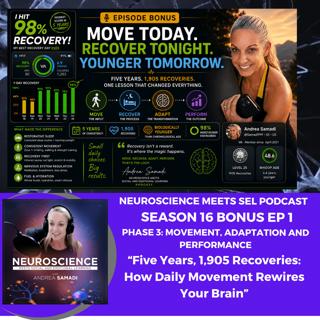
Five Years, 1,905 Recoveries: How Daily Movement Rewires Your Brain (Bonus Episode)

Five Years, 1,905 Recoveries: How Daily Movement Rewires Your Brain (Bonus Episode)

Andrea Samadi shares a five-year self-experiment using a WHOOP wearable to track sleep, recovery, movement, and biological age. She reveals how daily low-intensity movement and consistent recovery—not...

25 Jul 16min
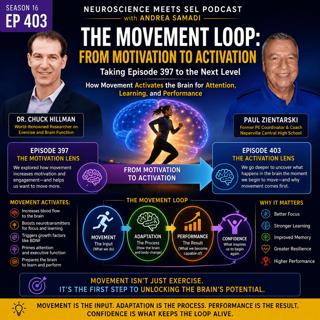
The Movement Loop: How Movement Activates the Brain for Learning, Adaptation & Performance

The Movement Loop: How Movement Activates the Brain for Learning, Adaptation & Performance

Welcome back to Season 16 of the Neuroscience Meets Social and Emotional Learning Podcast. I'm Andrea Samadi, and this is where we bridge neuroscience, social and emotional learning, and human perform...

19 Jul 34min

Populært innen Fakta

fastlegen
dine-penger-pengeradet
relasjonspodden-med-dora-thorhallsdottir-kjersti-idem
treningspodden
foreldreradet
rss-strid-de-norske-borgerkrigene
jakt-og-fiskepodden
rss-orjasater
hverdagspsyken
sinnsyn
mikkels-paskenotter
rss-kunsten-a-leve
lederskap-nhhs-podkast-om-ledelse
tomprat-med-gunnar-tjomlid
branncast
rss-impressions-2
fryktlos
gravid-uke-for-uke
rss-var-forste-kaffe
rss-det-virker-en-podkast-om-spesialpedagogikk