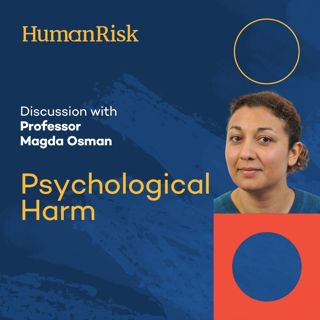
Professor Magda Osman on Psychological Harm

Professor Magda Osman on Psychological Harm

What is psychological harm, and can we really regulate it? Should an AI-companion app be allowed to dump the person who is using it?

📝 Episode Summary
On this episode, I’m joined once again by Professor Magda Osman, someone who’s been on the show several times before, who always has something compelling to say.

This time, we're talking about psychological harm, a term you’ve probably heard, but which remains vague, slippery, and surprisingly unhelpful when it comes to actually protecting people.

Together, we explore what psychological harm really means, why defining it matters, and why regulating it, especially in digital contexts, is so tricky.

We draw comparisons to physical harm, ask whether some emotional distress might be necessary, and consider what kinds of harm are moral rather than measurable.

The conversation touches on loneliness, AI companions, consent, and even chainsaws!

👤 Guest Biography
Magda is a Principal Research Associate at the Judge Business School, University of Cambridge, and holds a Professorial position at Leeds Business School, University of Leeds, where she supports policy impact.

She describes herself as a psychologist by training, with specific interests in decision-making under risk and uncertainty, folk beliefs in the unconscious, and behavioural change effectiveness.

Magda works at the intersection of behavioural science, regulation, and public policy, offering practical insights that challenge assumptions and bring clarity to complex issues.

⏱️ AI-Generated Timestamped Summary
[00:00:00] Introduction and framing of psychological harm

[00:02:00] The conceptual problems with defining psychological harm

[00:05:00] Psychological harm and the precautionary principle in digital regulation

[00:08:00] Social context, platform functions, and why generalisations don’t work

[00:12:00] The idea of rites of passage and unavoidable suffering

[00:15:00] AI companion apps and emotional dependency

[00:17:00] Exploitation, data harvesting, and moral transparency


[00:22:00] Frustration as normal vs. actual psychological damage

[00:26:00] The danger of regulating the trivial and the need for precision

[00:29:00] Why causal links are necessary for meaningful intervention

[00:33:00] Legal obligations and holding tech companies to account

[00:38:00] What users actually care about: privacy, data, trust

[00:42:00] Society’s negotiation of what counts as tolerable harm

[00:45:00] Why this isn’t an unprecedented problem — and how we’ve faced it before

[00:50:00] The risk of bad definitions leading to bad regulation

[00:54:00] Two contrasting examples of online services and their impacts

[00:57:00] What kind of regulation might we actually need?

[00:59:00] The case for rethinking how regulation itself is structured

[01:01:00] Where to find Magda’s work and final reflections

🔗 Links
Magda's LinkedIn profile: https://www.linkedin.com/in/magda-osman-11165138/

Her website: https://www.magdaosman.com/

Magda’s previous appearances on the show exploring:

Behavioural Interventions that fail:
https://www.humanriskpodcast.com/dr-magda-osman-on-behavioural/


Unconscious Bias: what is it, and can we train people not to show it?
https://www.humanriskpodcast.com/dr-magda-osman-on-unconscious/

Compliance, Coercion & Competence
https://www.humanriskpodcast.com/professor-magda-osman-on-compliance-coercion-competence/

Misinformation
https://www.humanriskpodcast.com/professor-magda-osman-on-misinformation/

Risk Prioritisation
https://www.humanriskpodcast.com/professor-magda-osman-on-risk-prioritisation/

Denne episoden er hentet fra en åpen RSS-feed og er ikke publisert av Podme. Den kan derfor inneholde annonser.

Episoder(368)

Will Tarrant on Service: Closing the gap between brand promise and reality

Will Tarrant on Service: Closing the gap between brand promise and reality

What makes great service? It’s one of those things we instantly recognise when we experience it, but struggle to define. And while organisations spend huge amounts of time trying to design seamless cu...

8 Mai 1h

Dr Carissa Véliz on Prophecy

Dr Carissa Véliz on Prophecy

What if prediction isn’t about knowing the future, but controlling it?  On this episode, I'm joined by a leading thinker on digital ethics, privacy and technology to explore the idea of prophecy.Episo...

25 Apr 1h 2min

Dr C Thi Nguyen on How to stop playing someone else's game

Dr C Thi Nguyen on How to stop playing someone else's game

We like to think we choose what matters. But what if the goals we’re chasing… aren’t actually ours?Episode Summary My guest on this episode is Dr. C. Thi Nguyen, philosopher and author of The Score: H...

12 Apr 1h 8min

Phil Dobson on Cognitive Leadership

Phil Dobson on Cognitive Leadership

We tend to assume that if we’re working hard, we’re working well. But what if that isn’t true?Episode SummaryMy guest on this episode is Phil Dobson, author of The Brain Book and founder of Brain Work...

4 Apr 1h 9min

Professor Mark Stoyle on The Western Rising of 1549

Professor Mark Stoyle on The Western Rising of 1549

What lessons does a religious protest that led to an uprising  in 1549 have to do with human risk?At first glance, not very much. It’s easy to see it as a distant historical event — something about re...

22 Mar 1h 4min

Jeffrey Ludlow on What A Sign Is...

Jeffrey Ludlow on What A Sign Is...

What exactly is a sign?  At first glance, that might sound like a strange question. Signs are everywhere: telling us where to go, what to do, what not to do, and sometimes what might happen if we igno...

14 Mar 1h 4min

Marc Ross on The Art of The Negroni

Marc Ross on The Art of The Negroni

What Can a Cocktail Teach Us About Curiosity and Creativity? At first glance, documenting Negronis around the world might sound like a frivolous hobby. But could a simple cocktail become a vehicle for...

7 Mar 45min

Tom & Sue Hardin On Wired On Wall Street

Tom & Sue Hardin On Wired On Wall Street

What’s the difference between a mistake… and a bad decision? My guest knows this only too well. Tom Hardin has been on the show several times before. As Tipper X, he wore a wire for the FBI and helped...

28 Feb 1h 15min

Populært innen Vitenskap

fastlegen
tingenes-tilstand
jss
rss-zahid-ali-hjelper-deg
rekommandert
sinnsyn
rss-paradigmepodden
liberal-halvtime
vett-og-vitenskap-med-gaute-einevoll
forskningno
rss-overskuddsliv
villmarksliv
kvinnehelsepodden
nordnorsk-historie
grunnstoffene
tidlose-historier
rss-inn-til-kjernen-med-sunniva-rose
nevropodden
dekodet-2
rss-rekommandert