Beyond Superintelligence: A Realist's Guide to AI

Beyond Superintelligence: A Realist's Guide to AI

The episode begins with Kapoor explaining the origins of AI Snake Oil, tracing it back to his PhD research at Princeton on AI's limited predictive capabilities in social science domains. He shares how he and co-author Arvind Narayanan uncovered major methodological flaws in civil war prediction models, which later extended to other fields misapplying machine learning.

The conversation then turns to the disconnect between academic findings and media narratives. Kapoor critiques the hype cycle around AI, emphasizing how its real-world adoption is slower, more fragmented, and often augmentative rather than fully automating human labor. He cites the enduring demand for radiologists as a case in point.

Kapoor introduces the concept of “AI as normal technology,” which rejects both the notion of imminent superintelligence and the dismissal of AI as a passing fad. He argues that, like other general-purpose technologies (electricity, the internet), AI will gradually reshape industries, mediated by social, economic, and organizational factors—not just technical capabilities.

The episode also examines the speculative worldviews put forth by documents like AI 2027, which warn of AGI-induced catastrophe. Kapoor outlines two key disagreements: current AI systems are not technically on track to achieve general intelligence, and even capable systems require human and institutional choices to wield real-world power.

On policy, Kapoor emphasizes the importance of investing in AI complements—such as education, workforce training, and regulatory frameworks—to enable meaningful and equitable AI integration. He advocates for resilience-focused policies, including cybersecurity preparedness, unemployment protection, and broader access to AI tools.

The episode concludes with a discussion on recalibrating expectations. Kapoor urges policymakers to move beyond benchmark scores and collaborate with domain experts to measure AI’s real impact. In a rapid-fire segment, he names the myth of AI predicting the future as the most misleading and humorously imagines a superintelligent AI fixing global cybersecurity first if it ever emerged.

Episode Contributors

Sayash Kapoor is a computer science Ph.D. candidate at Princeton University's Center for Information Technology Policy. His research focuses on the societal impact of AI. He previously worked on AI in the industry and academia at Facebook, Columbia University, and EPFL Switzerland. He is a recipient of a best paper award at ACM FAccT and an impact recognition award at ACM CSCW.

Nidhi Singh is a senior research analyst and program manager at Carnegie India. Her current research interests include data governance, artificial intelligence and emerging technologies. Her work focuses on the implications of information technology law and policy from a Global Majority and Asian perspective.

Suggested Readings

AI as Normal Technology by Arvind Narayanan and Sayash Kapoor.

Every two weeks, Interpreting India brings you diverse voices from India and around the world to explore the critical questions shaping the nation's future. We delve into how technology, the economy, and foreign policy intertwine to influence India's relationship with the global stage.

As a Carnegie India production, hosted by Carnegie scholars, Interpreting India, a Carnegie India production, provides insightful perspectives and cutting-edge by tackling the defining questions that chart India's course through the next decade.

Stay tuned for thought-provoking discussions, expert insights, and a deeper understanding of India's place in the world.

Don't forget to subscribe, share, and leave a review to join the conversation and be part of Interpreting India's journey.

Denne episoden er hentet fra en åpen RSS-feed og er ikke publisert av Podme. Den kan derfor inneholde annonser.

Episoder(153)

India, Australia, and the Critical Minerals Opportunity

India, Australia, and the Critical Minerals Opportunity

The conversation opens with a useful baseline on both countries. Australia has world-class mining equipment, technology, and services capabilities, and its mining sector contributes roughly 10 to 15 p...

13 Aug 49min
Chokepoints, Economic Warfare and India's Strategic Options

Chokepoints, Economic Warfare and India's Strategic Options

Edward lays out three criteria for what makes something a genuine choke point: dominant market share, difficulty to substitute, and the ability to weaponize it with asymmetric impact, hurting the adve...

10 Jul 33min
India's AI Ambitions and the Road to Viksit Bharat | AI Summit Special

India's AI Ambitions and the Road to Viksit Bharat | AI Summit Special

This is the final episode of our special series on the India AI Impact Summit, examining the conversations, decisions, and debates that are shaping global AI governance. This episode explores: India...

2 Jul 33min
Did India's AI Summit Get Safety Right? AI Summit Special

Did India's AI Summit Get Safety Right? AI Summit Special

This episode is part of our special series on the India AI Impact Summit, examining the conversations, decisions, and debates that are shaping global AI governance. Professor Ravindran addresses early...

19 Jun 40min
Subsea Cables, Trusted Networks, and India's Strategic Opportunity

Subsea Cables, Trusted Networks, and India's Strategic Opportunity

Pooja opens with a mismatch that frames the entire conversation. India consumes around 20% of global internet traffic but accounts for just 2% of global subsea cable infrastructure. Even with the expa...

4 Jun 46min
AI Literacy and the Future of Work in India

AI Literacy and the Future of Work in India

Jaspreet's framing for the AI and work debate is worth staying with. He is not dismissive of disruption: he thinks AI will destroy certain jobs, create new ones, and the rupture will be real. But he p...

26 Mai 44min
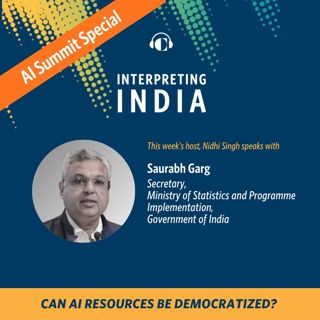
Can AI Resources Be Democratized? AI Summit Special

Can AI Resources Be Democratized? AI Summit Special

This episode is part of our special series on the India AI Impact Summit, examining the conversations, decisions, and debates that are shaping global AI governance. The working group was designed from...

15 Mai 28min

Space Security in the Age of AI

Space Security in the Age of AI

Almudena opens with a distinction that anchors the entire conversation: space security, unlike space safety, is about intentional harm. It concerns deliberate attempts to disrupt, deny, or destroy spa...

7 Mai 1h 7min

Populært innen Politikk og nyheter

giver-og-gjengen-vg
aftenpodden
forklart
stopp-verden
popradet
aftenpodden-usa
nokon-ma-ga
dine-penger-pengeradet
det-store-bildet
lydartikler-fra-aftenposten
rss-gukild-johaug
hanna-de-heldige
rss-ness
rss-penger-polser-og-politikk
aftenbla-bla
unitedno
frokostshowet-pa-p5
e24-podden
grasoner-den-nye-kalde-krigen
ta-dokumentar