#224 – There's a cheap and low-tech way to save humanity from any engineered disease | Andrew Snyder-Beattie

#224 – There's a cheap and low-tech way to save humanity from any engineered disease | Andrew Snyder-Beattie

Conventional wisdom is that safeguarding humanity from the worst biological risks — microbes optimised to kill as many as possible — is difficult bordering on impossible, making bioweapons humanity’s single greatest vulnerability. Andrew Snyder-Beattie thinks conventional wisdom could be wrong.

Andrew’s job at Open Philanthropy is to spend hundreds of millions of dollars to protect as much of humanity as possible in the worst-case scenarios — those with fatality rates near 100% and the collapse of technological civilisation a live possibility.

Video, full transcript, and links to learn more: https://80k.info/asb

As Andrew lays out, there are several ways this could happen, including:

  • A national bioweapons programme gone wrong, in particular Russia or North Korea
  • AI advances making it easier for terrorists or a rogue AI to release highly engineered pathogens
  • Mirror bacteria that can evade the immune systems of not only humans, but many animals and potentially plants as well

Most efforts to combat these extreme biorisks have focused on either prevention or new high-tech countermeasures. But prevention may well fail, and high-tech approaches can’t scale to protect billions when, with no sane people willing to leave their home, we’re just weeks from economic collapse.

So Andrew and his biosecurity research team at Open Philanthropy have been seeking an alternative approach. They’re proposing a four-stage plan using simple technology that could save most people, and is cheap enough it can be prepared without government support. Andrew is hiring for a range of roles to make it happen — from manufacturing and logistics experts to global health specialists to policymakers and other ambitious entrepreneurs — as well as programme associates to join Open Philanthropy’s biosecurity team (apply by October 20!).

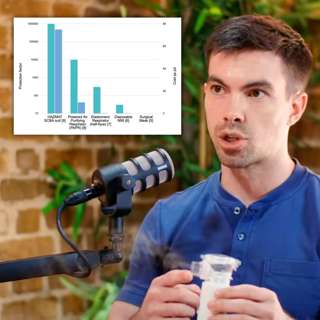
Fundamentally, organisms so small have no way to penetrate physical barriers or shield themselves from UV, heat, or chemical poisons. We now know how to make highly effective ‘elastomeric’ face masks that cost $10, can sit in storage for 20 years, and can be used for six months straight without changing the filter. Any rich country could trivially stockpile enough to cover all essential workers.

People can’t wear masks 24/7, but fortunately propylene glycol — already found in vapes and smoke machines — is astonishingly good at killing microbes in the air. And, being a common chemical input, industry already produces enough of the stuff to cover every indoor space we need at all times.

Add to this the wastewater monitoring and metagenomic sequencing that will detect the most dangerous pathogens before they have a chance to wreak havoc, and we might just buy ourselves enough time to develop the cure we’ll need to come out alive.

Has everyone been wrong, and biology is actually defence dominant rather than offence dominant? Is this plan crazy — or so crazy it just might work?

That’s what host Rob Wiblin and Andrew Snyder-Beattie explore in this in-depth conversation.


What did you think of the episode? https://forms.gle/66Hw5spgnV3eVWXa6

Chapters:

  • Cold open (00:00:00)
  • Who's Andrew Snyder-Beattie? (00:01:23)
  • It could get really bad (00:01:57)
  • The worst-case scenario: mirror bacteria (00:08:58)
  • To actually work, a solution has to be low-tech (00:17:40)
  • Why ASB works on biorisks rather than AI (00:20:37)
  • Plan A is prevention. But it might not work. (00:24:48)
  • The “four pillars” plan (00:30:36)
  • ASB is hiring now to make this happen (00:32:22)
  • Everyone was wrong: biorisks are defence dominant in the limit (00:34:22)
  • Pillar 1: A wall between the virus and your lungs (00:39:33)
  • Pillar 2: Biohardening buildings (00:54:57)
  • Pillar 3: Immediately detecting the pandemic (01:13:57)
  • Pillar 4: A cure (01:27:14)
  • The plan's biggest weaknesses (01:38:35)
  • If it's so good, why are you the only group to suggest it? (01:43:04)
  • Would chaos and conflict make this impossible to pull off? (01:45:08)
  • Would rogue AI make bioweapons? Would other AIs save us? (01:50:05)
  • We can feed the world even if all the plants die (01:56:08)
  • Could a bioweapon make the Earth uninhabitable? (02:05:06)
  • Many open roles to solve bio-extinction — and you don’t necessarily need a biology background (02:07:34)
  • Career mistakes ASB thinks are common (02:16:19)
  • How to protect yourself and your family (02:28:21)

This episode was recorded on August 12, 2025

Video editing: Simon Monsour and Luke Monsour
Audio engineering: Milo McGuire, Simon Monsour, and Dominic Armstrong
Music: CORBIT
Camera operator: Jake Morris
Coordination, transcriptions, and web: Katy Moore

Episoder(317)

Artificial General Intelligence leads to oligarchy | David Duvenaud, ex-Anthropic team lead

Artificial General Intelligence leads to oligarchy | David Duvenaud, ex-Anthropic team lead

Democracy might be a brief historical blip. That’s the unsettling thesis of a recent paper, which argues AI that can do all the work a human can do inevitably leads to the “gradual disempowerment” of ...

27 Jan 2h 31min

#145 Classic episode – Christopher Brown on why slavery abolition wasn't inevitable

#145 Classic episode – Christopher Brown on why slavery abolition wasn't inevitable

In many ways, humanity seems to have become more humane and inclusive over time. While there’s still a lot of progress to be made, campaigns to give people of different genders, races, sexualities, et...

20 Jan 2h 56min

#233 – James Smith on how to prevent a mirror life catastrophe

#233 – James Smith on how to prevent a mirror life catastrophe

When James Smith first heard about mirror bacteria, he was sceptical. But within two weeks, he’d dropped everything to work on it full time, considering it the worst biothreat that he’d seen described...

13 Jan 2h 9min

#144 Classic episode – Athena Aktipis on why cancer is a fundamental universal phenomena

#144 Classic episode – Athena Aktipis on why cancer is a fundamental universal phenomena

What’s the opposite of cancer? If you answered “cure,” “antidote,” or “antivenom” — you’ve obviously been reading the antonym section at www.merriam-webster.com/thesaurus/cancer.But today’s guest Athe...

9 Jan 3h 30min

#142 Classic episode – John McWhorter on why the optimal number of languages might be one, and other provocative claims about language

#142 Classic episode – John McWhorter on why the optimal number of languages might be one, and other provocative claims about language

John McWhorter is a linguistics professor at Columbia University specialising in research on creole languages. He's also a content-producing machine, never afraid to give his frank opinion on anything...

6 Jan 1h 35min

2025 Highlight-o-thon: Oops! All Bests

2025 Highlight-o-thon: Oops! All Bests

It’s that magical time of year once again — highlightapalooza! Stick around for one top bit from each episode we recorded this year, including:Kyle Fish explaining how Anthropic’s AI Claude descends i...

29 Des 20251h 40min

#232 – Andreas Mogensen on what we owe 'philosophical Vulcans' and unconscious beings

#232 – Andreas Mogensen on what we owe 'philosophical Vulcans' and unconscious beings

Most debates about the moral status of AI systems circle the same question: is there something that it feels like to be them? But what if that’s the wrong question to ask? Andreas Mogensen — a senior ...

19 Des 20252h 37min

#231 – Paul Scharre on how AI-controlled robots will and won't change war

#231 – Paul Scharre on how AI-controlled robots will and won't change war

In 1983, Stanislav Petrov, a Soviet lieutenant colonel, sat in a bunker watching a red screen flash “MISSILE LAUNCH.” Protocol demanded he report it to superiors, which would very likely trigger a ret...

17 Des 20252h 45min

Populært innen Fakta

fastlegen
dine-penger-pengeradet
relasjonspodden-med-dora-thorhallsdottir-kjersti-idem
treningspodden
foreldreradet
merry-quizmas
dopet
sovnlos
jakt-og-fiskepodden
rss-strid-de-norske-borgerkrigene
rss-kull
podme-bio-3
sinnsyn
gravid-uke-for-uke
hverdagspsyken
rss-kunsten-a-leve
rss-var-forste-kaffe
fryktlos
tomprat-med-gunnar-tjomlid
hagespiren-podcast