Unbundling AI Openness: Beyond the Binary

Unbundling AI Openness: Beyond the Binary

The episode challenges the familiar “open versus closed” framing of AI systems. Sharma argues that openness is not inherently good or bad—it is an instrumental choice that should align with specific policy goals. She introduces a seven-part taxonomy of AI—compute, data, source code, model weights, system prompts, operational records and controls, and labor—to show how each component interacts differently with innovation, safety, and governance. Her central idea, differential openness, suggests that each component can exist along a spectrum rather than being entirely open or closed. For instance, a company might keep its training data private while making its system prompts partially accessible, allowing transparency without compromising competitive or national interests. Using the example of companion bots, Sharma highlights how tailored openness across components can enhance safety and oversight while protecting user privacy. She urges policymakers to adopt this nuanced approach, applying varying levels of openness based on context—whether in public services, healthcare, or defense. The episode concludes by emphasizing that understanding these layers is vital for shaping balanced AI governance that safeguards public interest while supporting innovation.

How can regulators determine optimal openness levels for different components of AI systems? Can greater transparency coexist with innovation and competitive advantage? What governance structures can ensure that openness strengthens democratic accountability without undermining safety or national security?

Episode Contributors

Chinmayi Sharma is an associate professor of law at Fordham Law School in New York. She is a nonresident fellow at the Stoss Center, the Center for Democracy and Technology, and the Atlantic Council. She serves on Microsoft’s Responsible AI Committee and the program committees for the ACM Symposium on Computer Science and Law and the ACM Conference on Fairness, Accountability, and Transparency.

Shruti Mittal is a research analyst at Carnegie India. Her current research interests include artificial intelligence, semiconductors, compute, and data governance. She is also interested in studying the potential socio-economic value that open development and diffusion of technologies can create in the Global South.

Suggested Readings

Unbundling AI Openness by Parth Nobel, Alan Z. Rozenshtein, and Chinmayi Sharma.

Tragedy of the Digital Commons by Chinmayi Sharma.

India’s AI Strategy: Balancing Risk and Opportunity by Amlan Mohanty and Shatakratu Sahu.

Every two weeks, Interpreting India brings you diverse voices from India and around the world to explore the critical questions shaping the nation's future. We delve into how technology, the economy, and foreign policy intertwine to influence India's relationship with the global stage.

As a Carnegie India production, hosted by Carnegie scholars, Interpreting India, a Carnegie India production, provides insightful perspectives and cutting-edge by tackling the defining questions that chart India's course through the next decade.

Stay tuned for thought-provoking discussions, expert insights, and a deeper understanding of India's place in the world.

Don't forget to subscribe, share, and leave a review to join the conversation and be part of Interpreting India's journey.

Denne episoden er hentet fra en åpen RSS-feed og er ikke publisert av Podme. Den kan derfor inneholde annonser.

Episoder(153)

India, Australia, and the Critical Minerals Opportunity

India, Australia, and the Critical Minerals Opportunity

The conversation opens with a useful baseline on both countries. Australia has world-class mining equipment, technology, and services capabilities, and its mining sector contributes roughly 10 to 15 p...

13 Aug 49min
Chokepoints, Economic Warfare and India's Strategic Options

Chokepoints, Economic Warfare and India's Strategic Options

Edward lays out three criteria for what makes something a genuine choke point: dominant market share, difficulty to substitute, and the ability to weaponize it with asymmetric impact, hurting the adve...

10 Jul 33min
India's AI Ambitions and the Road to Viksit Bharat | AI Summit Special

India's AI Ambitions and the Road to Viksit Bharat | AI Summit Special

This is the final episode of our special series on the India AI Impact Summit, examining the conversations, decisions, and debates that are shaping global AI governance. This episode explores: India...

2 Jul 33min
Did India's AI Summit Get Safety Right? AI Summit Special

Did India's AI Summit Get Safety Right? AI Summit Special

This episode is part of our special series on the India AI Impact Summit, examining the conversations, decisions, and debates that are shaping global AI governance. Professor Ravindran addresses early...

19 Jun 40min
Subsea Cables, Trusted Networks, and India's Strategic Opportunity

Subsea Cables, Trusted Networks, and India's Strategic Opportunity

Pooja opens with a mismatch that frames the entire conversation. India consumes around 20% of global internet traffic but accounts for just 2% of global subsea cable infrastructure. Even with the expa...

4 Jun 46min
AI Literacy and the Future of Work in India

AI Literacy and the Future of Work in India

Jaspreet's framing for the AI and work debate is worth staying with. He is not dismissive of disruption: he thinks AI will destroy certain jobs, create new ones, and the rupture will be real. But he p...

26 Mai 44min
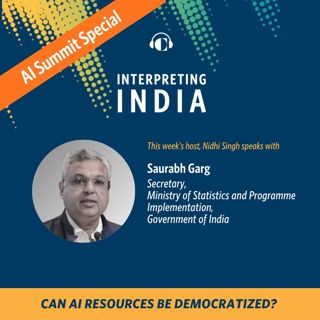
Can AI Resources Be Democratized? AI Summit Special

Can AI Resources Be Democratized? AI Summit Special

This episode is part of our special series on the India AI Impact Summit, examining the conversations, decisions, and debates that are shaping global AI governance. The working group was designed from...

15 Mai 28min

Space Security in the Age of AI

Space Security in the Age of AI

Almudena opens with a distinction that anchors the entire conversation: space security, unlike space safety, is about intentional harm. It concerns deliberate attempts to disrupt, deny, or destroy spa...

7 Mai 1h 7min

Populært innen Politikk og nyheter

giver-og-gjengen-vg
aftenpodden
forklart
stopp-verden
popradet
aftenpodden-usa
nokon-ma-ga
dine-penger-pengeradet
det-store-bildet
lydartikler-fra-aftenposten
rss-gukild-johaug
hanna-de-heldige
rss-ness
rss-penger-polser-og-politikk
aftenbla-bla
unitedno
frokostshowet-pa-p5
e24-podden
grasoner-den-nye-kalde-krigen
ta-dokumentar