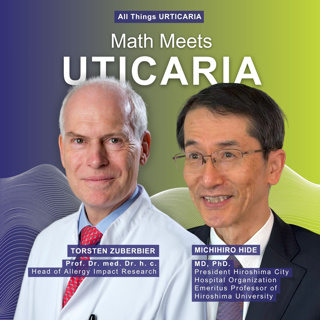
Why Do Hives Look the Way They Do?

In this episode of the GA²LEN (Global Allergy and Asthma Excellence Network) Podcast on Everything Urticaria, Professor Torsten Zuberbier speaks with Professor Michihiro Hide from Hiroshima, Japan — a pioneer in urticaria research — about an unexpected connection between dermatology and mathematics.

The discuss:

🔹 Why do urticaria wheals form distinct shapes — round, annular, or geographic?
🔹 What controls how long a wheal lasts before fading?
🔹 Can mathematical formulas help explain the biology of hives?
🔹 What could this mean for diagnosis and treatment in the future?


Professor Hide shares how a collaboration with a mathematician led to the creation of a computational model that simulates wheal formation in silico, revealing five recurring urticaria patterns that correspond to clinical types such as cholinergic or chronic spontaneous urticaria. Together, the two professors explore how mast cells, basophils, endothelial cells, and coagulation factors interact through feedback loops to create (and stop) a wheal — and how this model could reshape our understanding of urticaria’s pathophysiology and treatment.

Key Learnings from the Episode

Urticaria’s shapes and lifespans can be mathematically modeled using Turing-inspired reaction-diffusion formulas.

Five recurring patterns of wheals emerged from simulations, mirroring real-world urticaria morphology.

Basophil-driven small dots (e.g., cholinergic urticaria) differ mechanistically from mast-cell-driven geographic wheals.

Wheals persist longer than histamine-only reactions, implying sustained mast-cell activation.

Urticaria develops through three stages — initiation, expansion, and resolution — governed by positive and negative feedback.

Understanding the inhibitory phase that stops mast-cell activation is a key future research frontier.

Mathematical modeling could help visualize and predict disease activity, opening paths for personalized therapy.

Collaboration between clinicians and mathematicians may lead to a new diagnostic and research paradigm in chronic urticaria.

Chapters

00:00 Introduction to Urticaria Research

02:03 Exploring the Mechanisms of Urticaria

06:25 Mathematical Approaches to Urticaria

10:30 Patterns and Predictions in Urticaria

15:37 Understanding Treatment Responses

19:07 Future Directions in Urticaria Research


Press release

https://www.eurekalert.org/news-releases/1009793

References

1. Seirin-Lee S, et al. A single reaction-diffusion equation for. the multifarious eruptions of urticaria. PLOS Computational Biology. 2020;16(1):e1007590

2. Seirin-LeeS, et al. Mathematical-based morphological classification of skin eruptions corresponding to the pathophysiological state of chronic spontaneous urticaria.Communications Medicine. 2023;3(1):171.

3. Seirin-Lee S, et al. Pathophysiological Mechanisms of the Onset, Development, and Disappearance Phases of Skin Eruptions in Chronic Spontaneous Urticaria, Bulletin of Mathematical Biology. 2025; 87, 1


Michihiro Hide has receivedlecture and/or consultation fees from Japan Tobacco, Kaken, Kyorin, KyowaKirin, Meiji Seiyaku, Mitsubishi Tanabe, Nippon Zoki, Novartis, Sanofi, Taiho,Teikoku and Yuhan.


Do you have suggestions for future episodes? Please provide feedback and offer your suggestions for future topics and expert selection here.

Feedback form:
ATU: ⁠⁠⁠⁠https://forms.office.com/e/m6a2uEdsUH

Episoder(119)

A New Era in Urticaria Treatment

A New Era in Urticaria Treatment

In this episode of “All Things Urticaria” — a podcast from UCARE, the Global Allergy and Asthma Excellence Network — Prof. Torsten Zuberbier and Prof. Ana Giménez-Arnau discuss the newly released inte...

23 Apr 19min
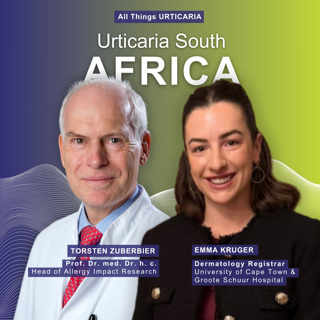
Managing Urticaria in Resource-Limited Settings

Managing Urticaria in Resource-Limited Settings

In this episode of the UCARE Global Allergy and Asthma Excellence Network podcast on Urticaria, Prof. Torsten Zuberbier speaks with Dr. Emma Kruger from Cape Town, South Africa, about managing urticar...

24 Mar 17min
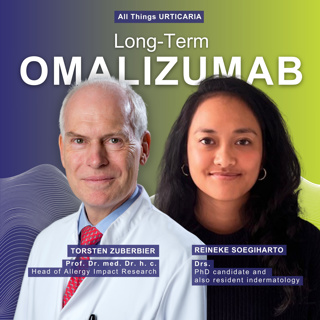
Drug Survival of Omalizumab

Drug Survival of Omalizumab

In this episode of the Urticaria podcast series, Prof. Torsten Zuberbier speaks with Reineke Soegiharto, PhD candidate and dermatology resident from UMC Utrecht, about the international UCARE study DR...

24 Feb 17min
Visualizing Urticaria Worldwide

Visualizing Urticaria Worldwide

In this episode of the GA²LEN Urticaria Podcast, Professor Torsten Zuberbier is joined by Professor Simon Francis Thomsen from Denmark to introduce an exciting new global initiative within the UCARE n...

28 Jan 19min

A New Era for Urticaria Treatment

A New Era for Urticaria Treatment

In this short, conference-based episode, Professor Torsten Zuberbier, President of Global Allergy and Asthma Excellence Network, speaks with Professor Kiran Godse from Mumbai, India, directly from the...

18 Des 20255min

Measuring What Matters: PROMs in Urticaria Care

Measuring What Matters: PROMs in Urticaria Care

In this episode of the GA²LEN (Global Allergy and Asthma Excellence Network) Podcast on Everything Urticaria, Professor Torsten Zuberbier talks with Dr. Karsten Weller, a leading expert and developer ...

2 Des 202519min

UDAY & New Guidelines: Empowering Patients Worldwide

UDAY & New Guidelines: Empowering Patients Worldwide

In this episode, Prof. Torsten Zuberbier (Global Allergy and Asthma Excellence Network President) welcomes Prof. Petra Staubach, urticaria expert from Germany, to talk about Urticaria Day (UDAY) — hel...

30 Sep 202517min

Populært innen Vitenskap

fastlegen
tingenes-tilstand
jss
liberal-halvtime
forskningno
rekommandert
sinnsyn
tomprat-med-gunnar-tjomlid
rss-paradigmepodden
villmarksliv
rss-overskuddsliv
tidlose-historier
fjellsportpodden
nevropodden
rss-inn-til-kjernen-med-sunniva-rose
nordnorsk-historie
dekodet-2
kvinnehelsepodden
rss-nysgjerrige-norge
diagnose