Dataverse pipelines: choose Synapse Link or Dataflow Gen2 based on refresh, storage ownership, and rollback safety—not hype

Dataverse pipelines: choose Synapse Link or Dataflow Gen2 based on refresh, storage ownership, and rollback safety—not hype

Dataverse pipelines are not failing because users are careless; they are failing because you picked the wrong extraction tool. In this episode of M365.fm, Mirko Peters puts Synapse Link and Dataflow Gen2 on the table side by side and shows how refresh frequency, storage ownership, and rollback safety—not hype—decide which one belongs in your architecture.

He starts with Synapse Link, the control freak’s dream. You choose exactly which Dataverse tables and columns to sync, define refresh cadence down to every 15 minutes, and land data directly in your own Azure Data Lake Storage Gen2 account in open Parquet format. That means you own the storage, satisfy governance and compliance people who care about where data physically lives, and have full flexibility to pipe those files into Fabric lakehouses, warehouses, or external platforms. The trade‑off: you are also responsible for Azure resources, permissions, Delta conversion, and cost discipline—Synapse Link is infrastructure, not a wizard.

Then he flips the scalpel for the Swiss Army knife: Dataflow Gen2. Built for speed and low‑code, it lets Power BI and Fabric users pull Dataverse tables into OneLake with a few clicks, apply simple transformations, and feed dashboards without touching the Azure portal. The price of that convenience shows up later: you are capped at 48 refreshes per day (every 30 minutes), stuck with append‑only or full overwrite behavior instead of row‑level delta, and consuming Fabric capacity units rather than explicit storage and compute bills. When multiple Dataflows point at the same table or Dev and Prod collide, you get silent overwrites and governance chaos at 2 a.m.

Throughout the episode, Mirko uses real‑world stories: a finely tuned Synapse setup that devolved into duplicated exports and overlapping refreshes when multiple teams piled in without governance, and a finance dashboard that looked “successful” in Dataflow Gen2 while nightly overwrites quietly corrupted years of transaction history. His conclusion is blunt: Synapse Link is the right choice when you need near real‑time feeds, storage ownership, and engineered pipelines; Dataflow Gen2 is for quick analytics, prototypes, and low‑risk reporting where losing precise rollback is acceptable. The problem is not your users—it is pretending both tools solve the same problem.

WHAT YOU WILL LEARN
  • Why Dataverse pipelines fail more from wrong tool choice than from user error.
  • Where Synapse Link shines: near real‑time sync, selective tables, your own ADLS Gen2 storage.
  • Where Dataflow Gen2 fits: low‑code, Fabric‑native refreshes with hard limits on frequency and rollback.
  • How refresh caps, overwrite behavior, and capacity consumption can quietly break Dataflow‑based solutions.
  • A simple rule of thumb to pick Synapse Link or Dataflow Gen2 based on refresh, ownership, and safety needs.
THE CORE INSIGHT

Your Dataverse pipeline is only as good as the extraction tool you design it around. Treat Synapse Link as the surgical instrument for governed, near real‑time pipelines and Dataflow Gen2 as the multitool for fast, low‑risk analytics—and you stop blaming users for problems your architecture baked in from day one.

WHO THIS EPISODE IS FOR

This episode is ideal for data engineers, Power Platform architects, and analytics teams moving Dataverse data into Fabric or Azure. It is especially valuable if you already have fragile pipelines, unclear cost patterns, or late‑night failures and need a clear mental model for when to bet on Synapse Link versus when a Dataflow Gen2 is actually enough.

ABOUT THE HOST

Mirko Peters is a Microsoft 365 and data platform consultant focused on building governed, observable pipelines across Dataverse, Fabric, and Azure. Through M365.fm, he shares practical stories, patterns, and anti‑patterns that help teams choose the right tools, avoid silent data corruption, and design pipelines that survive real‑world load.

Become a supporter of this podcast: https://www.spreaker.com/podcast/m365-fm-modern-work-security-and-productivity-with-microsoft-365--6704921/support.

Denne episoden er hentet fra en åpen RSS-feed og er ikke publisert av Podme. Den kan derfor inneholde annonser.

Episoder(694)

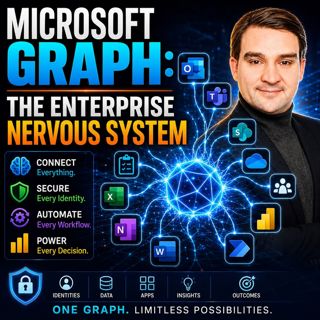
Microsoft Graph: The Enterprise Nervous System

Microsoft Graph: The Enterprise Nervous System

Enterprise IT has reached a tipping point. Organizations now manage millions of identities, files, applications, permissions, policies, and AI-powered workloads across Microsoft 365. Yet many IT depar...

5 Jul 1h 11min

Beyond the Script: The Architect's Guide to Microsoft Graph Platforms

Beyond the Script: The Architect's Guide to Microsoft Graph Platforms

Automation has become a cornerstone of digital transformation, yet many organizations unknowingly create more complexity than they eliminate. What starts as a simple PowerShell script or Power Automat...

5 Jul 1h 10min
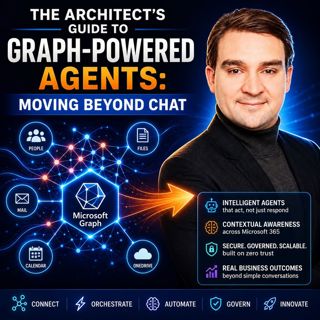
The Architect's Guide to Graph-Powered Agents: Moving Beyond Chat

The Architect's Guide to Graph-Powered Agents: Moving Beyond Chat

Artificial Intelligence has rapidly evolved from simple chatbots into sophisticated enterprise agents capable of reasoning, orchestrating workflows, and executing business processes. Yet many organiza...

4 Jul 1h 20min

The Hidden Logic of Microsoft Graph

The Hidden Logic of Microsoft Graph

Most Microsoft 365 professionals know Microsoft Graph as the API behind users, groups, Teams, and SharePoint. But beneath those familiar endpoints lies a much larger reality. Microsoft Graph has evolv...

4 Jul 1h 11min

Everything Microsoft Didn't Tell You About Teams with Everything Microsoft Didn't Tell You About Teams with Josh Blalock [MVP]

Everything Microsoft Didn't Tell You About Teams with Everything Microsoft Didn't Tell You About Teams with Josh Blalock [MVP]

Microsoft Teams has evolved from a simple collaboration platform into the digital workplace at the heart of modern business. But behind every successful Teams meeting lies far more than software. In t...

3 Jul 45min

Beyond the Portal: The Strategic Architecture of Microsoft Graph and PowerShell

Beyond the Portal: The Strategic Architecture of Microsoft Graph and PowerShell

For years, Microsoft 365 administration has been defined by portals. Administrators spend their days inside the Microsoft 365 Admin Center, Exchange Admin Center, SharePoint Admin Center, Teams Admin ...

3 Jul 1h 10min

Think Like an Attacker: Microsoft Security Exposure Management with Uros Babic [MVP-MCT]

Think Like an Attacker: Microsoft Security Exposure Management with Uros Babic [MVP-MCT]

Traditional cybersecurity focuses on vulnerabilities, alerts, and dashboards. Attackers don't. They look for opportunities, weak identities, exposed cloud resources, excessive permissions, forgotten e...

2 Jul 1h 9min

Stop Building Bots, Start Building Runtimes: A Field Guide to Microsoft Agents

Stop Building Bots, Start Building Runtimes: A Field Guide to Microsoft Agents

Everyone is calling Build 2026 the AI conference. Most of the attention went toward new copilots, voice experiences, and increasingly capable models. But beneath the headlines, Microsoft quietly intro...

2 Jul 1h 16min

Populært innen Politikk og nyheter

giver-og-gjengen-vg
aftenpodden
aftenpodden-usa
fotballpodden-2
forklart
stopp-verden
popradet
lydartikler-fra-aftenposten
det-store-bildet
rss-gukild-johaug
hanna-de-heldige
dine-penger-pengeradet
rss-ness
nokon-ma-ga
aftenbla-bla
rss-espen-lee-usensurert
rss-penger-polser-og-politikk
e24-podden
grasoner-den-nye-kalde-krigen
ukrainapodden