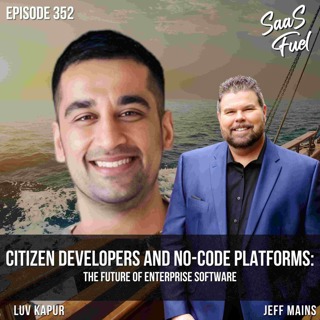
Citizen Developers and No-Code Platforms: The Future of Enterprise Software | Luv Kapur | 352
SaaS Fuel8 Jan

Citizen Developers and No-Code Platforms: The Future of Enterprise Software | Luv Kapur | 352

In this episode, Jeff Mains sits down with Luv Kapur, a technology leader at Bit who's reshaping how enterprises build software. Luv shares his journey from leading platform engineering at one of Canada's largest pension funds to joining a startup on a mission to help organizations scale development through composability and AI-powered tools.

The conversation explores how AI is fundamentally changing software development—not by writing more code, but by enabling teams to compose better solutions with less custom code. Luv challenges the hype around code generation, arguing that the real bottleneck isn't writing code but translating business requirements into sound architecture and reusing battle-tested components.

Luv also offers a grounded perspective on AI's impact on jobs, the importance of discoverability in component libraries, and practical advice for CTOs building composable organizations.

Key Takeaways

[0:00] - Episode introduction: AI-powered, cloud-native enterprise development tools

[1:00] - The hidden cost of poor discoverability in internal libraries and how it silently slows high-performing teams

[4:26] - Luv's background: From leading platform engineering at Healthcare of Ontario Pension Plan to joining Bit

[4:47] - The spark for the leap: Believing in the mission of helping enterprises scale development globally

[5:19] - The consistency problem: When products span multiple teams but feel disjointed to users

[6:37] - Building a platform team whose customers are developers themselves

[7:23] - Discoverability as the key problem: Developers couldn't find what already existed

[9:24] - Why inner source software transforms development artifacts into invaluable organizational assets

[11:37] - Viewing your org chart as a dependency graph, not a hierarchy

[15:51] - The AI hype is justified, but code generation isn't the real bottleneck

[17:01] - The bottleneck is translating business requirements into software architecture, not writing code

[18:41] - AI should help us do less work, not more work

[19:27] - Why developers won't lose jobs: There's infinite work, not finite work

[20:19] - Reusing battle-tested components increases quality and reduces surface area for errors

[21:59] - Reducing AI context to dependency graphs and APIs prevents hallucinations

[23:05] - Private enterprise data is the gold mine for AI value

[24:35] - The rise of citizen developers: Non-technical people building with natural language

[26:40] - Empowering citizen developers with internal component marketplaces

[27:19] - How AI changes the build vs. buy equation through faster prototyping

[30:09] - Internal tools will be hit hardest by AI disruption

[34:41] - SaaS companies must align with core business value to stay sticky

[36:19] - The biggest mistake: Equating vibe-engineered solutions with production-ready software

[39:01] - Building AI muscle: Start with clear scoped goals, not vague initiatives

[40:45] - The future: Higher skill ceiling, elimination of junior developer roles, but more opportunities overall

[43:45] - Junior developers must contribute to open source and build visible impact

[44:31] - The one capability every software leader needs: Willingness to adopt AI and keep learning

Tweetable Quotes"For an internal team, if it doesn't get adopted, it's useless. Adoption is key." - Luv Kapur"Don't look at your organizational chart as a hierarchical chart. Look at it as a dependency graph." - Luv Kapur"The bottleneck isn't the amount of code we write. The bottleneck is how quickly I can translate a business requirement into a software architecture." - Luv Kapur"We want AI to help us do less work, not more work. I don't want to write a large amount of code. I want to write less code and deliver the same." - Luv Kapur"We do not have a finite amount of work. We have an infinite amount of work. AI will only uplift the best technical talent to focus on larger problems." - Luv Kapur"Knowledge is now a commodity for everyone. It depends on what you do with it." - Luv Kapur"The more context AI has, the more it hallucinates. Reduce the amount of context but give it relevant context." - Luv Kapur"Delivering production-grade software is more than just writing code and watching it work." - Luv KapurSaaS Leadership Lessons1. Treat Your Org Chart as a Dependency Graph

Stop viewing your organization hierarchically and start seeing it as a network of dependencies. Each team either depends on something or is depended upon. This shift in perspective reveals how capabilities compose together to deliver stakeholder value and helps you identify where to standardize and build reusable components from the bottom up.

2. Discoverability Drives Adoption

Building great internal tools or component libraries means nothing if developers can't find them. Without discoverability and analytics, adoption suffers, and developers will find workarounds. Invest in platforms that make it easy to discover, understand usage, and contribute back to shared resources.

3. AI's Real Value Isn't Code Generation—It's Architectural Intelligence

The bottleneck in software development isn't typing speed or lines of code written. It's translating business requirements into sound software architecture and composing solutions from existing, battle-tested components. Focus AI efforts on helping teams make smarter architectural decisions, not just generating more code.

4. Reduce AI Context to Prevent Hallucinations

Don't dump massive codebases into AI context. Instead, give AI a dependency graph view and API-first understanding of your systems. This reduces hallucinations while providing relevant context for intelligent decision-making across your codebase.

5. Build vs. Buy Gets Redefined by Fast Prototyping

AI enables rapid prototyping that changes the build vs. buy calculation. You can now quickly validate whether you can build 60-80% of what you need internally before writing a check. This leads to more educated decisions and often reveals that building and augmenting is more feasible than previously thought.

6. Production-Ready Means More Than "It Works"

Vibe-engineered solutions that work in a demo are not production-ready. Production software requires compliance, security verification, analytics, maintainability, dependency management, and error handling. Leaders must ensure teams understand what it truly takes to ship enterprise-grade software before adopting AI coding tools.

Guest Resources

luv@bit.dev

https://bit.dev/

https://www.linkedin.com/in/luvkapur/

Episode Sponsor

The Captain's Keys

Small Fish, Big Pond – https://smallfishbigpond.com/ Use the promo code ‘SaaSFuel’

Champion Leadership Group – https://championleadership.com/

SaaS Fuel Resources

Website - https://championleadership.com/

Jeff Mains on LinkedIn - https://www.linkedin.com/in/jeffkmains/

Twitter - https://twitter.com/jeffkmains

Facebook - https://www.facebook.com/thesaasguy/

Instagram - https://instagram.com/jeffkmains

Avsnitt(385)

Overcoming Fear in Sales and Entrepreneurship: How to Build Confidence and Take Action | Jim Effner | 384

Overcoming Fear in Sales and Entrepreneurship: How to Build Confidence and Take Action | Jim Effner | 384

Jeff Mains sits down with Jim Effner, founder of P2P Group and a 36-year veteran of Northwestern Mutual, where he grew a firm from 63 to 127 financial advisors and nearly 400 total staff before sellin...

30 Apr 44min

The Future of Legacy: How AI Can Preserve Your Story Forever | Brian Will | 383

The Future of Legacy: How AI Can Preserve Your Story Forever | Brian Will | 383

Brian Will — Wall Street Journal bestselling author, serial entrepreneur, and founder/CEO of Living Forever AI — joins host Jeff Mains for a wide-ranging conversation on entrepreneurship, scaling, sal...

28 Apr 43min

How to Use AI Effectively: Smarter Ways to Work and Scale Your Business | Steve Wunker | 382

How to Use AI Effectively: Smarter Ways to Work and Scale Your Business | Steve Wunker | 382

What if AI isn't just a tool to plug into your business — but a reason to redesign the entire thing? In this episode, Jeff Mains sits down with Steven Wunker, managing director of New Markets Advisors...

23 Apr 48min

New Competitive Moats in AI: Why Trust and Relationships Matter More Than Ever | Nikki Barua | 381

New Competitive Moats in AI: Why Trust and Relationships Matter More Than Ever | Nikki Barua | 381

Nikki Barua — immigrant, serial entrepreneur, and CEO of Flip Work — joins Jeff Mains for a conversation on what it truly takes to build something outsized in the AI age. Drawing on two decades of exp...

21 Apr 45min

Ship, Learn, Repeat: The Real Growth Strategy for Startup Founders | Mike Collins | 380

Ship, Learn, Repeat: The Real Growth Strategy for Startup Founders | Mike Collins | 380

Mike Collins is a serial entrepreneur turned venture capitalist who has spent his career at the intersection of technology, innovation, and investing. Starting at a VC firm right out of college in 198...

16 Apr 52min

How to Turn Customers into Brand Advocates and Drive Word-of-Mouth Growth | Ken Rapp | 379

How to Turn Customers into Brand Advocates and Drive Word-of-Mouth Growth | Ken Rapp | 379

Most SaaS founders obsess over acquisition — but what happens after the sale is where loyalty is either built or silently lost. In this episode, Jeff Mains sits down with Ken Rapp, CEO and co-founder ...

14 Apr 46min

How Tech Professionals Can Avoid Concentration Risk and Build Financial Freedom | Stanley Leong | 378

How Tech Professionals Can Avoid Concentration Risk and Build Financial Freedom | Stanley Leong | 378

In this episode, Jeff Mains sits down with Stanley Leong — former IBM/Agilent engineer turned bestselling author and private wealth advisor — to explore what it truly means to engineer your finances. ...

9 Apr 45min

AI and Emotional Intelligence: Finding the Balance in Modern Research | James Warren | 377

AI and Emotional Intelligence: Finding the Balance in Modern Research | James Warren | 377

What if the most valuable data in your company isn't in a dashboard — it's buried in stories no one is asking for?In this episode, Jeff Mains sits down with James Warren, founder and CEO of Share More...

7 Apr 52min

Populärt inom Business & ekonomi

framgangspodden
varvet
rss-jossan-nina
rss-svart-marknad
rss-borsens-finest
badfluence
avanzapodden
uppgang-och-fall
svd-tech-brief
bathina-en-podcast
fill-or-kill
lastbilspodden
rss-dagen-med-di
rss-kort-lang-analyspodden-fran-di
tabberaset
rss-inga-dumma-fragor-om-pengar
24fragor
kapitalet-en-podd-om-ekonomi
rikatillsammans-om-privatekonomi-rikedom-i-livet
borsmorgon