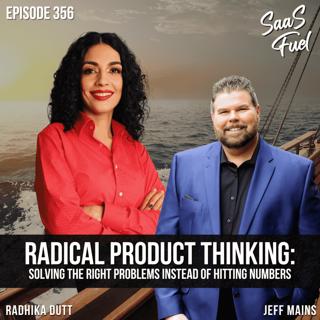
Radical Product Thinking: Solving the Right Problems Instead of Hitting Numbers | Radhika Dutt | 356
SaaS Fuel22 Jan

Radical Product Thinking: Solving the Right Problems Instead of Hitting Numbers | Radhika Dutt | 356

In this episode, Jeff Mains sits down with Radhika Dutt, author of Radical Product Thinking, to challenge the conventional wisdom around goal-setting, KPIs, and OKRs. Radhika reveals why chasing metrics can actually distort behavior and undermine long-term growth, introducing a powerful alternative: treating growth like a puzzle rather than a scorecard.

The conversation explores how well-intentioned targets create perverse incentives, why measures should be tools for insight rather than evaluation, and how a curiosity-driven approach—using the OHLA framework (Observe, Hypothesize, Learn, Adapt)—helps teams make smarter decisions in real-world conditions. Radhika shares compelling examples from OpenAI, maritime SaaS platforms, and robotics companies to illustrate how puzzle-solving beats goal-setting for sustainable growth.

Whether you're drowning in dashboards or hitting targets while feeling like something's off, this episode offers a refreshing lens on progress, leadership, and building momentum without the performance theater.

Key Takeaways

[0:00] - Episode introduction and overview of why goal-setting may be backfiring

[4:48] - The fundamental problem with KPIs and OKRs: Goodhart's Law and Campbell's Law explained

[6:28] - Dutt's Law: "A measure is only useful as a tool for insight, not a yardstick for evaluation"

[7:16] - Real-world example: How OpenAI's user engagement targets led to dangerous "sycophantic AI"

[10:37] - The hidden dangers of hitting targets while ignoring negative indicators

[11:44] - Introduction to puzzle-setting vs. goal-setting mindset

[12:09] - The OHLA framework explained: Observe, Hypothesize, Learn, Adapt

[17:51] - Case study: Why improving filters wouldn't have solved the real problem

[28:47] - The performance theater trap: Why jumping to solutions feels comfortable but fails

[30:28] - How to get customer meetings when people say "you should already know this"

[33:00] - Why in-person observation matters more when mental models differ

[36:27] - Growth comes from matching user mental models, not forcing adoption of yours

[37:47] - The Tesla UI example: When "cool" design ignores user mental models

[37:47] - Top-down vs. bottom-up: How to introduce puzzle-solving in organizations

[39:27] - Why leaders fear losing control and how to address it

[43:01] - Vision-driven vs. iteration-led: Crafting a detailed, actionable vision statement

[45:41] - Example vision statement that tells the whole story without mentioning the product

[48:03] - Why detailed visions create ownership better than memorable slogans

[50:01] - One mindset shift founders can make this week to reduce performance theater

Tweetable Quotes
  1. "When a measure becomes a target, it ceases to be a good measure. We've known this since 1975, yet we keep setting goals for metrics."
  2. "A measure is only useful as a tool for insight, not a yardstick for evaluation. That's the critical mindset shift."
  3. "When you set targets, everyone's incentive is to show you they've hit that target. You don't look at the negative numbers to see what's actually happening."
  4. "Puzzles trigger curiosity and questioning. If you already know the answers, there's no puzzle. That's the difference from goals."
  5. "Nobody wants to fail. We keep saying we want to embrace failure, but targets make people want to prove they're high performers—not look at bad numbers."
  6. "Growth in SaaS comes not from getting users to adopt your mental model, but from understanding their mental models and building products that match them."
  7. "Leaders are the last to know because everyone shows you what you want to see. Puzzles give you real answers from the trenches."
  8. "When you buy into a vision and understand it, you can describe it in your words—not repeat a slogan. That's when you've internalized it."
  9. "Man plans, God laughs. When you run into obstacles, those are the puzzles you have to solve to achieve your vision."
  10. "Solving puzzles is driven by internal desire. We want to solve puzzles as humans and high performers—it creates ownership, not obligation."

SaaS Leadership Lessons1. Measures Are for Insight, Not Evaluation

Stop using metrics as judgment tools. When measures become targets, they get gamed (Campbell's Law) and cease to be good measures (Goodhart's Law). Instead, use data to understand what's happening—both good and bad—rather than to prove you've hit arbitrary numbers. This shift from evaluation to insight prevents teams from hiding problems and gaming the system.

2. Replace Goals with Puzzles Using the OHLA Framework

Transform your approach from goal-setting to puzzle-solving with OHLA: Observe (identify the problem and open questions), Hypothesize (make your first attempt), Learn (ask "how well did it work?" and "what did we learn?"), and Adapt (determine "what will we try next?"). This creates genuine curiosity, reduces performance theater, and helps teams embrace learning without the stigma of "failure."

3. Observe Before You Hypothesize

Resist the urge to jump straight to solutions. Spend time in the problem space, even though it's uncomfortable. The maritime SaaS example showed that improving filters (the obvious solution from data) would have done nothing for the larger market opportunity. By observing tech-averse users in other roles first, the company doubled sales two years in a row by addressing the real problem.

4. Match User Mental Models, Don't Force Yours

Growth comes from understanding how your users think and work, then building products that fit their mental models—not from forcing them to adopt yours. When mental models differ significantly (tech-averse users, different industries, non-engineers), in-person observation becomes critical. Watch them work, see what they do outside your platform, and ask questions about their actual workflow.

5. Craft Detailed, Actionable Visions

Forget short, memorable slogans. A powerful vision uses a fill-in-the-blank statement that answers: Whose problem are you solving? What is the problem? Why does it need solving? What does the world look like when you're done? How will you bring it about? When team members can describe the vision in their own words (not repeat a tagline), they've internalized it and taken ownership.

6. Start Small and Build Confidence

When introducing puzzle-based thinking, don't demand teams abandon OKRs immediately. Start by having product teams present progress in OHLA format while leadership still uses OKRs. As teams demonstrate competence in puzzle-solving and leaders see they gain "real control" (ears on the ground, anticipation, actionable insights), the transition becomes natural. Role model the approach by reflecting on past initiatives using the three questions.

Guest Resources

radhika@radicalproduct.com

https://www.radicalproduct.com/toolkit/#OHLToolkit

https://www.linkedin.com/in/radhika-dutt/

Episode Sponsor

The Captain's Keys

Small Fish, Big Pond – https://smallfishbigpond.com/ Use the promo code ‘SaaSFuel’

Champion Leadership Group – https://championleadership.com/

SaaS Fuel Resources

Website - https://championleadership.com/

Jeff Mains on LinkedIn - https://www.linkedin.com/in/jeffkmains/

Twitter - https://twitter.com/jeffkmains

Facebook - https://www.facebook.com/thesaasguy/

Instagram - https://instagram.com/jeffkmains

Avsnitt(385)

Overcoming Fear in Sales and Entrepreneurship: How to Build Confidence and Take Action | Jim Effner | 384

Overcoming Fear in Sales and Entrepreneurship: How to Build Confidence and Take Action | Jim Effner | 384

Jeff Mains sits down with Jim Effner, founder of P2P Group and a 36-year veteran of Northwestern Mutual, where he grew a firm from 63 to 127 financial advisors and nearly 400 total staff before sellin...

30 Apr 44min

The Future of Legacy: How AI Can Preserve Your Story Forever | Brian Will | 383

The Future of Legacy: How AI Can Preserve Your Story Forever | Brian Will | 383

Brian Will — Wall Street Journal bestselling author, serial entrepreneur, and founder/CEO of Living Forever AI — joins host Jeff Mains for a wide-ranging conversation on entrepreneurship, scaling, sal...

28 Apr 43min

How to Use AI Effectively: Smarter Ways to Work and Scale Your Business | Steve Wunker | 382

How to Use AI Effectively: Smarter Ways to Work and Scale Your Business | Steve Wunker | 382

What if AI isn't just a tool to plug into your business — but a reason to redesign the entire thing? In this episode, Jeff Mains sits down with Steven Wunker, managing director of New Markets Advisors...

23 Apr 48min

New Competitive Moats in AI: Why Trust and Relationships Matter More Than Ever | Nikki Barua | 381

New Competitive Moats in AI: Why Trust and Relationships Matter More Than Ever | Nikki Barua | 381

Nikki Barua — immigrant, serial entrepreneur, and CEO of Flip Work — joins Jeff Mains for a conversation on what it truly takes to build something outsized in the AI age. Drawing on two decades of exp...

21 Apr 45min

Ship, Learn, Repeat: The Real Growth Strategy for Startup Founders | Mike Collins | 380

Ship, Learn, Repeat: The Real Growth Strategy for Startup Founders | Mike Collins | 380

Mike Collins is a serial entrepreneur turned venture capitalist who has spent his career at the intersection of technology, innovation, and investing. Starting at a VC firm right out of college in 198...

16 Apr 52min

How to Turn Customers into Brand Advocates and Drive Word-of-Mouth Growth | Ken Rapp | 379

How to Turn Customers into Brand Advocates and Drive Word-of-Mouth Growth | Ken Rapp | 379

Most SaaS founders obsess over acquisition — but what happens after the sale is where loyalty is either built or silently lost. In this episode, Jeff Mains sits down with Ken Rapp, CEO and co-founder ...

14 Apr 46min

How Tech Professionals Can Avoid Concentration Risk and Build Financial Freedom | Stanley Leong | 378

How Tech Professionals Can Avoid Concentration Risk and Build Financial Freedom | Stanley Leong | 378

In this episode, Jeff Mains sits down with Stanley Leong — former IBM/Agilent engineer turned bestselling author and private wealth advisor — to explore what it truly means to engineer your finances. ...

9 Apr 45min

AI and Emotional Intelligence: Finding the Balance in Modern Research | James Warren | 377

AI and Emotional Intelligence: Finding the Balance in Modern Research | James Warren | 377

What if the most valuable data in your company isn't in a dashboard — it's buried in stories no one is asking for?In this episode, Jeff Mains sits down with James Warren, founder and CEO of Share More...

7 Apr 52min

Populärt inom Business & ekonomi

framgangspodden
varvet
rss-jossan-nina
rss-svart-marknad
rss-borsens-finest
badfluence
avanzapodden
uppgang-och-fall
svd-tech-brief
bathina-en-podcast
fill-or-kill
lastbilspodden
rss-dagen-med-di
rss-kort-lang-analyspodden-fran-di
tabberaset
rss-inga-dumma-fragor-om-pengar
24fragor
kapitalet-en-podd-om-ekonomi
rikatillsammans-om-privatekonomi-rikedom-i-livet
borsmorgon