
S9 Ep15: What's next for Ukraine: Reconstruction

S9 Ep15: What's next for Ukraine: Reconstruction

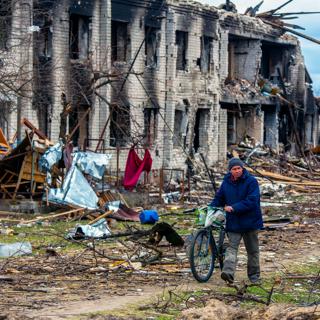
Ukraine's cities were failing long before the Russian invasion began. Kyiv and Lviv ranked among the 40 most congested cities in the world, yet neither makes the top 100 by population. Ninety per cent of Ukraine's housing stock was built before 1990. Its urban infrastructure was designed for a Soviet economy and never properly adapted for the one that followed. So when reconstruction begins, the question is not simply how to repair what was there: it is whether repairing what was there is the right goal.

Edward Glaeser of Harvard, Martina Kirchberger of Trinity College Dublin, and Andrii Parkhomenko of the University of Southern California argue that the most instructive precedent is not post-USSR Warsaw, or postwar Berlin, it is postwar Tokyo. Firebombed into ruin, Tokyo rebuilt in a way that was strikingly decentralised: master plans quickly abandoned, local communities empowered to combine small lots through land readjustment, and figure it out from the bottom up. Before the war, Ukraine's economic activity was already shifting away from heavy industry and the east, towards services and the west. Reconstruction that concentrates investment where the damage is greatest, rather than where people want to build a new life, would repair the buildings and miss the point.

The research behind this episode:

Glaeser, Edward L., Martina Kirchberger, and Andrii Parkhomenko. 2025. "Rebuilding Ukraine's Cities: Maximizing Benefits and Minimizing Costs." Economic Policy: Papers on European and Global Issues, special issue: "What's Next for Ukraine?"

To cite this episode:

Phillips, Tim. 2026, "What's Next for Ukraine: Reconstruction." Economic Policy: Papers on European and Global Issues (podcast).

Assign this as extra listening: the citation above is formatted and ready for a reading list or VLE.

About the guests

Edward Glaeser is Fred and Eleanor Glimp Professor of Economics at Harvard University and a Research Associate of the National Bureau of Economic Research. He is one of the world's leading urban economists, with a research agenda spanning cities, housing markets, economic growth, and governance.

Martina Kirchberger is a CEPR Research Affiliate and Assistant Professor in Economics at Trinity College Dublin. Her research focuses on structural transformation, urban economics, and development in low- and middle-income countries.

Andrii Parkhomenko is Assistant Professor of Real Estate at the USC Marshall School of Business and a researcher at the Kyiv School of Economics. His work centers on urban and spatial economics, with a particular focus on housing markets and city growth.

Research cited in this episode

Ukraine Rapid Damage and Needs Assessment, World Bank Group, European Commission, and UN, 2024. The source of the physical damage figure cited in this episode: approximately $175 billion by the end of 2024, with estimates for end-2025 likely exceeding $200 billion. Some independent projections cited by Glaeser run to $500 billion or above.

The concept of investing-in-investing, referenced by Kirchberger, originates in work by Paul Collier on how resource-rich developing countries can scale up capital investment effectively. It refers to the prior investments in institutions, skills, and capacity that must be made before large-scale capital flows can be productively absorbed. The implication for Ukraine: there is work to do now, before reconstruction begins at scale.

The Tokyo land readjustment model, which Glaeser cited as the most instructive reconstruction precedent, allowed owners of small fragmented lots to pool their land, redevelop it jointly, and receive a share of the new property in exchange for their stake in the old. It enabled large-scale urban reconstruction without central expropriation, and without waiting for government direction. The mechanism remains in active use in Japanese urban planning.

The Solidere reconstruction of central Beirut was raised as a cautionary counterexample: a centralised, top-down rebuild that produced a high-end commercial district with questionable benefit to ordinary Lebanese, and which substantially enriched its private shareholders. The contrast with Tokyo's decentralised model is the episode's sharpest illustration of what reconstruction can and cannot achieve when organised from above.

More in the "What's Next for Ukraine?" series

This episode is the second in a three-part series based on papers presented at the inaugural Economic Policy winter conference, Paris, December 2025.

Episode 1: Yuriy Gorodnichenko and Maurice Obstfeld on the investment and financing challenge: $40 billion a year, debt restructuring as a prerequisite for private capital, and why the number is more achievable than it sounds.

Episode 3: Demobilisation and the labour market: getting soldiers back into work without breaking the economy that kept the country going.

Related reading on VoxEU

Rebuilding cities in Ukraine: A VoxEU column on the urban reconstruction challenge, including the spatial decisions that will shape how Ukraine's cities develop in the decades after the war.

A blueprint for the reconstruction of Ukraine: A comprehensive VoxEU overview of the reconstruction architecture: what institutions are needed, how international financing can be coordinated, and what the sequencing of investment should look like.

Completing Ukraine's reconstruction architecture: On the remaining gaps in the international framework for financing and coordinating Ukraine's rebuild, and what needs to happen before reconstruction can begin at the required scale.

Lessons for rebuilding Ukraine from economic recoveries after natural disasters: What the evidence from post-disaster reconstruction in other countries tells us about what works, what fails, and how quickly economies can return to their pre-shock trajectories.

Det här avsnittet är hämtat från ett öppet RSS-flöde och publiceras inte av Podme. Det kan innehålla reklam.

Avsnitt(474)

S9 Ep47: The Next Generation: PSE 2026

S9 Ep47: The Next Generation: PSE 2026

Travel broadens the mind. So the Voxtalks visits a conference, we find the most interesting research from economists just starting out, and hand three of them a microphone. Ad that is today's episode,...

7 Aug 33min

S9 Ep46: Absorbing shocks since 1891

S9 Ep46: Absorbing shocks since 1891

Recorded at the PSE-CEPR Policy Forum 2026.A country wants a stable exchange rate, it wants money to move freely across its borders, and it wants to set its own interest rates. It's a well-known trile...

5 Aug 20min

S9 Ep45: Tariff Confusion

S9 Ep45: Tariff Confusion

If you run a business that exports to the United States, how big is the tariff you have to pay? In 2025 that question was hard to answer. Between February and December, 53 separate announcements intro...

31 Juli 31min
S9 Ep44: How superpowers shape trade

S9 Ep44: How superpowers shape trade

Recorded at the PSE-CEPR Policy Forum, Paris School of Economics.Tariffs move trade around, but so does economic power. When one economy dominates, other countries fall into step with it. They trade w...

29 Juli 15min

S9 Ep43: Navigating industrial policy

S9 Ep43: Navigating industrial policy

Recorded at the PSE-CEPR Policy Forum, Paris.In 2019 the IMF called the increasing adoption of industrial policy: "The return of the policy that shall not be named". No one is scared to name it in 202...

24 Juli 21min

S9 Ep42: The Safety Paradox

S9 Ep42: The Safety Paradox

Recorded at the PSE-CEPR Policy Forum, Paris School of Economics, June 2026.In 1941 the United States banned oil exports to Japan, to punish aggression without fighting a war. Historians now argue the...

22 Juli 20min

S9 Ep41: Making teenagers read newspapers

S9 Ep41: Making teenagers read newspapers

French teenagers carry a smartphone with access to almost anything, but few of them have been using it to read the news.Julia Cagé (Sciences Po, CEPR) ran an experiment to test the one barrier everyon...

17 Juli 20min

S9 Ep40: Are net zero commitments greenwash?

S9 Ep40: Are net zero commitments greenwash?

Sixty-three percent of large companies worldwide had made a net zero commitment by 2023, up from close to none in 2018. But if the target date is 2050, that's several corporate lifetimes away, and the...

15 Juli 24min

Populärt inom Business & ekonomi

framgangspodden
badfluence
dynastin
varvet
uppgang-och-fall
svd-tech-brief
avanzapodden
rss-inga-dumma-fragor-om-pengar
tabberaset
rss-kort-lang-analyspodden-fran-di
rikatillsammans-om-privatekonomi-rikedom-i-livet
fill-or-kill
borslunch-2
lastbilspodden
rss-dagen-med-di
rss-borslunch
ekonomiekot-extra
rss-hos-psykologen
bathina-en-podcast
rss-borssurr-med-mitelman-och-mellqvist