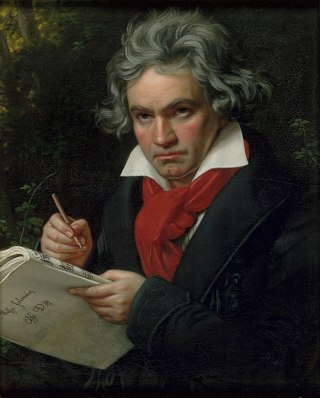
Beethoven String Quartet, Op. 59, No.2

Beethoven String Quartet, Op. 59, No.2

I'm always tickled by composer trivia questions, like which standard canon works begin in a major key and end in a minor key? I'll give you one, but please comment others below: Mendelssohn's 4th Symphony. Well, how about this one: how many of Beethoven's 16 string quartets end in a minor key? The answer? Just one, Op. 59, No. 2, the subject of today's show. And that minor key is hugely important to this darkest of the three Op. 59 quartets, three towering achievements that changed the string quartet repertoire for good.

Beethoven, as I've said many times on the show, was a revolutionary within limits, always expanding, rethinking, and reshaping what was possible without breaking anything beyond repair. But make no mistake: the Op. 59 quartets were revolutionary works. No one had written anything like them before in terms of scope, emotional intensity, difficulty, and complexity. In fact, like a few of Beethoven's greatest works, they were received with confusion and, in some cases, anger by musicians, audiences, and critics. Famously, the cellist of the first string quartet to receive the parts of Op. 59, No. 1 saw the Morse code-like, one-note theme of the second movement, threw the music aside, and stomped on it!

These quartets were Beethoven going out on a limb, applying the intensity and drama of his Middle Heroic Period to a genre that had been at least partly the province of amateur musicians, but not anymore. Op. 59, No. 2, as I said, is the darkest of this group: four movements all centered around the key of E, and with the exception of the glorious second movement, all in minor, presenting a seriousness and directness of purpose that is powerfully compelling. This might be my favorite of the Op. 59 quartets, and so I'm very excited to dig into it with you today. We'll discuss the enigmatic and ecstatic aspects of this quartet, as well as Beethoven's own philosophical views on life, which come to light in the second movement, one of Beethoven's greatest creations.

Recording: Cleveland Quartet

Det här avsnittet är hämtat från ett öppet RSS-flöde och publiceras inte av Podme. Det kan innehålla reklam.

Avsnitt(296)

Grieg: Peer Gynt

Grieg: Peer Gynt

Grieg's Peer Gynt suites are among the best-known and best-loved works of classical music in the world. They are practically embedded into popular culture, being used in a dizzying number of cartoons,...

3 Sep 1h 7min
Mozart Clarinet Concerto

Mozart Clarinet Concerto

When it comes to a piece like the Mozart Clarinet Concerto, a few words or phrases regularly come up: the concerto is described as "mellow" or Mozart's "swan song," but most often it is described as "...

20 Aug 51min
Bohuslav Martinu Symphony No. 1

Bohuslav Martinu Symphony No. 1

It took a lot to make the composer and critic Virgil Thomson happy. He was famous for savaging new works he didn't like, and the truth is, he didn't like very many new works at all. One exception was ...

6 Aug 1h 1min
Scriabin Poem of Ecstasy

Scriabin Poem of Ecstasy

Thence the universe resounds
 With a joyful cry  I AM. These are the final lines of Alexander Scriabin's epic Poem of Ecstasy, a 300-line poem that takes nearly 10 minutes to read aloud and is one of ...

23 Juli 51min
Sibelius Tapiola

Sibelius Tapiola

Ancient, mysterious, brooding savage dreams; Within them dwells the Forest's mighty God, And wood-sprites in the gloom weave magic secrets. These lines are affixed to the first page of Sibelius' tone...

10 Juli 47min
Arthur Honneger, Symphony No. 3, "Liturgique"

Arthur Honneger, Symphony No. 3, "Liturgique"

In the aftermath of World War II, the Swiss composer Arthur Honegger, who had been living in occupied Paris throughout the war, wrote a new symphony entitled "Liturgical." He wrote an extended comment...

25 Juni 53min
Dvorak Piano Quintet, Op. 81

Dvorak Piano Quintet, Op. 81

In 1872, at the age of 31, Dvořák wrote a Piano Quintet designated as Opus 5. Dvořák was not a prodigy like some other famous composers; instead, his development as a composer was slow and steady. Lat...

11 Juni 49min
Mozart String Quartet, K. 465, "Dissonance"

Mozart String Quartet, K. 465, "Dissonance"

You might be wondering: why on earth would I choose a piece that is literally called "Dissonance" when I was looking for something a bit simpler or cleaner to talk about on the show today? Actually, M...

28 Maj 49min

Populärt inom Nöje

mellan-himmel-och-jord-med-jlc
filip-fredrik-svarar
fordomspodden
dialogiskt
mardromsgasten
rss-p3-musikdokumentar
chilla-med-de-vet-du
fem-i-topp
badfluence
gott-snack-med-fredrik-soderholm
schulman-show
skandal
karatefylla
hemma-hos-strage
rss-made-in-sverige-podcast
vardagsmysterier
sexet
rss-bl-metal-podcast
mannen-utan-spar
podme-bio-4