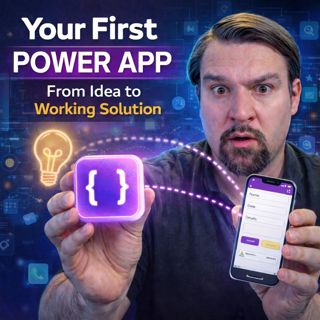

Your First Power App: From Idea to Working Solution

Your First Power App: From Idea to Working Solution

Most organizations think building an app is about screens, features, or tools. It’s not. Because apps don’t create value on their own—they change how work enters the business. And if the entry point is weak, everything behind it becomes slower, messier, and harder to trust. In this episode, we break down why your first Power App matters far more than it looks—and why the real shift isn’t “having an app,” but turning intent into structured, visible, and actionable work.

🚀 What You Will Learn
  • Why data alone doesn’t change business behavior
  • The critical difference between stored intent vs executed process
  • Why most first apps fail before anyone even opens them
  • How to define a business problem in operating terms (not features)
  • The real difference between Canvas and model-driven apps
  • Why your first app is a business interface—not a demo
  • How to reduce cycle time by fixing the entry point
  • The hidden risks of default environments and licensing decisions
  • How to handle real-world complexity without overbuilding
  • Why the best first app should feel boring (and that’s a good thing)
🧠 Core Insight

You didn’t build an app.
You redesigned how work enters the system.
  • A request in email → creates ambiguity
  • A request in Dataverse → creates structure
  • A request with status → creates visibility
Behavior doesn’t change when data exists.
It changes when interaction becomes easier than the workaround.

❌ Why First Apps Fail
  • Teams start with screens instead of process intent
  • Old workflows get copied into new interfaces
  • Too many features get added before trust exists
  • Complexity gets pushed onto users instead of the system
  • Licensing and environment decisions are made accidentally
  • The app looks modern—but behavior stays the same
⚠️ Failure Patterns 1. Digitizing the mess
  • Email → becomes a form
  • Spreadsheet → becomes fields
  • Confusion → becomes UI
👉 Same problem, better visuals 2. Overbuilding too early
  • Edge cases dominate design
  • Main path becomes unclear
  • First release becomes fragile
👉 Complexity replaces clarity 3. Confusing storage with execution
  • Data exists, but process doesn’t move
  • Tables are created, but behavior stays unchanged
👉 “We have the data” ≠ “The system works”

🧩 Core Model Every first app must align three things:
  • Event → How work enters the system
  • Decision → What happens next
  • Status → What everyone can see
If these are unclear, the app becomes decoration—not operation.

🔑 Key Takeaways
  • Your first app is a front door, not a full system
  • Adoption comes from reducing friction, not adding features
  • Canvas = interaction-first (front door)
  • Model-driven = structure-first (operations workspace)
  • Dataverse is not storage—it’s business structure
  • Simplicity creates trust → trust creates usage
  • Fixing entry improves everything downstream
🏗️ The Architectural Shift Move away from:
  • Feature-first thinking
  • UI-driven design
  • “Let’s include everything” releases
  • Email + memory-based processes
Move toward:
  • Clear entry points
  • Structured records in Dataverse
  • Shared status models
  • Separation of interaction vs orchestration
⚙️ Practical Shifts
  • Make the right path easier than the workaround
  • Capture only what the next decision needs
  • Keep the first app small and focused
  • Store complexity in the data model—not the UI
  • Avoid default environment for real solutions
  • Avoid unnecessary premium connectors early
⚡ The 30-Day Move Pick one process that still runs through:
  • Email
  • Teams messages
  • Memory
Then:
  1. Define:
    • Event
    • Decision
    • Status
  2. Build:
    • One clean entry (Canvas app)
    • One structured record (Dataverse)
  3. Measure:
    • Time to submit
    • Time to respond
    • Number of follow-ups
If the process becomes faster and clearer, you’re on the right path.

🎯 Who This Episode Is For
  • IT leaders starting with Power Platform
  • Architects designing first-use cases
  • Makers building their first real app
  • HR / Operations teams stuck in email workflows
  • Anyone whose “process exists”—but doesn’t actually work
💡 Final Thought

Your first app is not about Power Apps. It’s about changing how work begins. Because once the entry point becomes structured, visible, and trusted— everything behind it starts to move.

Become a supporter of this podcast: https://www.spreaker.com/podcast/m365-fm-modern-work-security-and-productivity-with-microsoft-365--6704921/support.

Det här avsnittet är hämtat från ett öppet RSS-flöde och publiceras inte av Podme. Det kan innehålla reklam.

Avsnitt(869)

The Death of the Chatbot: Why Your Dataverse Strategy Is Broken

The Death of the Chatbot: Why Your Dataverse Strategy Is Broken

Microsoft Copilot has transformed how organizations interact with AI, making conversational experiences more accessible than ever. But while chat-based AI delivers immediate productivity gains, it doe...

29 Juli 1h 41min

The Future of IT Is Agentic: Inside Windows 365, Intune & Microsoft's AI Vision with Christiaan Brinkhoff

The Future of IT Is Agentic: Inside Windows 365, Intune & Microsoft's AI Vision with Christiaan Brinkhoff

Christiaan Brinkhoff shares the remarkable career path that took him from speaking at community events and writing technical blogs to becoming one of the key people behind Microsoft's modern cloud des...

29 Juli 1h 29min

How Do You Successfully Deploy Microsoft 365 Copilot Across an Enterprise?

How Do You Successfully Deploy Microsoft 365 Copilot Across an Enterprise?

A successful Microsoft 365 Copilot deployment begins long before licenses are assigned. Organizations should first define measurable business outcomes, identify high-value use cases, and secure execut...

29 Juli 1h 32min

From Pilot to Production: Building Enterprise AI That Actually Delivers with Leon Gordon [MVP]

From Pilot to Production: Building Enterprise AI That Actually Delivers with Leon Gordon [MVP]

Leon Gordon explains why most enterprise AI initiatives never reach production and introduces the concept of the Pilot Tax—the hidden cost organizations pay when AI projects remain stuck in proof-of-c...

28 Juli 59min

Microsoft Purview is a Trap: The Hard Truth About Data Governance

Microsoft Purview is a Trap: The Hard Truth About Data Governance

Microsoft Purview is included with many Microsoft 365 subscriptions, making it incredibly easy to enable. That convenience is also its biggest danger. Because there is no procurement process or large ...

28 Juli 1h 1min

From Excel Expert to Microsoft MVP: Empowering Millions with Data, Dashboards & AI with Karen Abecia [Microsoft MVP]

From Excel Expert to Microsoft MVP: Empowering Millions with Data, Dashboards & AI with Karen Abecia [Microsoft MVP]

aren Abecia shares the remarkable journey that transformed a passion for Microsoft Excel into a global career as one of the world's best-known Excel educators. She explains how discovering creative sp...

27 Juli 59min

The Copilot Credit Trap- Why Your AI Economy is Already Broken

The Copilot Credit Trap- Why Your AI Economy is Already Broken

For decades, enterprise software followed a predictable financial model. Organizations purchased licenses, assigned them to users, and budgeted annual IT spending with confidence. AI changes that comp...

26 Juli 1h 12min
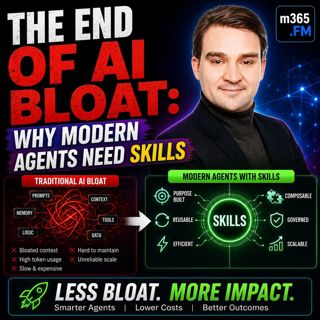
The End of AI Bloat: Why Modern Agents Need Skills

The End of AI Bloat: Why Modern Agents Need Skills

Many AI agents start out fast, responsive, and surprisingly intelligent. But after a few months of real-world use, something changes. Response times increase, costs rise, prompts become enormous, and ...

26 Juli 1h 13min

Populärt inom Politik & nyheter

svenska-fall
p3-krim
rss-krimstad
aftonbladet-krim
aftonbladet-daily
rss-sanning-konsekvens
flashback-forever
rss-krimreportrarna
tv4-nyheterna-story
motiv
mannen-utan-spar
rss-frandfors-horna
de-fyras-gang
rss-flodet
rss-aftonbladet-krim
spar
rss-vad-fan-hande
politiken
olyckan-inifran
krimmagasinet