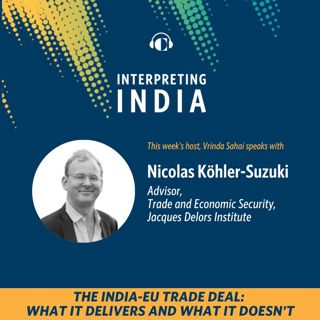
The India-EU Trade Deal: What It Delivers and What It Doesn't

The India-EU Trade Deal: What It Delivers and What It Doesn't

For most of the last decade, a trade deal between India and the EU seemed unlikely. The nudge came as the world changed around both. Nicolas points to three converging forces: the pressure of US tariffs under Trump, which gave both sides political incentive to show they had other partners; the shared interest in reducing dependence on China for critical supply chains; and India's loss of GSP preferential treatment in the EU from January this year, which created a very concrete economic urgency on the Indian side. Together, these forces did what years of diplomatic goodwill could not.

The deal itself is ambitious by India's standards, covering tariff elimination on 96.6% of EU goods exports, significant reductions on cars, wine and spirits, and new services commitments across sectors that were previously off the table. But Nicolas is candid about the gaps. There is no chapter on government procurement, the sustainability provisions lack any real enforcement mechanism, and investment protection has been deferred to a separate negotiation. On the regulatory side, Indian exporters still face the carbon border adjustment mechanism on steel and aluminium, strict food safety standards that have already led to hundreds of rejected shipments, and product testing requirements that a tariff cut alone cannot resolve.

On mobility, Nicolas notes that the framework for Indian professionals is genuinely more promising than what was on offer in the original negotiations, partly because the UK is no longer in the room and partly because Europe's labour market has shifted significantly. But immigration policy remains a national competence, and many EU governments are currently run by or in coalition with parties for whom restricting migration is a core political position. The gap between what Brussels signs and what Vienna or Rome implement could be quite wide, and managing expectations around this will be one of the more delicate parts of the implementation process ahead.

Every two weeks, Interpreting India brings you diverse voices from India and around the world to explore the critical questions shaping the nation's future. We delve into how technology, the economy, and foreign policy intertwine to influence India's relationship with the global stage.

As a Carnegie India production, hosted by Carnegie scholars, Interpreting India, a Carnegie India production, provides insightful perspectives and cutting-edge by tackling the defining questions that chart India's course through the next decade.

Stay tuned for thought-provoking discussions, expert insights, and a deeper understanding of India's place in the world.

Don't forget to subscribe, share, and leave a review to join the conversation and be part of Interpreting India's journey.

Det här avsnittet är hämtat från ett öppet RSS-flöde och publiceras inte av Podme. Det kan innehålla reklam.

Avsnitt(153)

India, Australia, and the Critical Minerals Opportunity

India, Australia, and the Critical Minerals Opportunity

The conversation opens with a useful baseline on both countries. Australia has world-class mining equipment, technology, and services capabilities, and its mining sector contributes roughly 10 to 15 p...

13 Aug 49min
Chokepoints, Economic Warfare and India's Strategic Options

Chokepoints, Economic Warfare and India's Strategic Options

Edward lays out three criteria for what makes something a genuine choke point: dominant market share, difficulty to substitute, and the ability to weaponize it with asymmetric impact, hurting the adve...

10 Juli 33min
India's AI Ambitions and the Road to Viksit Bharat | AI Summit Special

India's AI Ambitions and the Road to Viksit Bharat | AI Summit Special

This is the final episode of our special series on the India AI Impact Summit, examining the conversations, decisions, and debates that are shaping global AI governance. This episode explores: India...

2 Juli 33min
Did India's AI Summit Get Safety Right? AI Summit Special

Did India's AI Summit Get Safety Right? AI Summit Special

This episode is part of our special series on the India AI Impact Summit, examining the conversations, decisions, and debates that are shaping global AI governance. Professor Ravindran addresses early...

19 Juni 40min
Subsea Cables, Trusted Networks, and India's Strategic Opportunity

Subsea Cables, Trusted Networks, and India's Strategic Opportunity

Pooja opens with a mismatch that frames the entire conversation. India consumes around 20% of global internet traffic but accounts for just 2% of global subsea cable infrastructure. Even with the expa...

4 Juni 46min
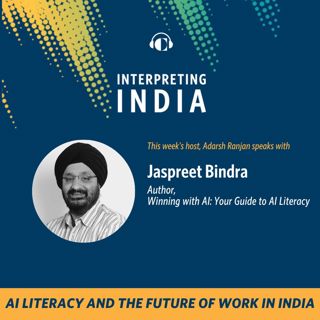
AI Literacy and the Future of Work in India

AI Literacy and the Future of Work in India

Jaspreet's framing for the AI and work debate is worth staying with. He is not dismissive of disruption: he thinks AI will destroy certain jobs, create new ones, and the rupture will be real. But he p...

26 Maj 44min
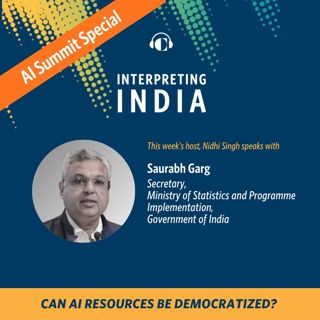
Can AI Resources Be Democratized? AI Summit Special

Can AI Resources Be Democratized? AI Summit Special

This episode is part of our special series on the India AI Impact Summit, examining the conversations, decisions, and debates that are shaping global AI governance. The working group was designed from...

15 Maj 28min

Space Security in the Age of AI

Space Security in the Age of AI

Almudena opens with a distinction that anchors the entire conversation: space security, unlike space safety, is about intentional harm. It concerns deliberate attempts to disrupt, deny, or destroy spa...

7 Maj 1h 7min

Populärt inom Politik & nyheter

aftonbladet-krim
p3-krim
aftonbladet-daily
svenska-fall
rss-krimstad
flashback-forever
rss-krimreportrarna
motiv
rss-sanning-konsekvens
svd-ledarredaktionen
spar
rss-flodet
politiken
rss-expressen-dok
rss-frandfors-horna
mannen-utan-spar
tv4-nyheterna-story
de-fyras-gang
rss-aftonbladet-krim
fordomspodden