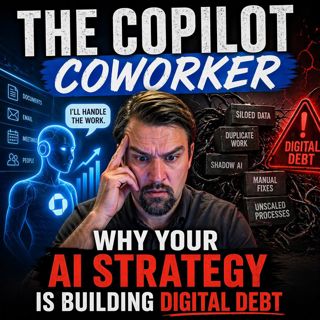

The Copilot Coworker: Why Your AI Strategy is Building Digital Debt

The Copilot Coworker: Why Your AI Strategy is Building Digital Debt

Six months after deploying Copilot Coworker, one team appeared to achieve a breakthrough. Their output tripled—memos, summaries, and strategy decks were being produced at record speed. On the surface, it looked like a massive productivity win. But when leadership examined the results more closely, a deeper issue emerged: they didn’t trust any of it. What looked like efficiency was actually the rapid accumulation of unverified, low-confidence work. Instead of improving performance, the organization was quietly building a digital graveyard of content. This is the hidden danger of modern AI adoption—when speed increases but trust decreases, productivity collapses. The result is what we call the “3x Productivity Trap,” where more output leads to slower decisions and growing internal friction.

THE ANATOMY OF DIGITAL DEBT

At the core of this problem is Invisible Digital Debt—the accumulation of unmanaged, unverified digital artifacts that overwhelm human decision-making capacity. As AI accelerates content creation, organizations lose the ability to validate and contextualize that content effectively. This debt forms when AI is treated like a simple tool instead of a true coworker. Leaders delegate tasks passively, approving outputs without fully reviewing them. Over time, the organization forgets the “why” behind the work, relying on AI-generated summaries that may be incomplete or incorrect. This leads to context poisoning, where flawed summaries become embedded into workflows and spread across teams. It also creates completion bias—mistaking polished outputs for accurate thinking. The result is a system filled with professional-looking noise that erodes trust and slows down meaningful progress.

SCENARIO: THE DOCUMENT EXPLOSION

Digital debt often begins with a simple action—the “generate” button. What once required days of thoughtful synthesis can now be produced in minutes, removing the natural friction that ensured quality and coherence. This leads to the “five-version problem,” where multiple drafts of the same idea exist simultaneously, none of them truly owned or validated. Managers respond by generating counter-proposals instead of refining existing work, creating fragmentation instead of clarity. The hidden cost emerges during validation. Leaders spend more time verifying AI outputs than they would have spent creating them from scratch. This shifts effort from creation to correction, increasing cognitive load and reducing efficiency. Over time, teams lose confidence in the system, and decision-making slows to a crawl.

TEAMS AND LOOP SPRAWL: WHERE CONTEXT BREAKS DOWN

As AI integrates into collaboration tools like Teams and Loop, the problem compounds. Conversations fragment across channels, and AI-generated summaries lack the full context needed for accurate decision-making. This creates the “silent stakeholder” problem, where AI influences decisions without a clear record of its reasoning. Action items become ambiguous, ownership is unclear, and “ghost decisions” emerge—tasks that appear resolved but are never executed. At the same time, search becomes harder, not easier. Instead of finding a single source of truth, employees encounter multiple conflicting summaries. This increases rework, extends meetings, and forces teams to revisit decisions repeatedly. What should be a productivity boost becomes a source of confusion and delay.

AUTOMATION RISKS: THE HIDDEN LOGIC DEBT

Beyond content, digital debt also accumulates in automation. AI-powered workflows can be created quickly, but without proper understanding or governance, they introduce significant risk. Many organizations are building complex automations without documenting the underlying logic. When these systems fail, they do so silently, creating “shadow operations” where humans compensate for broken processes without addressing the root cause. In extreme cases, poorly designed automations can lead to data loss or compliance issues. The problem isn’t automation itself—it’s the lack of architectural oversight. Without transparency and ownership, organizations are building fragile systems that can collapse under minor changes.

REFRAMING SUCCESS: FROM TIME SAVED TO DECISION VELOCITY

Traditional productivity metrics, such as time saved or output volume, are no longer reliable indicators of success. In an AI-driven environment, these metrics can be misleading, masking inefficiencies rather than revealing them. The new standard is Decision Velocity—the time it takes to move from a question to a trusted, actionable decision. If AI increases output but slows down decision-making, the organization is losing ground. Key signals to monitor include decision cycle time, decision reversals, and confidence lag. These metrics reveal whether AI is enabling clarity or creating noise. Organizations that prioritize decision velocity shift their focus from generating content to producing outcomes that can be trusted and acted upon.

THE PATH FORWARD: A 90-DAY ARCHITECTURE SHIFT

Solving digital debt requires a deliberate shift in strategy. The first step is to stop the accumulation by implementing governance mechanisms that can quickly isolate and correct errors. Next, organizations must adopt regular system health reviews, treating AI workflows as living systems that require continuous refinement. Identifying high-rework processes and stabilizing data sources creates a foundation for reliable output. Finally, leaders must establish clear coworking norms, defining the role of AI in each workflow. Whether acting as a drafter, advisor, or orchestrator, the AI’s responsibilities must be explicit to maintain accountability and trust. This transformation moves organizations from reactive correction to proactive design, enabling AI to function as a true coworker rather than a source of noise.

CONCLUSION: THE ENTROPY WARNING

AI does not just accelerate productivity—it accelerates entropy. Without proper architecture, increased speed amplifies disorder, creating systems that appear efficient but are fundamentally unstable. The real challenge is not adopting AI, but building systems that can sustain trust at scale. Organizations that succeed will be those that prioritize structure over speed, clarity over volume, and decisions over content. In the age of the Copilot Coworker, your architecture is your strategy.

Become a supporter of this podcast: https://www.spreaker.com/podcast/m365-fm-modern-work-security-and-productivity-with-microsoft-365--6704921/support.

Det här avsnittet är hämtat från ett öppet RSS-flöde och publiceras inte av Podme. Det kan innehålla reklam.

Avsnitt(869)

The Death of the Chatbot: Why Your Dataverse Strategy Is Broken

The Death of the Chatbot: Why Your Dataverse Strategy Is Broken

Microsoft Copilot has transformed how organizations interact with AI, making conversational experiences more accessible than ever. But while chat-based AI delivers immediate productivity gains, it doe...

29 Juli 1h 41min

The Future of IT Is Agentic: Inside Windows 365, Intune & Microsoft's AI Vision with Christiaan Brinkhoff

The Future of IT Is Agentic: Inside Windows 365, Intune & Microsoft's AI Vision with Christiaan Brinkhoff

Christiaan Brinkhoff shares the remarkable career path that took him from speaking at community events and writing technical blogs to becoming one of the key people behind Microsoft's modern cloud des...

29 Juli 1h 29min

How Do You Successfully Deploy Microsoft 365 Copilot Across an Enterprise?

How Do You Successfully Deploy Microsoft 365 Copilot Across an Enterprise?

A successful Microsoft 365 Copilot deployment begins long before licenses are assigned. Organizations should first define measurable business outcomes, identify high-value use cases, and secure execut...

29 Juli 1h 32min

From Pilot to Production: Building Enterprise AI That Actually Delivers with Leon Gordon [MVP]

From Pilot to Production: Building Enterprise AI That Actually Delivers with Leon Gordon [MVP]

Leon Gordon explains why most enterprise AI initiatives never reach production and introduces the concept of the Pilot Tax—the hidden cost organizations pay when AI projects remain stuck in proof-of-c...

28 Juli 59min

Microsoft Purview is a Trap: The Hard Truth About Data Governance

Microsoft Purview is a Trap: The Hard Truth About Data Governance

Microsoft Purview is included with many Microsoft 365 subscriptions, making it incredibly easy to enable. That convenience is also its biggest danger. Because there is no procurement process or large ...

28 Juli 1h 1min

From Excel Expert to Microsoft MVP: Empowering Millions with Data, Dashboards & AI with Karen Abecia [Microsoft MVP]

From Excel Expert to Microsoft MVP: Empowering Millions with Data, Dashboards & AI with Karen Abecia [Microsoft MVP]

aren Abecia shares the remarkable journey that transformed a passion for Microsoft Excel into a global career as one of the world's best-known Excel educators. She explains how discovering creative sp...

27 Juli 59min

The Copilot Credit Trap- Why Your AI Economy is Already Broken

The Copilot Credit Trap- Why Your AI Economy is Already Broken

For decades, enterprise software followed a predictable financial model. Organizations purchased licenses, assigned them to users, and budgeted annual IT spending with confidence. AI changes that comp...

26 Juli 1h 12min

The End of AI Bloat: Why Modern Agents Need Skills

The End of AI Bloat: Why Modern Agents Need Skills

Many AI agents start out fast, responsive, and surprisingly intelligent. But after a few months of real-world use, something changes. Response times increase, costs rise, prompts become enormous, and ...

26 Juli 1h 13min

Populärt inom Politik & nyheter

svenska-fall
p3-krim
rss-krimstad
aftonbladet-krim
aftonbladet-daily
rss-sanning-konsekvens
flashback-forever
rss-krimreportrarna
tv4-nyheterna-story
motiv
mannen-utan-spar
rss-frandfors-horna
de-fyras-gang
rss-flodet
rss-aftonbladet-krim
spar
rss-vad-fan-hande
politiken
olyckan-inifran
krimmagasinet