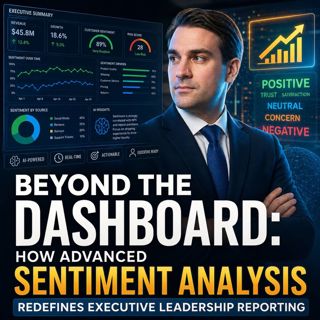

Beyond The Dashboard: How Advanced Sentiment Analysis Redefines Executive Leadership Reporting

Beyond The Dashboard: How Advanced Sentiment Analysis Redefines Executive Leadership Reporting

Most executive dashboards don’t reflect reality—they reflect what’s easy to measure. In boardrooms, everything looks perfect: green charts, rising adoption, high completion rates. But step outside the slide deck, and a different story emerges. Employees are frustrated, confused, and often working around the very systems leaders believe are succeeding. This is the Green Dashboard trap—where activity is mistaken for progress, and comfort replaces truth. The core issue is simple: we measure what’s clean, not what’s meaningful. Logins, clicks, and usage stats create the illusion of success, but they fail to capture the human experience behind the data. A project can appear “on track” while being culturally broken. This disconnect creates a hidden Behavioral Gap—the space between what dashboards report and what people actually feel.

THE STRUCTURAL FLAW IN EXECUTIVE REPORTING

Traditional reporting models are built on flawed assumptions. They equate participation with success and rely heavily on activity-based metrics that look impressive but lack depth. These metrics—logins, completion rates, click-throughs—are easy to quantify but often meaningless in terms of real impact. Data aggregation further distorts reality. By the time insights reach leadership, nuance is gone. Frustration becomes a percentage. Resistance becomes a trendline. The “why” disappears entirely. This creates a sanitized version of truth—one that protects leadership from discomfort but also blinds them to risk. The result? Leaders are making high-stakes decisions based on incomplete, filtered data. And in a fast-moving, AI-driven world, that’s not just inefficient—it’s dangerous.

THE UNTAPPED GOLDMINE: UNSTRUCTURED DATA

The real pulse of an organization doesn’t live in dashboards—it lives in conversations. Microsoft 365 environments are filled with rich, unstructured data: Teams chats, meeting transcripts, collaborative edits. This is where the truth exists. Until recently, this data was too complex to analyze at scale. But with AI and tools like Copilot, we can now detect linguistic patterns that reveal sentiment, confidence, and friction in real time. This isn’t about reading private messages—it’s about identifying patterns in how people communicate. Language shifts when organizations struggle. Words become more passive. Confidence turns into hesitation. Frustration surfaces subtly before it becomes visible in traditional metrics. These are leading indicators—signals that allow leaders to act before problems escalate.

TRUST IS THE FOUNDATION, NOT A FEATURE

There’s a critical constraint: trust. If sentiment analysis is perceived as surveillance, it fails immediately. Employees will self-censor, and the data becomes meaningless. The solution is a privacy-first model built on aggregation and anonymization. Leaders don’t need to know who is frustrated—they need to understand what is broken. This shifts the mindset from monitoring individuals to diagnosing systems. Think of it as a public health model for organizations: you’re tracking patterns, not people. When trust is preserved, the data remains authentic—and that’s where real insight lives.

THE COPILOT ADOPTION TRAP

AI rollouts like Microsoft Copilot highlight the limitations of traditional dashboards. High adoption rates and usage metrics may suggest success, but they often hide underlying friction. Employees can use tools they don’t trust. They can complete training without understanding it. They can generate activity that looks like engagement but actually signals inefficiency. This is where a new metric emerges: the Adoption-to-Trust Ratio. It compares usage with sentiment. Are employees confident in the tool—or quietly struggling with it? Without this context, organizations risk scaling frustration instead of productivity.

FROM DASHBOARDS TO EXECUTIVE SIGNALS

The future of leadership reporting isn’t more charts—it’s better signals. Instead of overwhelming executives with data, advanced sentiment analysis distills organizational health into a few critical insights:
  • DECISION CONFIDENCE INDEX – Are leaders aligned and decisive, or hesitant and uncertain?
  • BEHAVIOR SHIFT INDICATOR – Is transformation actually changing how work gets done?
  • ESCALATION RISK SIGNAL – Where are problems forming before they become visible?
These signals move leadership from reactive reporting to proactive decision-making. They reveal not just what is happening—but how people feel about it.

LEADING BY PULSE, NOT BY PROXY

The biggest risk in modern leadership isn’t a lack of data—it’s false confidence in the wrong data. Green dashboards create comfort, but they often hide the truth. To lead effectively in the age of AI, executives must shift from proxy-based leadership—relying on filtered reports—to pulse-based leadership—understanding the real-time emotional and behavioral state of their organization. Stop asking: Are people using the tools?
Start asking: Do they trust them? Because in the end, leadership isn’t about tracking activity—it’s about understanding people.


Become a supporter of this podcast: https://www.spreaker.com/podcast/m365-fm-modern-work-security-and-productivity-with-microsoft-365--6704921/support.

Det här avsnittet är hämtat från ett öppet RSS-flöde och publiceras inte av Podme. Det kan innehålla reklam.

Avsnitt(869)

The Death of the Chatbot: Why Your Dataverse Strategy Is Broken

The Death of the Chatbot: Why Your Dataverse Strategy Is Broken

Microsoft Copilot has transformed how organizations interact with AI, making conversational experiences more accessible than ever. But while chat-based AI delivers immediate productivity gains, it doe...

29 Juli 1h 41min

The Future of IT Is Agentic: Inside Windows 365, Intune & Microsoft's AI Vision with Christiaan Brinkhoff

The Future of IT Is Agentic: Inside Windows 365, Intune & Microsoft's AI Vision with Christiaan Brinkhoff

Christiaan Brinkhoff shares the remarkable career path that took him from speaking at community events and writing technical blogs to becoming one of the key people behind Microsoft's modern cloud des...

29 Juli 1h 29min

How Do You Successfully Deploy Microsoft 365 Copilot Across an Enterprise?

How Do You Successfully Deploy Microsoft 365 Copilot Across an Enterprise?

A successful Microsoft 365 Copilot deployment begins long before licenses are assigned. Organizations should first define measurable business outcomes, identify high-value use cases, and secure execut...

29 Juli 1h 32min

From Pilot to Production: Building Enterprise AI That Actually Delivers with Leon Gordon [MVP]

From Pilot to Production: Building Enterprise AI That Actually Delivers with Leon Gordon [MVP]

Leon Gordon explains why most enterprise AI initiatives never reach production and introduces the concept of the Pilot Tax—the hidden cost organizations pay when AI projects remain stuck in proof-of-c...

28 Juli 59min

Microsoft Purview is a Trap: The Hard Truth About Data Governance

Microsoft Purview is a Trap: The Hard Truth About Data Governance

Microsoft Purview is included with many Microsoft 365 subscriptions, making it incredibly easy to enable. That convenience is also its biggest danger. Because there is no procurement process or large ...

28 Juli 1h 1min

From Excel Expert to Microsoft MVP: Empowering Millions with Data, Dashboards & AI with Karen Abecia [Microsoft MVP]

From Excel Expert to Microsoft MVP: Empowering Millions with Data, Dashboards & AI with Karen Abecia [Microsoft MVP]

aren Abecia shares the remarkable journey that transformed a passion for Microsoft Excel into a global career as one of the world's best-known Excel educators. She explains how discovering creative sp...

27 Juli 59min

The Copilot Credit Trap- Why Your AI Economy is Already Broken

The Copilot Credit Trap- Why Your AI Economy is Already Broken

For decades, enterprise software followed a predictable financial model. Organizations purchased licenses, assigned them to users, and budgeted annual IT spending with confidence. AI changes that comp...

26 Juli 1h 12min

The End of AI Bloat: Why Modern Agents Need Skills

The End of AI Bloat: Why Modern Agents Need Skills

Many AI agents start out fast, responsive, and surprisingly intelligent. But after a few months of real-world use, something changes. Response times increase, costs rise, prompts become enormous, and ...

26 Juli 1h 13min

Populärt inom Politik & nyheter

svenska-fall
p3-krim
rss-krimstad
aftonbladet-krim
aftonbladet-daily
rss-sanning-konsekvens
flashback-forever
rss-krimreportrarna
tv4-nyheterna-story
motiv
mannen-utan-spar
rss-frandfors-horna
de-fyras-gang
rss-flodet
rss-aftonbladet-krim
spar
rss-vad-fan-hande
politiken
olyckan-inifran
krimmagasinet