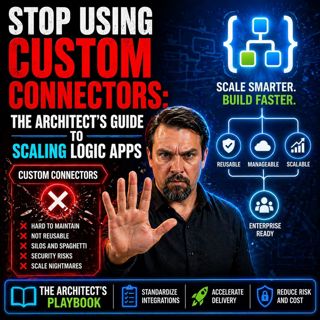

Stop Using Custom Connectors: The Architect's Guide to Scaling Logic Apps

Stop Using Custom Connectors: The Architect's Guide to Scaling Logic Apps

Your automation strategy looks like it’s scaling—but underneath, it’s accumulating invisible debt. What feels like speed today becomes fragmentation tomorrow. Custom connectors promise fast integration, low-code accessibility, and quick wins. But by 2026, they’ve quietly become one of the biggest blockers to governance, security, and cost control in enterprise environments. This is the fragmentation tax—and most organizations are paying it without realizing it. While teams celebrate rapid delivery, architecture slowly erodes. Connectors multiply, ownership becomes unclear, and visibility disappears. The result? A system that works… until it doesn’t. The top architects have already made the shift. They’ve stopped building flows and started building infrastructure—moving toward Logic Apps Standard as the foundation for scalable, governed automation.

⚠️ THE CUSTOM CONNECTOR TRAP

The problem isn’t the tool—it’s the assumption behind it. We assumed that making APIs easier to access would empower the business. In reality, it created a new layer of Shadow IT. Every custom connector becomes a black box: easy to build, hard to monitor, and nearly impossible to govern at scale. What starts as a simple wrapper quickly turns into a distributed risk surface. Governance tools can tell you a connector exists—but not what it actually does. That lack of visibility creates serious consequences, especially when sensitive data flows through insecure or over-permissioned APIs. Where custom connectors break down:
  • Lack of deep visibility into API behavior and data flow
  • Increased security risks due to inconsistent authentication and permissions
  • High maintenance overhead when APIs change or evolve
  • Dependency on individual makers instead of centralized architecture
Over time, this leads to fragile systems tied to people instead of platforms. When employees leave, integrations break. When APIs change, flows fail. What looked like agility becomes operational chaos.

💸 THE HIDDEN COST: THE API TAX

Beyond governance, there’s a financial reality most teams overlook. Consumption-based models charge per action. At small scale, it feels negligible. But as automation grows, those tiny costs compound into a significant and unpredictable expense. You’re effectively paying more as you become more efficient. This is where the model collapses. High-volume workflows—something as simple as invoice processing—can generate millions of actions per month. At that point, you’re no longer optimizing—you’re leaking budget. Logic Apps Standard flips this model entirely. Instead of paying per execution, you move to a fixed compute cost. Custom integrations run locally within the runtime, eliminating per-call charges and stabilizing your spend. The shift is not just technical—it’s financial. You move from unpredictable scaling costs to a controlled infrastructure model that aligns with enterprise growth.

🔐 GOVERNANCE AND NETWORK CONTROL AS A REQUIREMENT

Security is no longer optional—and architecture now defines compliance. Most low-code flows rely on public endpoints, meaning your data leaves your environment and travels across shared infrastructure. For regulated industries, this is a critical failure point. You cannot enforce Zero Trust principles if your automation layer depends on public network paths. Logic Apps Standard changes this by embedding automation inside your own virtual network. Instead of exposing data externally, you bring the runtime into your security perimeter. Traffic becomes private, controlled, and auditable. This isn’t just about protection—it’s about control. You define how data moves, where it flows, and who can access it. The architecture itself enforces governance, rather than relying on policies to catch issues after the fact.

🏗️ FROM CITIZEN DEVELOPMENT TO ENTERPRISE ARCHITECTURE

There’s a fundamental shift happening in how automation is built. Low-code tools made it easy to create solutions—but they also removed the discipline required to maintain them. Building directly in a browser with no separation between development and production leads to fragile, unstructured systems. Logic Apps Standard introduces a different mindset. Automation becomes code. Workflows are developed locally, version-controlled, and deployed through pipelines. Changes are intentional, traceable, and reversible. What changes with the architect model:
  • Development moves from portal-based editing to structured environments
  • Deployments become controlled through pipelines and source control
  • Updates can be isolated to specific workflows, reducing risk
  • Integrations shift from UI-driven automation to API-first orchestration
This is where automation matures. It’s no longer about building something quickly—it’s about building something that lasts.

🔮 THE 2026 ARCHITECT MODEL: FROM FLOWS TO ORCHESTRATION

The future of automation is not trigger-action—it’s event-driven orchestration. Instead of linear flows, systems now reason about processes. They handle complex, multi-step operations across systems, data sources, and timelines. Logic Apps Standard enables this shift by supporting both lightweight stateless workflows and durable, long-running processes. It also removes the limitations of low-code environments. When needed, you can extend workflows with custom code, integrate deeply with services, and design systems that reflect real business complexity. This creates a layered architecture:
  • Power Automate handles user-facing, lightweight automation
  • Logic Apps Standard manages core integrations and data pipelines
The result is a system that balances flexibility with control—empowering users without sacrificing structure.

🛣️ THE MIGRATION PATH FOR SCALABLE AUTOMATION

Moving away from custom connectors doesn’t happen overnight—but it starts with clarity. Begin by identifying your most critical connectors, especially those with unclear ownership or high execution volume. These are your highest-risk assets and your biggest cost drivers. From there, the goal is not just migration—but re-platforming. You’re not copying flows; you’re rebuilding them within a model designed for scale, governance, and reliability. This is where organizations start to see measurable impact—reduced costs, fewer failures, and a dramatic improvement in visibility across their automation landscape.

🧭 THE BOTTOM LINE

Custom connectors were never meant to scale your enterprise. They were a shortcut—and shortcuts don’t hold up under pressure. If your automation isn’t fully visible, auditable, and governed at the transaction level, it’s not ready for enterprise use. The shift to Logic Apps Standard is not just a technical upgrade—it’s a structural correction. Stop building disconnected solutions.
Start building systems that scale. Because in 2026, the difference between success and failure isn’t how fast you build—it’s how well your architecture holds together.

Become a supporter of this podcast: https://www.spreaker.com/podcast/m365-fm-modern-work-security-and-productivity-with-microsoft-365--6704921/support.

Det här avsnittet är hämtat från ett öppet RSS-flöde och publiceras inte av Podme. Det kan innehålla reklam.

Avsnitt(869)

The Death of the Chatbot: Why Your Dataverse Strategy Is Broken

The Death of the Chatbot: Why Your Dataverse Strategy Is Broken

Microsoft Copilot has transformed how organizations interact with AI, making conversational experiences more accessible than ever. But while chat-based AI delivers immediate productivity gains, it doe...

29 Juli 1h 41min

The Future of IT Is Agentic: Inside Windows 365, Intune & Microsoft's AI Vision with Christiaan Brinkhoff

The Future of IT Is Agentic: Inside Windows 365, Intune & Microsoft's AI Vision with Christiaan Brinkhoff

Christiaan Brinkhoff shares the remarkable career path that took him from speaking at community events and writing technical blogs to becoming one of the key people behind Microsoft's modern cloud des...

29 Juli 1h 29min
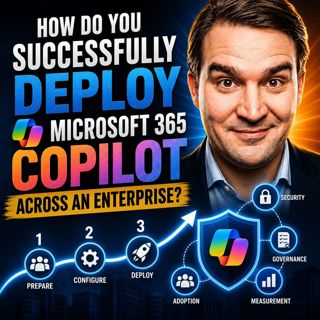
How Do You Successfully Deploy Microsoft 365 Copilot Across an Enterprise?

How Do You Successfully Deploy Microsoft 365 Copilot Across an Enterprise?

A successful Microsoft 365 Copilot deployment begins long before licenses are assigned. Organizations should first define measurable business outcomes, identify high-value use cases, and secure execut...

29 Juli 1h 32min

From Pilot to Production: Building Enterprise AI That Actually Delivers with Leon Gordon [MVP]

From Pilot to Production: Building Enterprise AI That Actually Delivers with Leon Gordon [MVP]

Leon Gordon explains why most enterprise AI initiatives never reach production and introduces the concept of the Pilot Tax—the hidden cost organizations pay when AI projects remain stuck in proof-of-c...

28 Juli 59min

Microsoft Purview is a Trap: The Hard Truth About Data Governance

Microsoft Purview is a Trap: The Hard Truth About Data Governance

Microsoft Purview is included with many Microsoft 365 subscriptions, making it incredibly easy to enable. That convenience is also its biggest danger. Because there is no procurement process or large ...

28 Juli 1h 1min

From Excel Expert to Microsoft MVP: Empowering Millions with Data, Dashboards & AI with Karen Abecia [Microsoft MVP]

From Excel Expert to Microsoft MVP: Empowering Millions with Data, Dashboards & AI with Karen Abecia [Microsoft MVP]

aren Abecia shares the remarkable journey that transformed a passion for Microsoft Excel into a global career as one of the world's best-known Excel educators. She explains how discovering creative sp...

27 Juli 59min

The Copilot Credit Trap- Why Your AI Economy is Already Broken

The Copilot Credit Trap- Why Your AI Economy is Already Broken

For decades, enterprise software followed a predictable financial model. Organizations purchased licenses, assigned them to users, and budgeted annual IT spending with confidence. AI changes that comp...

26 Juli 1h 12min
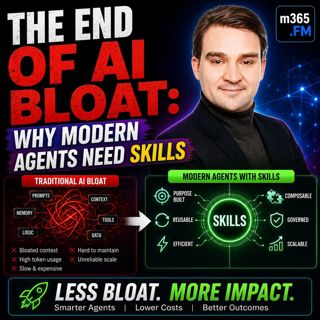
The End of AI Bloat: Why Modern Agents Need Skills

The End of AI Bloat: Why Modern Agents Need Skills

Many AI agents start out fast, responsive, and surprisingly intelligent. But after a few months of real-world use, something changes. Response times increase, costs rise, prompts become enormous, and ...

26 Juli 1h 13min

Populärt inom Politik & nyheter

svenska-fall
p3-krim
rss-krimstad
aftonbladet-krim
aftonbladet-daily
rss-sanning-konsekvens
flashback-forever
rss-krimreportrarna
tv4-nyheterna-story
motiv
mannen-utan-spar
rss-frandfors-horna
de-fyras-gang
rss-flodet
rss-aftonbladet-krim
spar
rss-vad-fan-hande
politiken
olyckan-inifran
krimmagasinet