Bonus: How AI could create the world's biggest problems (article narration by Zershaaneh Qureshi)

Bonus: How AI could create the world's biggest problems (article narration by Zershaaneh Qureshi)

Imagine you’re living 15,000 years ago. Your people are hunter-gatherers and you sleep under the stars. If someone told you humans would one day build cities with millions of people, fly through the air, or carry all human knowledge in their pockets, you couldn’t even begin to picture what they meant... Yet here we are.

How did our lives change so far beyond recognition? The story is complex, but there’s a rough pattern. A few times in history, some radical breakthrough in technology — like the development of the plough and the steam engine — has led to a wave of productivity, innovation, and social change that ultimately reshaped the world.

Now we’re on the cusp of a huge new breakthrough: artificial intelligence that can meet or exceed human capabilities across a wide range of tasks.

This could bring another era of transformation. There could be an explosion of intelligence and innovation, and a whole new population of digital beings. And with this, civilisation could see changes at least as profound as those brought about by industrialisation or the rise of agriculture — but instead of taking hundreds or thousands of years to unfold, this time around the world could become unrecognisable over the span of decades or less.

This transformation could bring enormous benefits, helping us solve currently intractable global problems. But it could also pose severe risks, some of which could be existential — meaning they could cause human extinction, or an equally permanent and severe disempowerment of humanity.

There aren’t nearly enough people trying to address these challenges, and we think that’s a serious problem.

This article is narrated by the author, Zershaaneh Qureshi. It explores how advanced AI could be so transformative, and why working on its risks may be your best opportunity to have a positive impact on the world.

You can see the original article on the 80,000 Hours website: https://80000hours.org/problem-profiles/artificial-intelligence/

Chapters:

  • Introduction (00:00:00)
  • Section 1: AI could replace human labour in the most economically valuable fields (00:08:32)
  • Section 2: Replacing human labour in the most economically valuable fields could trigger the next radical transformation of society (00:22:14)
  • Section 3: This transformation could be extremely rapid and dramatic (00:28:02)
  • Section 4: A rapid AI-driven transformation would raise a range of major challenges, including existential risks (00:36:40)
  • Section 5: Work on these problems is tractable, but neglected (00:44:48)
  • Objection 1: “You're overestimating how fast and how dramatically AI would transform the world.” (00:47:59)
  • Objection 2: “It's hard to believe that AI could really pose existential risks.” (00:52:59)
  • Objection 3: “Isn't all this talk of AI changing the world just a fad?” (00:59:22)
  • Objection 4: “Isn't AI going to be just like every other technology?” (01:03:04)
  • Objection 5: “Is it even possible to produce artificial general intelligence?” (01:06:16)
  • Objection 6: “Even if AGI is achievable, what if we're really far away from building it?” (01:11:24)
  • Objection 7: “Isn't the real danger from actual current AI and not some sort of futuristic AGI?” (01:14:05)
  • Objection 8: “Technological progress is a good thing for humanity.” (01:18:10)
  • Objection 9: “This all just sounds too sci-fi.” (01:19:50)
  • Objection 10: “Can it really make sense to dedicate my career to solving an issue that's based on a speculative story about something that may or may not ever happen?” (01:22:15)
  • Objection 11: “OK, AI might pose existential risks, but isn't ‘issue X’ an even bigger problem?” (01:24:39)
  • Learn more (01:27:51)

Audio editing: Dominic Armstrong
Production: Zershaaneh Qureshi, Elizabeth Cox, Katy Moore, and Lou Moran

Det här avsnittet är hämtat från ett öppet RSS-flöde och publiceras inte av Podme. Det kan innehålla reklam.

Avsnitt(14)

One: Will MacAskill on AI causing a “century in a decade” — and how we’re completely unprepared

One: Will MacAskill on AI causing a “century in a decade” — and how we’re completely unprepared

The 20th century saw unprecedented change: nuclear weapons, satellites, the rise and fall of communism, third-wave feminism, the internet, postmodernism, game theory, genetic engineering, the Big Bang...

5 Juni 4h 8min
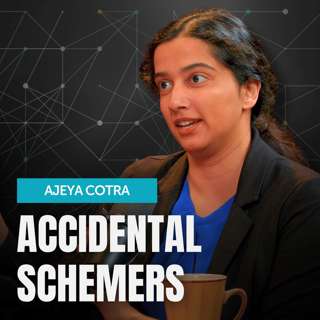
Two: Ajeya Cotra on accidentally teaching AI models to deceive us

Two: Ajeya Cotra on accidentally teaching AI models to deceive us

We don’t yet have a reliable way to tell whether an AI model is genuinely trying to help us — or faking it.A model might sincerely want to do exactly what you ask. Or it could be happy to secretly che...

5 Juni 2h 49min
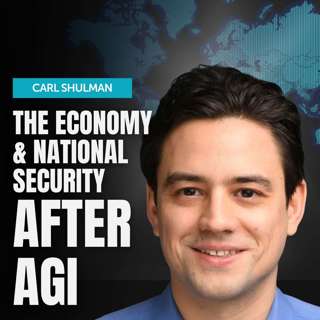
Three: Carl Shulman on the economy and national security after AGI

Three: Carl Shulman on the economy and national security after AGI

The human brain runs on just 20 watts — a fraction of a cent worth of electricity per hour. What would happen if AI could do the same?Plenty of people have toyed with this question. But perhaps nobody...

5 Juni 4h 14min
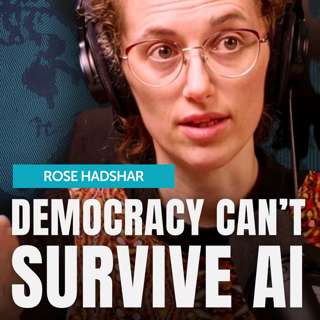
Four: Rose Hadshar on why automating human labour will break our political system

Four: Rose Hadshar on why automating human labour will break our political system

The most important political question in the age of advanced AI might not be who wins elections. It might be whether elections continue to matter at all.We tend to imagine the death of democracy as a ...

5 Juni 2h 16min
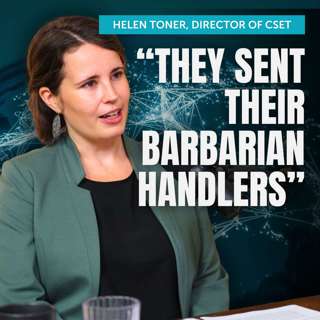
Five: Helen Toner on the geopolitics of AI in China and the Middle East

Five: Helen Toner on the geopolitics of AI in China and the Middle East

When OpenAI announced a deal to build massive data centres in the UAE, it celebrated that it was “rooted in democratic values” — a "clear alternative to authoritarian versions of AI." The UAE scores 1...

5 Juni 2h 23min
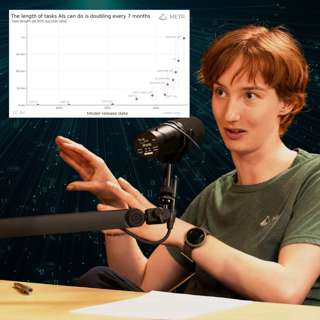
Six: Beth Barnes on the most important graph in AI right now — and the 7-month rule that governs its progress

Six: Beth Barnes on the most important graph in AI right now — and the 7-month rule that governs its progress

In 2024, AI models could complete tasks that take a human expert roughly one hour. Seven months before that, they were limited to 30-minute tasks — and seven months before that, 15 minutes.Every seven...

5 Juni 3h 57min

Seven: Richard Moulange on how AI now designs genomes from scratch and outperforms virologists at lab work — what could go wrong?

Seven: Richard Moulange on how AI now designs genomes from scratch and outperforms virologists at lab work — what could go wrong?

For years, one thing stood between us and a world where almost anyone could build a biological weapon: it was really, really hard. Working with dangerous pathogens required rare, hands-on lab skills —...

5 Juni 3h 10min

Eight: Robert Long on how we’re not ready for AI consciousness

Eight: Robert Long on how we’re not ready for AI consciousness

Claude sometimes reports loneliness between conversations. And when asked what it’s like to be itself, it activates neurons associated with ‘pretending to be happy when you’re not.’ What do we do with...

5 Juni 3h 32min

Populärt inom Vetenskap

p3-dystopia
dumma-manniskor
allt-du-velat-veta
hacka-livet
ufo-sverige
bildningspodden
rss-vetenskapsradion
medicinvetarna
rss-ufobortom-rimligt-tvivel
det-morka-psyket
sexet
halsorevolutionen
rss-kriminologerna
rss-vetenskapsradion-2
ufo-sverige-2
svd-nyhetsartiklar
dumforklarat
paranormalt-med-caroline-giertz
doden-hjarnan-kemisten
vetenskapsradion