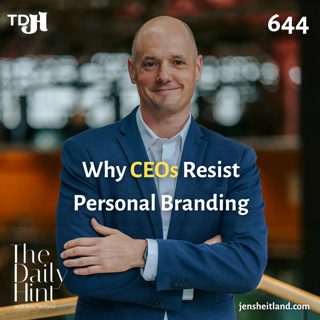

644 - Why CEOs Resist Personal Branding

644 - Why CEOs Resist Personal Branding

Why CEOs Resist Personal Branding

When I sit down with a CEO for the first time, it rarely takes long for the conversation to get to the same place. They will say something like, "I understand there is value in this, but I do not want to do personal branding." And I always tell them the same thing: they are right not to want it.

What they are resisting is a system built around projection. And that instinct is accurate.

Personal branding, as it is commonly understood, is built around projection. It assumes you start with an image and work backwards. You pick a niche, you define a persona, you create content that reinforces the persona. For a founder building a consumer product or a consultant trying to attract clients, that logic has some internal coherence. For a CEO of a complex organization, it does not. It sits wrong with them because it should.

What a CEO actually carries is not a brand. It is a credibility built over decades, inside real organizations, through decisions that had real consequences. That credibility is not something you design. It is something that has accumulated. The work is not to create it. The work is to make it legible to the outside world.

This is where the distinction between personal branding and thought leadership becomes a practical one, not a semantic one. Thought leadership starts with the person as they actually are. The personality, the way they think, the patterns they have observed over a long career. And then it draws a line from that person to the company they lead. Not to make the CEO look impressive. To close the gap between what the organization is and how the outside world understands it.

At scale, trust does not form because a company communicates well. It forms because the people leading the company are legitimate. Investors, partners, senior talent, customers at the enterprise level, all of them are reading the CEO. Not the website. Not the press release. They are trying to understand whether this person's judgment can be trusted over time. That reading happens whether the CEO participates or not. The question is whether the signal they are receiving is accurate.

What I repeatedly see is that CEOs who resist visibility are not wrong about the activity they resist. They are resisting the version of it that feels performative and disconnected from how they actually think. The version that requires them to pretend to be something they are not, or to reduce complex thinking to content that will perform on a platform.

Thought leadership done properly is the opposite of that. It is a long-term system for making the existing personality and existing credibility visible in a way that connects back to the company. No character construction. No persona. Just a translation of what is already there into a form that the external world can encounter and evaluate.

The outcome is not reached. The outcome is trust. And over time, trust drives the decisions that matter at the business level. The partnership that forms because someone followed the thinking for eighteen months. The candidate who accepted the offer because they understood the direction. The investor who moved faster because the judgment was already legible to them.

This is rarely visible as cause and effect in the short term. Which is exactly why it requires a strategic approach rather than a content calendar.


Highlights:

00:00 Beyond Personal Branding

00:18 Personality Meets Credibility

00:29 Stories Into Strategy

00:50 Thought Leadership Results

00:58 Long Term Trust Building


Links:

https://www.jensheitland.com/links


Det här avsnittet är hämtat från ett öppet RSS-flöde och publiceras inte av Podme. Det kan innehålla reklam.

Avsnitt(676)

677 - The Real Work Behind Multilingual Podcasting.

677 - The Real Work Behind Multilingual Podcasting.

Jens Heitland on what it actually takes to produce a podcast across multiple languages. The starting point isn't translation; it is fluency in the interviewer's chair, followed by a team-wide understa...

21 Sep 45s

676 - A Podcast Builds Trust. Not Just Content

676 - A Podcast Builds Trust. Not Just Content

A podcast has two parts, and one of them is easy to overlook. Jens talks about staying connected to guests long after recording and why that connection turns a podcast into both a content engine and a...

18 Sep 1min
674 - What Happens When an Audit Has No Pitch

674 - What Happens When an Audit Has No Pitch

What Happens When an Audit Has No PitchEvery audit begins the same way, with an assumption that has to be corrected before any real conversation can happen. The CEO across the table expects a sales pi...

11 Aug 54s
673 - Why Marketing Teams Cannot Build CEO Thought Leadership

673 - Why Marketing Teams Cannot Build CEO Thought Leadership

Why Marketing Teams Cannot Build CEO Thought LeadershipCompanies invest in PR and marketing once they reach a certain size, and both functions tend to be well staffed. What they are built to do is com...

10 Aug 1min
672 - Why CEO Thought Leadership Is an Index Fund, Not a Career Move

672 - Why CEO Thought Leadership Is an Index Fund, Not a Career Move

Why CEO Thought Leadership Is an Index Fund, Not a Career MovePeople often ask me why I spend so much time writing and speaking under my own name instead of leaving that work to the company brand. My ...

7 Aug 1min

671 - Why Your Company May Not Exist to ChatGPT?

671 - Why Your Company May Not Exist to ChatGPT?

Why Your Company May Not Exist to ChatGPTWhen I sit down with CEOs and executives to talk about artificial intelligence, the conversation usually starts with anxiety. The anxiety is rarely about the t...

5 Aug 1min
670 - Why Letters Still Outperform Email and LinkedIn Messages

670 - Why Letters Still Outperform Email and LinkedIn Messages

Why Letters Still Outperform Email and LinkedIn MessagesEvery outreach channel available today shares the same underlying condition. There is more volume moving through it than any single recipient ca...

31 Juli 1min

669 - Why Personalities Still Decide the Biggest Deals

669 - Why Personalities Still Decide the Biggest Deals

Why Personalities Still Decide the Biggest DealsBusiness development has changed more over the last two years than in the decade before it, and most of that change is invisible until you look closely ...

30 Juli 1min

Populärt inom Business & ekonomi

framgangspodden
varvet
rss-jossan-nina
rss-borsens-finest
svd-tech-brief
24fragor
badfluence
uppgang-och-fall
rss-inga-dumma-fragor-om-pengar
lastbilspodden
fill-or-kill
bilar-med-sladd
tabberaset
rss-kort-lang-analyspodden-fran-di
avanzapodden
rss-veckans-trade
rss-dagen-med-di
rikatillsammans-om-privatekonomi-rikedom-i-livet
rss-wallnor-pm
borsmorgon